
Blog
Arani Silk Sarees: Tamil Nadu’s Distinctive Silk Weaving and Traditional Designs

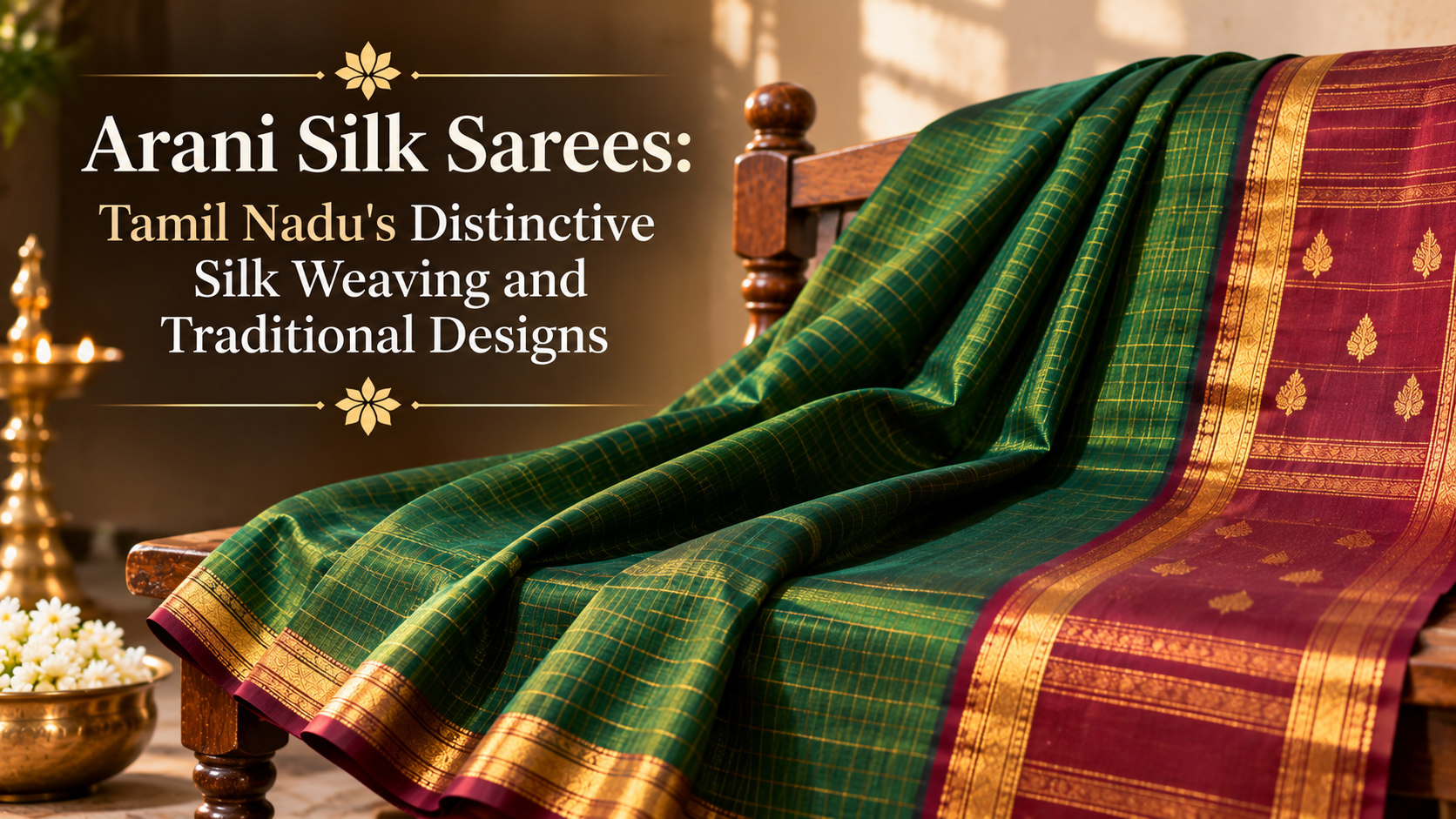
Ask people to name a Tamil Nadu silk saree and most will say Kanjivaram. Fewer know that a second weaving town, about a hundred and thirty kilometres from Chennai, has been turning out silk sarees of its own for generations. That town is Arani, also spelled Arni, and the Arani silk saree has a quieter, lighter character than its famous neighbour.
This guide explains where Arani silk weaving comes from, how its weaving community works, how the sarees are made, and what their borders, pallus and motifs usually look like. It also compares Arani silk with Kanjivaram and Dharmavaram silk and offers practical advice on choosing one. Sources disagree on some details, and the article says so where they do. It does not claim that every Arani saree is the same, and it makes no promises about silk purity or zari quality that a photograph cannot support.
Where Arani silk comes from
Arani is a town in Tiruvannamalai district in northern Tamil Nadu, roughly 130 to 145 kilometres from Chennai depending on the source and the route. Accounts of the name differ in detail, but a common explanation is that it means a place surrounded by forest. The town is also known for rice milling, and published descriptions of the district mention rice and silk weaving as its two major trades.
Arani silk sarees carry a Geographical Indication tag under the name Arani Silk, registered in 2008. A GI tag links a product name to a place and a body of tradition. It tells you that the name refers to sarees associated with Arani, but it does not by itself tell you how a particular saree was woven or what fibre it contains, so you still need to ask a seller for those details.
History and development of Arani silk weaving
Published accounts place the beginning of silk weaving in Arani in the Vijayanagara period, with the trade growing under the local jagir rulers and again in the British era. Some accounts also mention inscriptions in nearby villages that refer to handloom weaving. Several details in these popular accounts, such as the name of the first weaving unit and the number of active weavers, circulate without strong sourcing, so this article does not repeat them as fact.
What sources do agree on is the outcome. Arani grew into one of the best known silk saree centres in Tamil Nadu after Kanchipuram, and silk weaving became a major source of income in the town and the district. Over time the cluster added jacquard and dobby mechanisms, and some production moved from hand operated looms toward mechanised methods. One district description notes that handlooms are still often used while some producers have turned to power looms, which is a useful reminder that the name Arani describes a place and a tradition, not a single method of production.
The weaving community
Arani silk weaving is a community enterprise more than a single workshop craft. Published descriptions say that men and women both take part, and that the skill passes from one generation to the next through watching and practice, with little formal teaching. The same descriptions note that low wages have pushed some traditional weavers out of the trade, which is worth remembering when you think about what goes into a handwoven piece.
The trade is typically organised around master weavers. One account explains that master weavers buy prepared yarn from merchants and distribute it to weavers, who then work it into cloth. Some accounts also trace the weaving families to communities that migrated south during the Vijayanagara period, though the details vary by source. As a reader, the practical point is simple: behind each saree there is usually a chain of people, from dyers and yarn preparers to weavers and traders, and the price you pay reflects that chain.
How an Arani silk saree is made
The stages below summarise published descriptions of Arani weaving. Workshops differ, so treat this as a general outline and not a fixed recipe.
Yarn preparation and dyeing
The saree begins with silk yarn, and sources describe the use of mulberry silk in both warp and weft for the traditional dobby variety. The yarn is dyed before weaving, and Arani handlooms are often described as known for colours that hold. One account links this to the dye mix, but exact dye chemistry differs between workshops and is not something a buyer can verify by eye.
Preparing the weft and the warp
For the weft, yarn is wound on a charkha to produce thread that will be carried across the loom. For the warp, a long length of yarn is loaded on the loom, and that length is known in the local trade as a pavvu. One published account says that a weaver can produce four sarees from one pavvu and that completing one pavvu takes about a week. These are descriptive figures from a single source, so use them as a rough guide, not a rule.
Weaving
Arani sarees are woven in several loom set ups. A government backed handloom description says they are woven on throw shuttle pit looms and frame looms fitted with a dobby or a jacquard attachment. A craft documentation source says frame looms are most commonly used, with designs punched into cards and loaded into a jacquard that lifts threads according to the pattern. Dobby mechanisms produce small repeating geometric patterns, while jacquard allows more elaborate designs.
The same craft source reports a count of 2400 for the saree, a measure of thread density that contributes to strength. Count varies from one saree to another, so do not treat it as a guarantee about any specific piece.
Border construction and finishing
Border handling differs by account. One retail article says Arani sarees use the korvai technique, in which body and border are woven separately and joined at the loom. Another description from a handloom promotion source says traditional Arani sarees have a small zari border and no solid contrast border of the Kanjivaram kind. Both can be true, because Arani weavers produce a range of designs, and the safest reading is that border style varies. Finishing steps such as trimming, checking and folding follow weaving, but the sources I reviewed describe the weaving stages in far more detail than the final finishing, so this article does not describe finishing in detail.
Fabric texture and silk characteristics
Arani silk sarees are commonly described as lighter than Kanjivaram and heavier than Banarasi, with a soft hand and a smooth fall. A craft documentation source calls Arani handlooms soft, durable and comfortable in all climates, though comfort in practice depends on the weave, the amount of zari and the weather on the day.
Weight in particular is a matter of degree. A dobby saree with a thin border will feel quite different from a heavily patterned jacquard piece, and both can carry the Arani name. If weight matters to you, ask for the weight in grams or handle the saree before you buy.
For readers still working out how silk differs from cotton in everyday comfort, our comparison of cotton vs silk sarees covers heat, drape and care in plain terms.
Borders and pallu designs
The Arani silk border is one of the main ways people recognise the saree, though what you will see varies. Descriptions of the traditional style mention a thin, single sided zari border, and a body in a single colour with simple designs. Handloom promotion material describes the pallu as relatively simple, without the extra warp threads that give heavier silks their dense pallus.
Many modern Arani sarees go beyond this. You will find broader zari borders, contrast borders and richer pallus, especially on jacquard pieces made for weddings. So while the quiet, light look is a good picture of the tradition, treat it as a tendency, not a rule.
One feature that several sources mention is the reversible design, in which a saree can show a different body and pallu on each side, so it can be worn as two different looks. This is described as a speciality, but not every saree has it, so ask if it matters to you.
Motifs, colours and design arrangements
Arani silk is best known for simple, geometric designs. A retail source highlights check patterns, called kottadi in Tamil, as a signature of the weave, and dobby weaving suits small repeating motifs such as dots, stripes and checks. Jacquard weaving can add more detailed motifs, such as florals, creepers and temple inspired elements, while keeping the overall effect restrained.
Colour combinations range from deep jewel tones to softer shades. Traditional sarees are described as single coloured, while newer pieces use contrasts, double tones and checks in two or three colours. Common arrangements include a plain or checked body with a narrow zari border, a body with small scattered buttas, or a richer body with a more elaborate border and pallu. Because designs follow the loom set up and the weaver’s choices, no two collections are identical.
Zari and what to ask about it
Some accounts say the Arani cluster is known for using silver zari, but zari composition varies from one saree to another. Real zari, imitation zari and metallic yarn differ in material, feel and price, and you cannot tell them apart from a photograph. If zari quality matters to you, ask the seller what the zari is made of, whether it is tested and whether any certificate or label comes with the saree.
Arani silk sarees for weddings, festivals and formal wear
Arani silk sarees suit a range of occasions. Their lighter weight and understated finish make them a popular choice for pujas, festival days, family functions and formal events, and for wedding guests who want silk without the weight of a heavily brocaded saree. Richer jacquard pieces with broader borders and elaborate pallus can also be chosen for wedding ceremonies, including by brides who prefer a lighter silk.
Think about the venue, the weather and how long you will wear the saree. A lighter silk can be more comfortable for a long daytime event, while a heavy saree may suit a short evening ceremony better. If you are choosing for several occasions at once, our complete guide to buying sarees for women helps you match fabric, weight and budget to each one.
Arani vs Kanjivaram vs Dharmavaram silk
All three are silk traditions with zari, but they come from different places and are commonly associated with different looks. The table sums up general tendencies, and individual sarees vary widely.
| Feature | Arani silk | Kanjivaram silk | Dharmavaram silk |
| Place of origin | Arani, Tiruvannamalai district, Tamil Nadu | Kanchipuram, Tamil Nadu | Dharmavaram, Sri Sathya Sai district, Andhra Pradesh |
| Typical impression | Lighter, restrained, often simple body with a slim zari border | Heavy silk with strongly contrasting borders and rich pallu | Contrasting borders, often a double shaded body, broad zari pallu |
| Common design vocabulary | Checks, small geometric motifs, narrow borders, simple pallus | Temple borders, checks, florals and other traditional motifs | Temple inspired motifs such as elephants, peacocks and lotuses |
| Weight and feel | Often described as lighter than Kanjivaram, heavier than Banarasi | Often described as heavier and more structured | Structured silk, often substantial |
| Looms and technique | Dobby and jacquard on pit and frame looms, with some mechanised production | Interlocked border technique commonly associated with the weave | Registered product described as woven on pit looms, with some jacquard or dobby use |
| Typical use | Pujas, festivals, formal wear, lighter wedding wear | Weddings and major celebrations | Weddings and festive functions |
| GI status | Registered as Arani Silk | Registered under its own name | Registered as Dharmavaram handloom pattu sarees and paavadas |
Some points to keep in mind when reading the table. Arani and Kanjivaram both come from Tamil Nadu, but they are different centres, and Arani’s usual lighter weight and slimmer borders are what many writers use to tell them apart. Similar vocabulary such as zari, checks and temple inspired motifs appears across all three, so do not identify a saree from one feature. Imitations exist in every category, and a regional name on a listing is not a guarantee of origin.
How to choose an Arani silk saree
A few simple checks make choosing easier.
Decide the occasion first, then the weight. If you want a saree for repeated wear, a lighter dobby piece may serve you better than a heavily patterned one.
Next, look at the cloth. The body should look even, the border should sit cleanly, the colour should be consistent and any zari should look secure and unbroken. Look at the saree in natural light where you can, because shop lighting can change colours.
Then ask direct questions. Is the saree pure silk or a blend? Is it handloom, power loom or a mix? Is the zari real or imitation? Does it carry a Silk Mark label? You cannot judge any of these from a picture, and a clear answer is a good sign about the seller.
If you are weighing a lighter blend against pure silk, our cotton silk saree guide explains how blended sarees differ and what to look for on the label.
When you are buying remotely, our online saree shopping guide shows how to read descriptions, check photographs and review seller details before you pay.
Caring for an Arani silk saree
Follow the care label first. For silk with zari, dry cleaning is often the safest choice. Store the saree folded in soft cotton or muslin cloth, keep it dry, and refold it along different lines now and then to stop permanent creases. Keep perfume and hair products away from the fabric and the zari.
Frequently asked questions
What is an Arani silk saree?
An Arani silk saree is a silk saree woven in or around Arani, a town in Tiruvannamalai district of Tamil Nadu. It is known for a comparatively light weight, simple designs and a restrained look.
Is Arani silk the same as Kanjivaram silk?
No. Both are Tamil Nadu silks, but they come from different towns and are commonly associated with different looks. Arani is generally described as lighter, while Kanjivaram is generally described as heavier with more strongly contrasted borders.
What is an Arani pattu saree?
Pattu is the Tamil word for silk, so an Arani pattu saree is an Arani silk saree. The terms are used interchangeably.
Are Arani silk sarees handwoven?
Some are woven on handlooms, and others on power looms or mechanised set ups. The name Arani describes the place and tradition, not a single method, so ask the seller how a specific saree was made.
Are all Arani silk sarees pure silk?
No guarantee can be given from the name alone. Many are woven from mulberry silk, but blends and imitations exist. Ask for fibre details and check labels such as the Silk Mark.
Is an Arani silk saree good for weddings?
It can be, especially for guests and for brides who prefer a lighter silk. Richer jacquard pieces with broader borders and elaborate pallus suit ceremonies, while simpler dobby sarees suit pujas and daytime functions.
How can I recognise an Arani silk border?
Traditional descriptions mention a slim zari border and a simple body, but many modern sarees have broader or contrast borders. Do not rely on the border alone, and ask about origin and weaving details.
How should I care for an Arani silk saree?
Follow the care label, prefer dry cleaning for heavy zari, store the saree in soft cloth in a dry place, and refold it periodically.
Conclusion
The Arani silk saree is a good example of how much variety Tamil Nadu silk holds. It sits between the weight of Kanjivaram and the lightness of many festive silks, with a design language of checks, small motifs and slim borders that many wearers find easy to live with. Its name points to a place and a weaving community, and its details change from one weaver and one saree to the next.
When you shop, ask about fibre, loom, zari and weight, look closely at the weave, and choose for the occasion you have in mind. A saree chosen that way is more likely to stay a favourite for years.
