
Blog
Venkatagiri Sarees: Andhra Pradesh’s Fine Handloom Weaving and Zari Borders

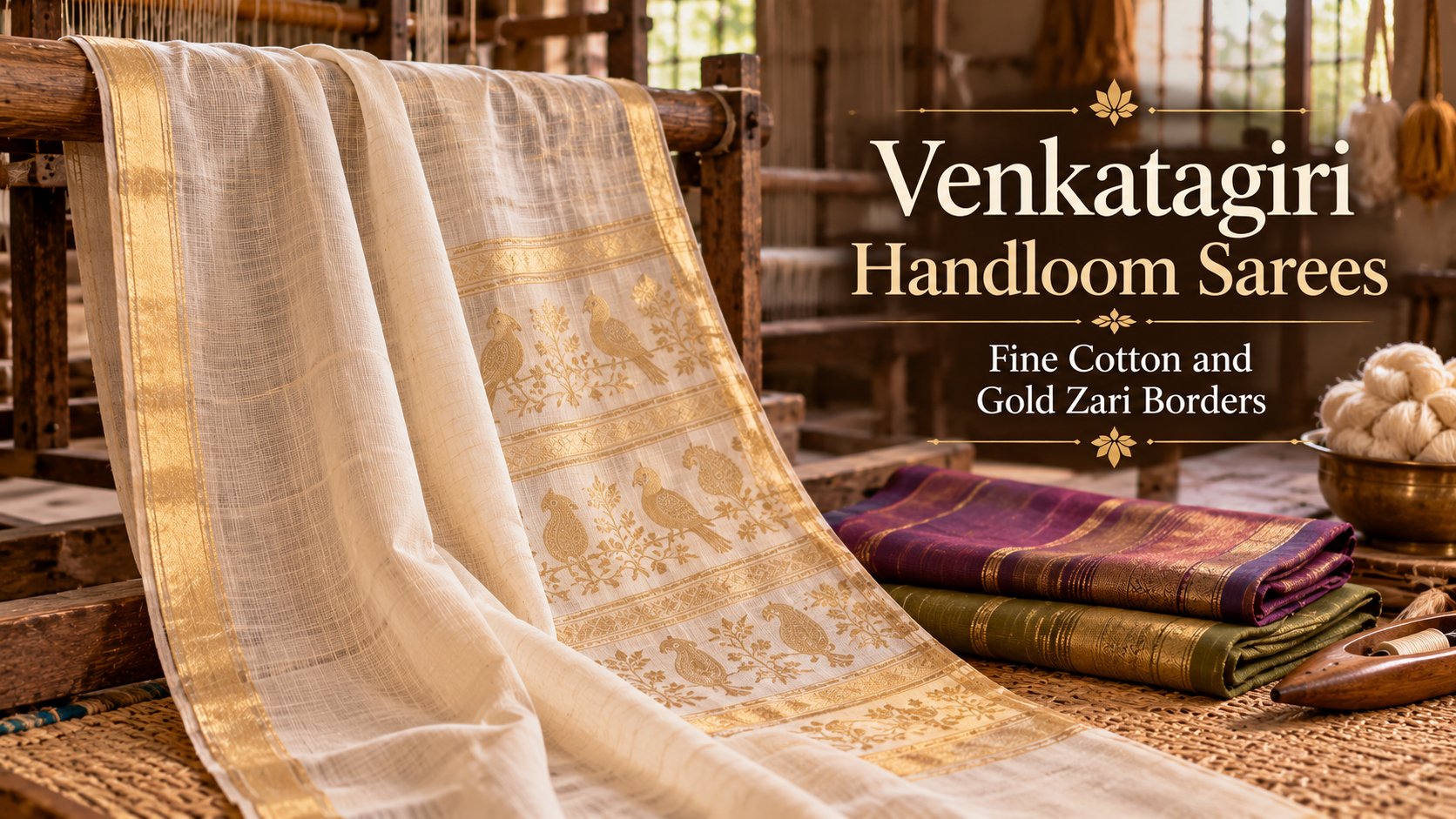
Hold a Venkatagiri saree up to the light and the first thing you notice is how little cloth seems to be there. The cotton is sheer and crisp, the body is often plain, and a narrow band of gold zari runs along each edge. The weight sits in the pallu, where a few well spaced motifs repeat between gold stripes. It is a quiet saree that gets its effect from fineness and restraint.
The Venkatagiri saree is one of Andhra Pradesh’s best known handloom traditions, and it is also one of the most misdescribed. Online listings call it everything from “Jamdani silk” to “royal pattu” without saying what is actually on the loom. This guide sets out what government handloom resources, the Geographical Indications registry and craft documentation say about the weave: where it comes from, how the fabric is built, what the zari borders and motifs look like, how cotton and silk versions differ, how the Jamdani connection should be understood, and how traditional handloom pieces differ from today’s adaptations. For the wider context of sarees and purchase experience, see our Guide to Buying Sarees for Women.
Where Venkatagiri weaving comes from
Venkatagiri is a small town in the Tirupati district of Andhra Pradesh. Older sources place it in Nellore district, which it belonged to before the district boundaries were redrawn, and the Ministry of Textiles handloom profile describes it as about 60 km from Nellore. The town is also reported to have been called Kalimili before it took its present name.
The weaving tradition is tied to the Velugoti rulers of Venkatagiri. The district profile prepared for Tirupati’s One District One Product programme says weaving here began over 300 years ago under Velugoti patronage. It describes a group of about 40 weavers supported to make soft cotton dhotis and turbans, with fine embroidery, for the royal family. Over time the weavers moved into sarees, woven for queens, royal women and zamindari households. The same profile says the former kingdoms of Bobbili and Pithapuram also encouraged the craft. Popular accounts date the saree to the early 1700s. That date is repeated widely but is a traditional estimate, so treat it as approximate.
Weaving here has long been a community craft. The district profile names the Padmashali and Devanga communities as the traditional weavers, and adds that people from other communities now weave as well. It records about 3,064 households engaged in weaving on around 2,500 looms in and around Venkatagiri town, in neighbourhoods and nearby villages. Whole families take part, with different members handling yarn preparation, loom setting and weaving.
The Geographical Indication
“Venkatagiri Sarees” is a registered Geographical Indication. The GI registry entry lists the application as number 189, filed on 13 November 2009, with the Venkatagiri Handloom Sarees Apex Society as applicant. The certificate of registration is dated 11 May 2011, and the registration is recorded as valid until 12 November 2029. The Ministry of Textiles lists it among registered handloom GIs.
You will sometimes see “GI registered in 1999”. That figure is the year of the Geographical Indications of Goods (Registration and Protection) Act, not the year of the saree’s registration. Some press reports also give 2009, which is the year of filing. The registry dates above are the authoritative ones.
A GI protects the name and the place of origin. It has not stopped imitation, and a 2015 report in The Hans India noted that power looms elsewhere in South India were copying Venkatagiri designs without much action against it. The tag is a useful starting point for a buyer, though it does not replace asking how a particular piece was made.
The fine fabric: how a Venkatagiri saree is built
Venkatagiri weaving is known for fineness. Ministry of Textiles documentation describes the saree as woven on a traditional fly shuttle pit loom, using shuttles that are longer than usual. In the pit loom the weaver sits with legs lowered into a pit that holds the pedals, which keeps the loom low and stable.
Yarn count and weave structure
The classic saree is a fine cotton. Handloom documentation says the older sarees used a very fine 120s cotton in both warp and weft, and that today’s cotton sarees are generally woven in 100s count in both directions. Equal counts in warp and weft matter here, because the weave uses an equal number of warp ends and weft picks in the ground. A craft documentation source describes the closed shed method used on the pit loom, which gives an even, soft and durable cloth, and notes that careful sizing of the yarns is a particular strength of the cluster.
The district profile gives typical dimensions of about 5.2 metres in length and 1.17 metres in width for a standard cotton saree, with a silk saree slightly wider. These are typical figures, and individual orders vary.
Colour
Older Venkatagiri sarees were woven white or unbleached. Handloom documentation notes that pastel colours and new designs were later added to suit the market. The district profile adds that the cluster dyes with vat and naphthol dyes, producing saturated colours such as purple, orange, olive green, bright green and bright red, and credits the region’s soft water for dyes that hold in washing. That is a claim from the profile and not an independently tested one, but it fits the cluster’s reputation for bold yarn dyed colour.
Zari borders: the signature of the weave
The border is where a Venkatagiri saree is easiest to identify. Traditional borders are narrow, usually one to two inches wide, and woven in gold zari with cotton. Handloom documentation calls the classic border a kaddi anchu, a plain zari stripe, and the district profile notes that the border is plain gold, with no elaborate extra warp design. It also records a decorative detail called patti, dotted lines woven alongside the gold bands.
Zari is a metallic thread used for decoration. The district profile says pure zari is sourced from Kanchipuram and imitation zari mostly from Surat, with the choice depending on the order and price. Gold and silver zari are both documented, and local listings describe silver zari Venkatagiri sarees as a separate offering. The type of zari is the biggest single factor in the cost of a saree, so it is worth asking about before buying.
Today the cluster also weaves coloured borders, with or without gold. That is a contemporary development and does not replace the classic gold stripe.
Motifs and patterns
Traditional Venkatagiri design is sparing. The body of the saree is plain or carries occasional small buttas, and the pallu is where the decoration gathers. Documented motifs include dots, coins, leaves, mangoes, lotuses, peacocks, parrots, swans and simple geometric patterns. They repeat across the pallu between bands of gold, and they are woven in zari or in coloured cotton thread.
Commercial names describe some of the common types:
- Venkatagiri 100, the fine 100s cotton saree, considered the lightest and the most popular
- Venkatagiri putta, carrying small repeated motifs
- Venkatagiri silk and Venkatagiri pattu, the silk versions
These names are used by weavers and retailers and are not a formal classification, so the details differ between sellers.
Cotton, silk and other fabric variations
The cluster weaves more than cotton, and the documentation is consistent on the main options.
Venkatagiri cotton saree
This is the original form. It is woven in 100s to 120s cotton with zari borders and a zari pallu. It is light, breathable and suited to warm weather, and it is the version most closely tied to the old court tradition.
Venkatagiri silk saree
The district profile says Venkatagiri sarees are made of cotton, a silk and cotton mix, and pure silk. Its product specification for a silk saree gives a warp and weft of 20 to 22 denier silk. The profile also explains why silk became common. Power looms and falling demand for cotton pushed weavers toward silk, and some began weaving in Kanchipuram, Banarasi and Paithani styles to follow the market, at the cost of the cluster’s own design language. A Venkatagiri silk saree is therefore a legitimate product of the town, but it is a later development than the cotton saree.
Cotton silk and silk blends
The profile lists cotton with silk as a documented combination and notes that pure or art silk yarn is chosen depending on the price. Cotton and silk yarn come from sources such as Coimbatore and the National Handloom Development Corporation. A listing that says only “silk” without saying whether it is pure silk, art silk or a blend leaves out information a buyer needs.
I found no documented fibre in the government sources beyond cotton, silk, silk blends and zari. Claims about other fibres should be treated cautiously unless the seller can show them.
Jamdani designs: what is supported and what is debated
Jamdani is an extra weft technique in which each motif is woven into the cloth on the loom by adding supplementary weft threads, so the pattern is part of the fabric and not embroidered afterwards. The technique is most associated with Bengal and Bangladesh, and in Andhra Pradesh with Uppada. Our guide to Uppada Jamdani sarees and how their motifs are woven into fine silk explains the method in detail.
For Venkatagiri, the evidence is mixed, and it helps to separate three claims.
First, extra weft motifs are well documented in current Venkatagiri sarees. The Ministry of Textiles describes zari used in extra weft for ornamentation, with a jacquard used to lift the threads for the designs. The district profile describes large Jamdani style motifs of parrots, swans, peacocks, mangoes and leaves as the distinctive feature and says the technique has been followed by about 14 generations.
Second, other accounts describe extra weft in the body and pallu as a relatively recent development. Craft documentation says Venkatagiri weavers introduced weft patterning in the body and end pieces to compete with Uppada, and some descriptions refer to Jamdani technique arriving from Bangladesh. These accounts are less formal than the government documents, and they do not agree with the “14 generations” statement.
Third, the method differs from Uppada’s. The Uppada Jamdani GI documentation says the designs there are woven purely by hand with no dobby or jacquard. Venkatagiri’s documented process uses a jacquard with punch cards for the extra weft. That is a practical difference in how the motifs are produced.
The safest description, and the one used in this article, is “Jamdani style” or “Jamdani inspired” weaving. The extra weft technique is documented in Venkatagiri, but how long it has been central to the saree is disputed, and it is not identical to Uppada’s hand-woven method. Treat “Venkatagiri Jamdani” as a description of a technique and not as a separate, protected saree type.
The weaving process
The district profile sets out the production sequence, and it matches the stages in our general explainer on the saree making process. In Venkatagiri the steps run as follows:
- Preparation. Yarn arrives as hanks. It is washed and desized, which removes starch so the yarn takes dye evenly and feels softer.
- Dyeing. Cotton is dyed with vat or naphthol dyes. Silk and zari are bought in colour or dyed to order.
- Winding. A charkha winds yarn onto bobbins and pirns for the warp and the weft.
- Warping. The warp yarns are untangled and laid out evenly on a wheel warping frame, then loaded onto beams.
- Sizing. The warp is stiffened with rice or pulse starch so it does not break under the loom’s tension.
- Drawing in. The warp is passed through the heddles and the reed, which fixes the pattern of interlacement.
- Weaving. The weaver sets the warp beam on the pit loom, throws the shuttle and treadles the shed. For extra weft designs, jacquard punch cards lift the chosen threads, and the zari weft is inserted by hand to form each motif.
- Finishing. The cloth is cut from the loom and checked.
Time depends heavily on the design. The district profile gives a few days for a typical saree, while a heavily patterned piece, with many motifs in zari, naturally takes much longer. The profile itself describes extra weft work as slow and demanding.
Traditional handloom vs contemporary adaptations
The Venkatagiri saree has been through a hard period, and the sarees sold under its name today are not all the same product.
Traditional handloom pieces are woven on pit looms by weavers in the cluster, in fine cotton or in silk, with a plain gold zari border and a sparing pallu. The weaving, sizing and dyeing follow the stages above.
Power loom copies reproduce the look at lower cost. The Hans India report mentioned earlier recorded this problem after the GI was granted. A copy may match the colours and border but not the fineness of the count or the construction.
Style borrowing is a quieter change. The district profile says weavers wove Kanchipuram, Banarasi and Paithani designs to meet demand, which dilutes the cluster’s own look.
Revival and design work is the other direction. The Antaran programme of the Tata Trusts has worked with the Venkatagiri cluster on design education and links to buyers, according to the district profile. It names weaver Patnam Subramanyam, who revived finer 100s count yardage, wove 120s and 140s counts, brought back older buttas and experimented with natural dyes. These are reported achievements from the programme’s own description, and they show the craft being renewed with documented care.
How to evaluate a Venkatagiri saree
There is no single test for authenticity, but several questions help:
- Is it described as handloom, and by whom? Look for the Handloom Mark and ask for the weaver or society.
- Does the listing state the fibre in each part, such as cotton body, silk, or blend?
- Does it say which zari is used?
- Does the border look like the classic narrow gold stripe, or is it a different style sold under the same name?
- Does it carry a Silk Mark if sold as silk?
A missing label does not prove a piece is imitation, since many small weavers sell without labels, but it is a reason to ask.
Comparison with other Andhra Pradesh and Telugu region weaves
| Weaving tradition | Region | Main fibre | Border and pattern | Technique notes |
| Venkatagiri | Venkatagiri, Tirupati district, Andhra Pradesh | Fine cotton, with silk and cotton silk versions | Narrow plain gold zari border, extra weft motifs on the pallu | Pit loom, jacquard for extra weft, GI registered 2011 |
| Uppada Jamdani | Uppada, Kothapalli mandal, East Godavari | Silk, with cotton silk versions | Jamdani motifs across body and pallu | GI documentation describes hand woven motifs without dobby or jacquard |
| Mangalagiri | Mangalagiri, Guntur district | Cotton, with silk cotton versions | Nizam border with zari, plain body | Weaving is usually sparse in the body, with focus on the border |
| Dharmavaram | Dharmavaram, Anantapur district | Silk | Broad borders and gold brocade pallus | Heavy bridal and festive silk |
| Gadwal (Telangana) | Gadwal, Jogulamba Gadwal district | Cotton body with silk border and pallu, also pure silk | Contrast silk border with zari | Border and body joined on the loom by interlocked weft |
The table draws on GI and Ministry of Textiles documentation. Our guide to Gadwal sarees and their cotton bodies with silk borders covers the Telangana weave that sits closest to these Andhra traditions. Contemporary pieces in every tradition vary, so the table describes traditional features only.
Frequently asked questions
What is a Venkatagiri saree?
A Venkatagiri saree is a handloom saree woven in and around Venkatagiri town in Andhra Pradesh. It is known for fine cotton cloth, narrow gold zari borders and zari motifs on the pallu, and silk versions are also woven.
Is the Venkatagiri saree GI registered?
Yes. The GI registry lists “Venkatagiri Sarees” with a certificate dated 11 May 2011, held by the Venkatagiri Handloom Sarees Apex Society. The registration is recorded as valid until 12 November 2029.
Is a Venkatagiri saree cotton or silk?
Both. The classic saree is fine cotton with zari. The district profile also documents pure silk and cotton silk versions, and silk became more common as weavers responded to market demand.
Is Venkatagiri a Jamdani saree?
Venkatagiri sarees use an extra weft technique that the district profile calls Jamdani. How long it has been central to the saree is debated, and it differs from Uppada’s hand woven method because Venkatagiri uses a jacquard. “Jamdani style” is the more careful description.
What are the traditional motifs?
Documented motifs include dots, coins, leaves, mangoes, lotuses, peacocks, parrots, swans and simple geometric shapes, repeated in the pallu between gold bands.
How can I tell if a Venkatagiri saree is handloom?
Ask whether it is woven on a pit loom, who the weaver or society is, and which fibres and zari are used. Look for the Handloom Mark, and for a Silk Mark on silk. A missing label is a reason to ask questions and not proof of imitation.
Is the zari real gold?
Not necessarily. The district profile says pure zari comes from Kanchipuram and imitation zari mostly from Surat. The seller should say which one is used.
How long does it take to weave one?
It depends on the design. The district profile lists a few days for a standard saree, and a heavily patterned piece takes much longer because the extra weft motifs are slow to weave.
Conclusion
The Venkatagiri saree is defined by restraint: fine cotton, a narrow gold border and a pallu with a few carefully repeated motifs. Silk and Jamdani style versions belong to the town as well, but they came later or have a more debated history, and they sit alongside copies that borrow the name without the construction.
For a buyer, the practical steps are short. Ask which fibre is in each part of the saree, which zari is used, and who wove it. Check the GI and handloom labels where they apply. Compare the saree against the traditional details in this guide, such as the plain gold stripe, the fine count and the sparse body. A piece that matches those details, and a seller who can answer these questions, is a good sign.
