
Blog
Pochampally Ikat Sarees: Resist-Dyeing, Geometric Patterns and Telangana’s Weaving Heritage

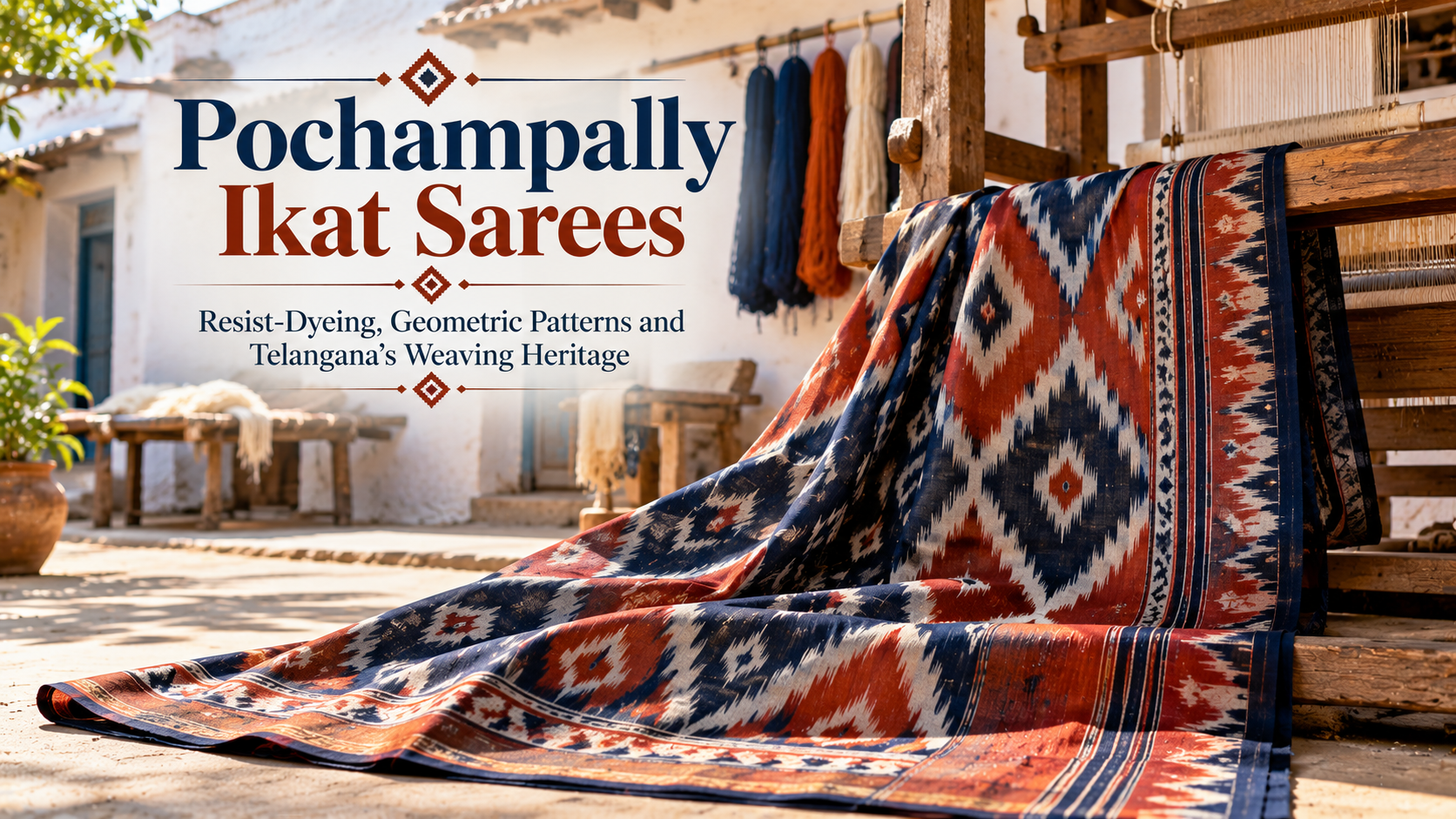
A Pochampally Ikat saree is easy to spot from a distance: bold diamonds, chevrons and interlocking geometric shapes, each edged with a slight blur where one colour softens into the next. Up close, that blur tells you how the pattern was made. The design was dyed into bundles of yarn before weaving, then assembled thread by thread on the loom.
This guide explains where Pochampally Ikat comes from, how resist-dyeing produces its patterns, what roles warp, weft and double Ikat play, and how woven Pochampally Ikat differs from printed imitations.
Pochampally and Telangana’s weaving heritage
Bhoodan Pochampally is a town in the Yadadri Bhuvanagiri district of Telangana, about 50 km from Hyderabad. It sits at the centre of a cluster of weaving villages, and the name “Pochampally” is used for Ikat woven across this wider area.
The prefix Bhoodan commemorates the Bhoodan (land gift) movement, which Vinoba Bhave launched from this village in April 1951. The name is a reminder that the town’s history extends beyond textiles, but weaving is what it is now best known for.
Local names for the technique
In Telangana, the Ikat technique is locally called Paagadu Bandhu or Chitki. Government handloom sources record both terms. The craft developed a distinct identity in Pochampally and surrounding villages in the 20th century, while yarn tie-dyeing itself has a longer history in the wider Deccan region.
Telia rumal and older Ikat traditions
Telangana and neighbouring Andhra Pradesh also have an older Ikat tradition known as telia rumal, an “oily handkerchief” named after the oil treatment applied to the yarn. These square cloths, traditionally in red, black and white, were woven for trade and use as head cloths and scarves. Telia rumal is a related but distinct tradition, and today it is associated with specific weaving villages in the region.
Geographical Indication and recognition
Pochampally Ikat received Geographical Indication registration in 2004, one of the early handloom GIs in India. In 2021, Pochampally was named one of the Best Tourism Villages by the United Nations World Tourism Organization (UNWTO), recognised for its weaving heritage and rural tourism.
Ikat resist-dyeing: patterns made in the yarn
Ikat is a family of techniques in which yarn is resist-dyed before weaving. Sections of thread are tightly bound so that dye cannot reach them. When the binding is removed, each thread carries a sequence of dyed and undyed sections. When those threads are woven in the right order, the sections line up to form a pattern.
The essential point is that the pattern exists in the yarn before the fabric does. This separates Ikat from printing, where colour is applied to woven cloth.
Warp Ikat, weft Ikat and double Ikat
- Warp Ikat: only the lengthwise warp threads are tie-dyed.
- Weft Ikat: only the crosswise weft threads are tie-dyed.
- Double Ikat: both warp and weft are tie-dyed, and the pattern forms where their dyed sections meet.
Pochampally weavers produce both single Ikat (most commonly weft Ikat) and double Ikat. Pochampally double Ikat is especially admired for the precision needed to make both sets of threads align. A single saree may combine methods, for example a weft Ikat body with double Ikat elements in the border or pallu.
How a Pochampally Ikat saree is made
General saree-making stages, from yarn preparation to finishing, are covered in our guide to the saree making process. The steps below focus on how Pochampally Ikat weaving turns a design into tied and dyed yarn.
1. Planning the design
The designer or master weaver plans the pattern on graph paper. Each square on the graph corresponds to a section of thread, and the colour of each square tells the tier where to bind and where to leave yarn open for each dye bath.
Because Pochampally designs are strongly geometric, they translate naturally onto a grid. Diamonds, chevrons and stepped shapes can be broken into precise units.
2. Preparing the yarn
Cotton or silk yarn is wound into hanks, then stretched on a frame so that many threads lie side by side in an orderly bundle. Each bundle will become a set of rows (for weft) or a set of lengthwise threads (for warp) in the finished saree.
For weft Ikat, the bundle represents the full sequence of weft passes. For double Ikat, separate bundles are prepared for warp and weft, and both must be tied to match.
3. Tying (Paagadu Bandhu)
The tier marks the pattern onto the stretched yarn and binds the marked sections tightly. Traditionally this was done with cotton thread; today rubber strips cut from inner tubes are widely used because they resist dye well and are quick to tie and remove.
Tying is the most skilled and time-consuming stage. Every tied section is a point in the final design that must stay free of a particular colour.
4. Dyeing in stages
The bundle is dyed in the first colour. For multi-coloured designs, the process repeats: some ties are removed to expose new sections, others are added to protect colours already dyed, and the yarn goes into the next dye bath. Lighter colours are usually dyed first and darker colours later, so later baths do not muddy earlier ones.
The number of colours directly affects the number of tying and dyeing rounds, which is why a multi-coloured Pochampally Ikat takes much longer to produce than a two-colour one.
5. Untying and winding
After the final dye bath, all ties are removed. The dyed yarn is carefully opened out and wound onto bobbins or pirns in exactly the order it will be woven. If the sequence is broken, the pattern will not form.
6. Weaving and alignment
The warp is set on the handloom; in double Ikat, the tie-dyed warp is laid in its precise sequence. The weaver then passes each weft thread across and adjusts its position so that the dyed sections line up with the design. Small shifts at this stage produce the characteristic blurred edge of Ikat motifs.
Borders are often woven with plain contrast-colour warp threads, and the pallu is planned as a distinct section, usually with larger or denser motifs.
7. Finishing
The finished saree is cut from the loom, checked and finished.
Pochampally saree motifs and design language
Pochampally Ikat is closely associated with geometric design. Common forms include:
- Diamonds and lozenges, often nested or repeated in bands
- Chevrons and zigzags running across or along the saree
- Squares, checks and stepped shapes
- Interlocking lattices that cover the body
- Stylised florals and birds, simplified into angular forms, especially in borders and pallus
Many designs fill the whole body with a repeating pattern rather than leaving large areas plain. Contemporary weavers also produce more open layouts, figurative motifs and modern abstract designs. Specific motif names vary between workshops, and claims that particular shapes carry fixed meanings are not consistently documented, so it is best to see Pochampally’s motifs as a design vocabulary rather than a fixed set of symbols.
Colour planning and pattern alignment
Colour
Pochampally Ikat uses a wide colour range, from traditional deep reds, indigo blues, blacks and whites to contemporary pastels and bright contrasts. Colour planning is built into the tying plan from the start, because each colour requires its own round of tying and dyeing.
Alignment
Alignment is what makes an Ikat design readable. In single Ikat, the weaver aligns one set of threads. In double Ikat, warp and weft must meet precisely, and even small misalignments are visible. Good alignment shows as clear, repeating motifs, while slight blurring at the edges is expected and is part of the Ikat character.
Borders and pallu
Borders may be plain contrast bands or carry their own Ikat patterning. The pallu is typically the most elaborate section, with larger motifs, bands of pattern or a change of colour. Some Pochampally sarees add zari to the border or pallu.
Pochampally saree fabrics
Pochampally Ikat is woven in several fibres:
- Cotton: breathable and suited to daily and office wear
- Silk: lustrous and used for festive and formal occasions
- Silk-cotton (often called sico): a blend that balances sheen and comfort
The fibre should be stated separately from the weaving method. A “silk Pochampally” and a “Pochampally print on art silk” are very different products. For a broader explanation of how fibre blends affect feel and value, see our article on silk saree vs silk blend saree.
Woven Ikat vs printed imitations
Printed fabrics often copy Pochampally designs, including the blurred edge. These are cheaper and can look convincing in photos. Visual signs help, but none is definitive on its own.
Check the reverse. Because the colour runs through the yarn, woven Ikat shows the pattern almost as clearly on the back as on the front. Many prints are paler or fainter on the reverse, though some printing methods penetrate well.
Look at the edges. Ikat edges feather along the direction of the dyed threads. Prints usually have sharp, uniform edges, but some deliberately imitate the blur.
Look for small variations. Handwoven Ikat shows slight differences between repeats. Perfectly identical motifs suggest printing or machine production.
Read the description. “Handloom Pochampally Ikat”, “handwoven double Ikat” or “Paagadu Bandhu” claim woven Ikat. “Pochampally print”, “Ikat print” or “Ikat design” usually indicate printed fabric.
Ask about labels. GI-linked labels and the Government of India Handloom Mark support handloom and origin claims. Their absence, especially from small producers, is a reason to ask rather than proof of imitation.
Consider the price. Tying, multiple dye baths and alignment make Ikat labour-intensive. A very low price for “handwoven double Ikat silk” deserves questions.
Our complete saree buying guide covers general budgeting, occasion and fabric decisions; the checks above are specific to Ikat.
Pochampally Ikat compared with Sambalpuri Ikat
Pochampally and Sambalpuri are India’s two best-known Ikat saree traditions, and both are respected handloom crafts with GI protection. They share the core resist-dyeing method but differ in region and typical design emphasis.
| Feature | Pochampally Ikat | Sambalpuri Ikat |
| Region | Bhoodan Pochampally and nearby villages, Yadadri Bhuvanagiri district, Telangana | Western Odisha: Sambalpur, Bargarh, Balangir, Subarnapur, Boudh districts |
| Local name for the technique | Paagadu Bandhu, Chitki | Bandha |
| GI | Pochampally Ikat, registered 2004 | Sambalpuri Bandha Saree & Fabrics (registered) |
| Ikat methods | Single (commonly weft) and double Ikat | Single (commonly weft) and double Ikat |
| Typical design emphasis | Bold geometric patterns: diamonds, chevrons, lattices, often covering the body | Motifs drawn from Odia life and worship, such as shankha, chakra and phula, plus checks like Pasapali |
| Common fibres | Cotton, silk, silk-cotton | Cotton, silk, blends |
| Typical colour approach | Wide range, from deep traditional tones to contemporary contrasts | Strong traditional reds, blacks and whites alongside wider modern palettes |
These are general tendencies. Weavers in both regions produce a wide variety of designs, and contemporary pieces from each can overlap in look.
Caring for a Pochampally Ikat saree
- Dry clean silk Pochampally sarees.
- Hand wash cotton Pochampally separately in cold water with mild detergent for the first few washes, and check for colour bleeding.
- Avoid soaking and do not wring.
- Dry in shade.
- Iron on medium for cotton and low for silk, on the reverse side where possible.
- Store folded in cotton cloth and refold periodically.
Conclusion
The Pochampally Ikat saree comes from a specific place in Telangana and a technique in which the design is tied and dyed into the yarn before weaving. Careful planning on graph paper, rounds of tying and dyeing, and precise alignment on the loom produce the bold geometric patterns and softly blurred edges the tradition is known for. Within that tradition, sarees can be cotton, silk or blended, single or double Ikat, and handwoven or imitated in print, so reading fibre and weaving details carefully is the surest way to understand what a particular saree is.
Frequently asked questions
Where are Pochampally Ikat sarees made?
They are made in Bhoodan Pochampally and nearby weaving villages in the Yadadri Bhuvanagiri district of Telangana, about 50 km from Hyderabad.
What is the local name for Pochampally Ikat?
The technique is known locally as Paagadu Bandhu or Chitki.
Does Pochampally Ikat have a GI tag?
Yes. Pochampally Ikat received Geographical Indication registration in 2004.
What is Pochampally double Ikat?
In double Ikat, both warp and weft threads are tie-dyed before weaving. The pattern forms where the dyed sections of both sets meet, which requires very precise alignment.
What are typical Pochampally saree motifs?
Pochampally is known for geometric motifs such as diamonds, chevrons, zigzags, squares and interlocking lattices, along with stylised florals and birds.
How is Pochampally Ikat different from Sambalpuri Ikat?
Both use resist-dyed yarn. Pochampally is from Telangana and is known for bold geometric patterns. Sambalpuri is from western Odisha and is known for motifs such as shankha, chakra and phula.
How can I tell woven Pochampally Ikat from a printed copy?
Check whether the pattern is clear on the back, look for feathered edges and slight variations between repeats, and read the description for “handloom” or “print”. No single sign is conclusive.
Are Pochampally sarees cotton or silk?
Both. Pochampally Ikat is woven in cotton, silk and silk-cotton (sico) blends.
