
Blog
Monochrome Ethnic Outfits for Navratri: How to Style One Colour from Head to Toe

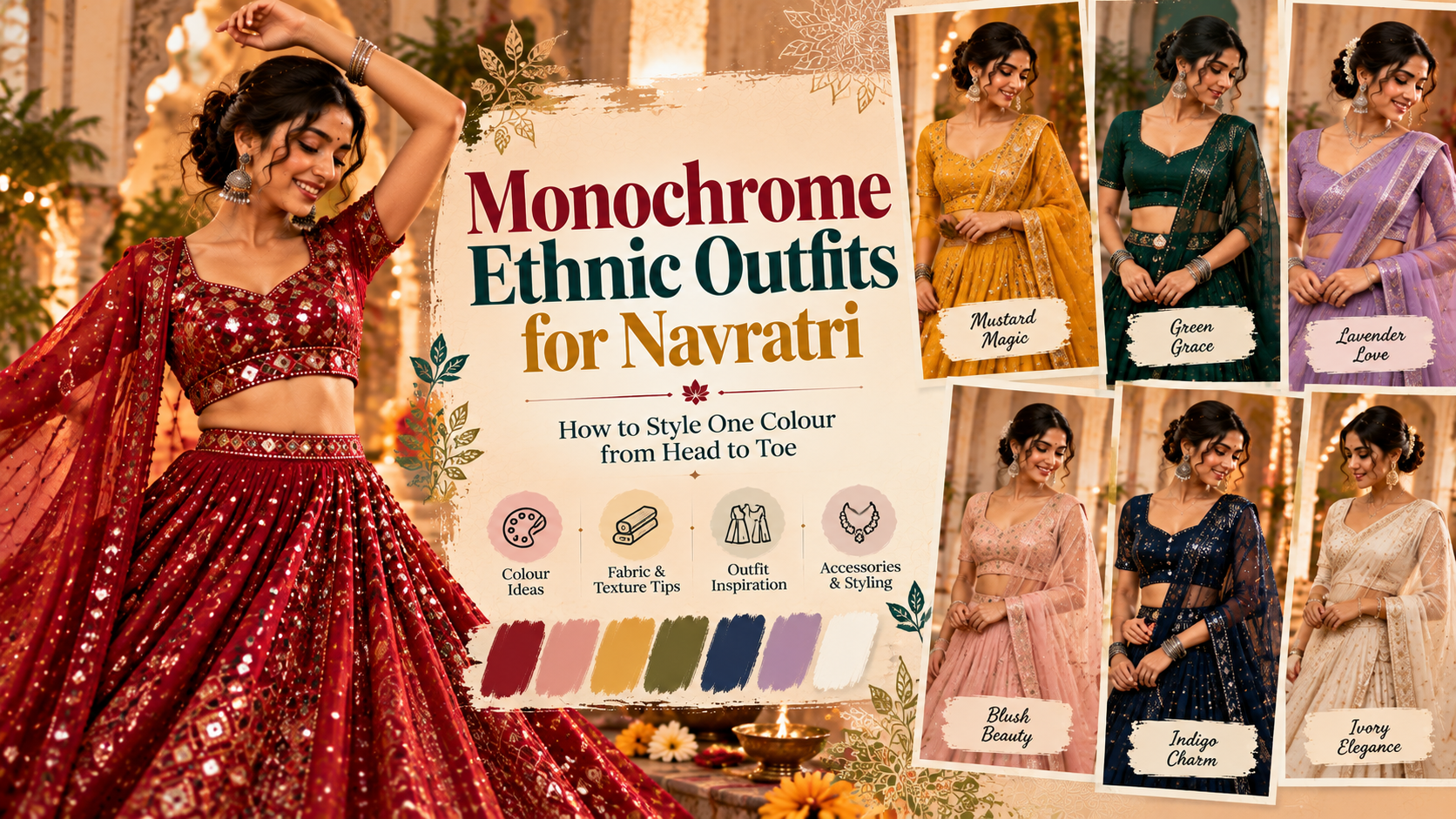
Navratri is usually a riot of colour: bandhani in five shades, mirror work in every hue, dupattas that contrast with everything. A monochrome look goes the other way. You pick one colour and wear it from the blouse to the dupatta to the juttis, and let the fabrics, embroidery and finishes do the work that contrast colours usually do.
Done well, a single colour outfit looks deliberate and polished rather than plain. The secret is texture. A matte cotton skirt, a silk blouse with a sheen, a sheer dupatta and a band of tonal embroidery all read differently even in the same shade. This guide explains how to choose a colour, style monochrome lehengas, sarees and suits, add depth with texture and finishes, and adapt the look for puja, Garba and family gatherings. For more outfit ideas across the season, see our Navratri Outfit Ideas 2026 guide.
What are monochrome ethnic outfits?
A monochrome ethnic outfit uses one colour family throughout. That can mean an exact match, such as a red lehenga, red blouse and red dupatta, or a tonal look that moves through shades of the same colour, such as a maroon skirt, a cherry-red blouse and a rose dupatta.
Monochrome is not the same as plain. A monochrome outfit can be heavily embroidered, printed or embellished, as long as the embroidery, print or embellishment stays within the same colour family or uses neutral metallics such as gold or silver.
Monochrome styling vs the daily Navratri colours
Many people follow a colour for each day of Navratri. Those colours are published in calendars and vary by year and region; our Navratri Colours 2026 Guide lists this year’s sequence.
Monochrome styling is a separate idea. Following the daily colour tells you which colour to wear. Monochrome styling is about how you wear one colour. The two work well together: if the day’s colour is green, a head-to-toe green look is an easy way to follow the tradition. But you can wear a monochrome look on any day, in any colour, without following the sequence at all.
Choosing a colour palette
Most colours can work in monochrome. What changes is the mood and the occasion each suits.
Reds and maroons: traditional, festive and strong. A red monochrome look suits puja and evening functions. Mix brick, cherry, wine and maroon for a tonal effect.
Greens: from mint and pista to emerald and bottle green. Light greens feel fresh for daytime; deep greens look rich for evenings, especially with gold.
Blues: powder blue and sky blue feel calm and modern; royal blue, navy and indigo look striking at night. Indigo cotton suits folk-inspired Garba looks.
Pinks: blush, rani pink, magenta and fuchsia. Rani pink is a classic festive shade; blush and rose suit softer, contemporary looks.
Yellows and oranges: mustard, haldi yellow, marigold and saffron. These feel bright and celebratory and suit daytime puja well.
Purples: lavender, mauve, wine and aubergine. Lavender is light and modern; aubergine and wine are rich and evening-appropriate.
Neutrals: ivory, beige, gold and champagne. An all-ivory or all-gold outfit looks elegant, especially with metallic embroidery.
Black: an all-black ethnic look with mirror or silver work can be striking for evening Garba. Some families or communities avoid black for religious occasions, so consider the setting and your own customs.
Choosing your shade: pick a colour you already own pieces in, one you feel good wearing, or the day’s colour if you follow the sequence. Try the shade against your face in daylight before committing.
How to style monochrome lehengas and chaniya cholis
A monochrome lehenga is the easiest place to start, because lehengas come as coordinated sets.
The base set: skirt, blouse and dupatta in one colour family. If the set comes in exact matching colours, introduce variation through texture: a silk blouse with a net dupatta, or a mirror-work border on a plain skirt.
Tonal variation: pair a deep-toned skirt with a lighter blouse and a mid-tone dupatta. For example, a bottle-green skirt, a pista-green blouse and an emerald dupatta create depth while staying within green.
Chaniya cholis: traditional chaniya cholis are often multicoloured, but monochrome versions look fresh at Garba. Try a red skirt with red mirror-work and a red bandhani dupatta, so the bandhani dots and mirrors provide pattern without breaking the colour.
Outfit example, evening Garba: an indigo cotton chaniya choli with indigo thread embroidery and silver mirror work, an indigo bandhani dupatta, oxidised silver jhumkas and indigo juttis.
Outfit example, family function: a blush-pink net lehenga with tonal pink sequin work, a pink silk blouse, a sheer rose organza dupatta, pearl earrings and nude-pink embellished flats.
Monochrome saree styling
Sarees offer three easy places to play with tone: the body, the border and the blouse.
Blouse: a blouse in the exact saree colour gives the cleanest monochrome line. A blouse one shade lighter or darker adds subtle depth. A textured blouse, such as brocade, velvet or embroidered silk, in the same colour adds richness without breaking the palette.
Border: sarees with a tone-on-tone border, such as a maroon saree with a deeper wine border, are naturally monochrome. A gold or silver zari border also works, since metallics act as neutrals.
Accessories: choose jewellery in the metal tone of the border, or tonal stones in the saree colour, such as emeralds with green or rubies with red.
Outfit example, daytime puja: a mustard cotton silk saree with a self-woven border, a mustard blouse with elbow sleeves, small gold studs, a thin gold chain and tan kolhapuris.
Outfit example, evening function: a wine georgette saree with a tonal sequinned border, a wine velvet blouse, a polki-style choker and wine embellished heels or flats.
For festival-friendly saree options in many colours, see the Best Sarees to Wear for Navratri 2026.
Monochrome suits, Anarkalis and sharara sets
Matching ethnic sets are designed for monochrome styling, since the kurta, bottom and dupatta often come in one colour.
Suits: a straight or A-line kurta, matching pants or palazzos and a dupatta in the same shade make a clean daytime look. Add interest with a printed or embroidered dupatta in tonal colours. Our Navratri Suit Designs for Women guide has more cuts and necklines to try.
Anarkalis: a floor-length Anarkali in one colour looks dramatic when it twirls. Choose tonal embroidery at the yoke and hem for detail.
Sharara sets: shararas give plenty of fabric for texture. Try a cotton kurta with a georgette sharara and a chiffon dupatta, all in the same pink or green.
Outfit example, Garba night: an emerald georgette Anarkali with emerald thread embroidery at the yoke, an emerald chiffon dupatta pinned cross-body, gold-tone jhumkas and emerald juttis.
Outfit example, daytime visits: a powder-blue cotton kurta set with white-and-blue chikankari, a powder-blue mulmul dupatta, silver studs and white flats. White here works as a neutral alongside the blue.
Using texture, embroidery, prints and finishes to add depth
Texture is what keeps a one colour traditional outfit from looking flat.
Mix fabric finishes: pair matte with shiny and solid with sheer. For example:
- Matte cotton skirt with a silk blouse.
- Velvet blouse with a georgette saree.
- Raw silk kurta with a net or organza dupatta.
Tonal embroidery: thread embroidery in the same colour as the fabric creates pattern you notice up close without breaking the colour. Resham, chikankari and tonal sequins all work.
Tonal prints: bandhani, leheriya, block prints and florals in two or three shades of the same colour keep the outfit monochrome while adding movement.
Metallic accents: gold, silver and copper act as neutrals. A gold zari border, silver mirror work or copper-toned sequins add sparkle without introducing a new colour.
Weave and pattern within the fabric: jacquard, brocade and self-woven motifs give depth through the weave itself.
As a simple guide, aim for at least two different textures in an outfit, and three if the colour is very flat or matte.
Choosing jewellery and footwear
Monochrome outfits look best with accessories that support rather than compete.
Metal tone: choose one metal and use it consistently. Gold suits warm shades such as red, yellow, orange and green. Silver and oxidised silver suit cool shades such as blue, purple and grey, and folk-style looks. These are suggestions, not rules; wear what you like.
Tonal stones: stones in the same colour as the outfit, such as green with green, keep the palette unified.
Pearls and neutrals: pearls and polki-style pieces go with almost every colour and suit softer monochrome looks.
One statement piece: choose a statement necklace, a pair of large earrings or a maang tikka, not all three. Monochrome outfits draw attention to accessories, so one strong piece is usually enough.
Footwear: match footwear to the outfit colour, the metal tone or a neutral such as tan, nude or gold. Flat juttis and kolhapuris are practical for Garba.
Bags: a potli in the outfit colour or in the metal tone completes the look.
Daytime puja vs evening Garba
Daytime puja
Lighter fabrics, softer or brighter shades and minimal shine suit daytime. Cotton, cotton silk, chanderi and linen blends work well.
Example: a haldi-yellow chanderi kurta with a yellow cotton palazzo, a yellow block-printed dupatta, small gold jhumkas and tan juttis.
Example: a mint-green cotton saree with a self border, a mint blouse, pearl studs and white kolhapuris.
Evening Garba
Deeper shades, mirror work, sequins and metallic accents catch the evening lights. Choose breathable fabrics and secure dupatta drapes for dancing.
Example: a black cotton chaniya choli with black thread embroidery and silver mirror work, a black-and-silver dupatta, oxidised silver jewellery and black juttis.
Example: a rani-pink georgette lehenga with tonal mirror work, a rani-pink blouse with tassels, a pink bandhani dupatta and gold-tone jhumkas.
Coordinating family outfits with tonal colours
Coordinated festive clothing for a family does not have to mean identical outfits. A tonal approach looks coordinated in photos while letting everyone wear what suits them.
Pick one colour family: for example, green. Then let each person choose their own shade and garment.
- One person in an emerald silk saree.
- Another in a pista-green Anarkali.
- A child in a mint lehenga.
- Men in bottle-green kurtas or green Nehru jackets with neutral kurtas.
Mix garment types: sarees, lehengas, suits and kurtas together look more natural than everyone in the same style.
Use a shared detail: gold embroidery or mirror work across outfits ties the group together.
Keep comfort first: let each person pick fabrics and fits they are comfortable in, especially children and older relatives.
Reusing existing garments
You probably already own pieces that can be combined into a monochrome look.
- Mix sets: a red blouse from one lehenga with a red skirt from another, or a green kurta with green pants from a different suit.
- Use a plain base: a solid saree or skirt is easy to restyle with a different same-coloured blouse or dupatta each time.
- Swap the dupatta: a tonal or matching dupatta can turn a mismatched set into a monochrome one.
- Add Indo-Western pieces: a cape, jacket or crop top in the same colour can update an existing skirt.
- Check shades in daylight: two “reds” can look different side by side. Make sure combined pieces look intentional, either clearly matching or clearly tonal.
Common monochrome styling mistakes
- Using only one texture. The outfit looks flat. Fix: mix at least two fabrics or finishes.
- Shades that almost match. Two slightly different tones can look like a mistake. Fix: either match closely or make the tonal difference clear.
- Too many accessories. Monochrome draws attention to accessories, so a crowded look stands out. Fix: choose one statement piece.
- Mixing metals randomly. Gold necklace, silver earrings and copper bangles can look scattered. Fix: pick one metal tone, or mix deliberately.
- Ignoring the setting. Some colours, such as black, may not suit every religious event. Fix: consider the occasion and your family’s customs.
- Forgetting comfort. A heavy velvet monochrome set may look rich but feel warm for Garba. Fix: choose breathable fabrics for dancing.
- Assuming monochrome means plain. Fix: use tonal embroidery, prints and metallic accents for detail.
Comparison table
| Colour family | Fabric combinations | Accessory options | Suitable occasions |
| Reds and maroons | Silk saree with velvet blouse; cotton chaniya choli with bandhani dupatta | Gold, ruby-toned stones, kundan | Puja, evening functions, Garba |
| Greens | Chanderi kurta with cotton dupatta; georgette Anarkali with chiffon dupatta | Gold, emerald-toned stones, pearls | Daytime puja (light), evening (deep) |
| Blues and indigo | Indigo cotton with mirror work; silk saree with brocade blouse | Oxidised silver, silver, sapphire-toned stones | Garba, evening gatherings |
| Pinks | Net lehenga with silk blouse; georgette sharara with organza dupatta | Pearls, gold, rose gold | Garba, family functions, daytime events |
| Yellows and oranges | Cotton silk saree; chanderi kurta with printed dupatta | Gold, pearls, tan accessories | Daytime puja, family gatherings |
| Purples | Silk saree with velvet blouse; georgette lehenga | Silver, amethyst-toned stones, gold | Evening functions |
| Neutrals (ivory, beige, gold) | Silk with zari; chikankari cotton; organza dupatta | Gold, pearls, polki-style pieces | Puja, family photographs, evening events |
| Black | Cotton chaniya choli with mirror work; georgette lehenga | Oxidised silver, silver | Evening Garba (where suitable for the setting) |
Frequently asked questions
1. What is a monochrome ethnic outfit? An outfit in one colour family from top to bottom, either matching exactly or using different shades of the same colour, often with metallic accents.
2. Is monochrome the same as wearing the Navratri colour of the day? No. The daily colour tells you which colour to wear. Monochrome is a way of styling one colour. You can combine them by wearing the day’s colour head to toe.
3. How do I stop a monochrome outfit from looking flat? Mix textures such as matte and shiny or solid and sheer, and add tonal embroidery, prints or metallic details.
4. Can I add gold or silver to a monochrome look? Yes. Metallics act as neutrals and add sparkle without introducing a new colour.
5. Which colours work best for monochrome Garba outfits? Any colour works. Deep shades such as indigo, emerald, rani pink and maroon look striking under evening lights, especially with mirror work.
6. Should my shoes match the outfit? They can match the outfit, the metal tone of your jewellery or a neutral such as tan, nude or gold. Choose what looks best and is comfortable for dancing.
7. How can my family coordinate without wearing identical outfits? Choose one colour family and let each person wear a different shade and garment, with a shared detail such as gold embroidery.
8. Can I create a monochrome look from clothes I already own? Yes. Combine same-coloured pieces from different sets, swap dupattas, or add a matching jacket or cape. Check the shades in daylight first.
9. Do monochrome outfits work for puja? Yes. Lighter or traditional shades in cotton, silk or chanderi with simple jewellery suit daytime puja well.
Conclusion
Monochrome ethnic outfits are an easy way to look coordinated and contemporary during Navratri, and they work for every garment, from lehengas and sarees to suits and shararas. The look succeeds when you build depth through texture, tonal embroidery and metallic accents rather than extra colours.
A few practical ideas to try:
- Start with a matching set and add a textured dupatta in the same shade.
- Pair a matte skirt with a shiny blouse, or a sheer dupatta with a solid saree.
- Pick one metal tone and one statement accessory.
- Use light shades and soft fabrics for daytime puja, and deeper shades with mirror work for evening Garba.
- Coordinate family outfits through one colour family rather than identical clothes.
- Look through your wardrobe for same-coloured pieces you can combine.
Whether you follow the daily colours or simply choose a shade you love, one colour from head to toe can look as festive as any multicoloured outfit.
