
Blog
Plus-Size Ethnic Wear for Navratri: Outfit Silhouettes, Prints and Styling Ideas

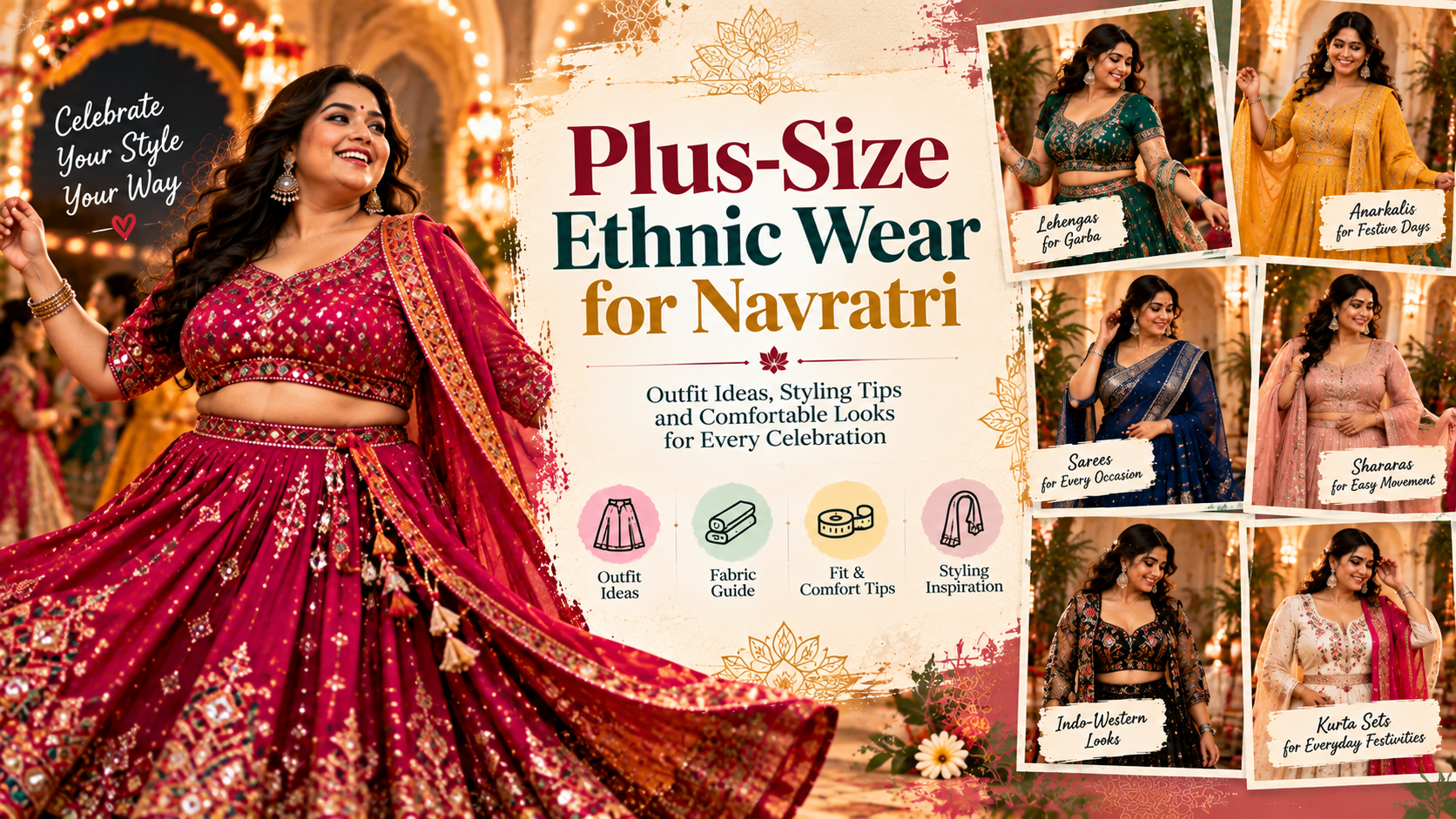
Navratri asks a lot of an outfit. It has to look festive in family photographs, stay comfortable through hours of Garba, sit well on the floor during puja and still feel like you at the end of a long night. For plus-size shoppers, the challenge is rarely about what you “can” wear. It is usually about finding pieces that are cut generously enough, made in fabrics that breathe and move, and sized honestly enough that you are not left guessing.
This guide is about plus size ethnic wear as a matter of fit, comfort and personal choice. There are no rules here about hiding, slimming or flattering. Every body can wear a lehenga, a saree, a sharara or a crop-top set. What changes from person to person is preference: how much structure you like, how much coverage you want, how warm you run and how you want to move. If you are still planning looks for the season, our Navratri Outfit Ideas 2026 guide is a good place to start.
Understanding the outfit options
Lehengas
A plus size lehenga works the same way as any lehenga: a skirt, a blouse and usually a dupatta. The details that matter are the waistband (how adjustable it is), the number of panels or kalis (which affects flare and movement) and the blouse construction. Lehengas suit Garba, weddings and evening functions.
Chaniya cholis
The traditional Garba outfit, usually a flared skirt with a short choli and a dupatta, often in bright colours with mirror work or bandhani. A wide flare makes spinning comfortable, and the choli can be cut longer or with sleeves if you prefer more coverage. Our Chaniya Choli Styling Guide covers dupatta and jewellery pairings in detail.
Sarees
A saree is one of the most adaptable plus size traditional dresses because the drape adjusts to the wearer rather than coming in a fixed size. Only the blouse and petticoat need to fit. You can drape it with more or fewer pleats, a longer or shorter pallu, and pinned or open, depending on what feels comfortable.
Kurtas and kurta sets
Kurtas come in straight, A-line, flared and high-low cuts, paired with palazzos, churidars, cigarette pants or salwars. They are practical for puja, daytime visits and long days when you want something easy.
Anarkalis
Fitted at the bodice and flaring from the waist or under the bust into a long, full skirt. Anarkalis twirl well, which makes them popular for Garba, and the floor-length versions feel dressy enough for evening functions.
Shararas and gharara sets
Wide, flared trousers (sharara) or trousers flaring from the knee (gharara), worn with a kurta or short top. They give the movement of a skirt with the ease of trousers, which many people find comfortable for dancing and sitting.
Indo-Western outfits
Dhoti pants with a peplum top, cape sets, jacket lehengas, crop tops with skirts, and draped skirts. These suit evening events and anyone who wants a contemporary look while staying within ethnic styling.
Choosing a silhouette by preference and movement
Instead of choosing a silhouette to change how your body looks, it helps to ask what you want the outfit to do.
Do you want to move freely? Flared lehengas, chaniya cholis, Anarkalis and shararas all allow full leg movement for Garba spins. Check that the flare starts where you want it and that there is enough fabric in the skirt.
Do you prefer structure or softness? A structured blouse and a stiff lehenga feel held-in and formal. A soft georgette Anarkali or a flowing kurta feels relaxed. Neither is better; it depends on what feels good to you.
How much coverage do you want? Longer kurtas, longer blouses, sleeves and dupattas all add coverage. Crop tops, sleeveless blouses and open backs reduce it. Choose based on comfort and the occasion, not on rules about body size.
How will you sit? If you will sit on the floor for puja, a sharara, salwar or full lehenga is often easier than a narrow skirt or fitted churidar.
How warm do you get? Long nights of dancing in a crowd can get hot. Lighter fabrics, fewer layers and sleeveless or short-sleeved options can help, while heavier outfits may suit shorter events.
Fabric selection
Fabric affects comfort more than almost any other choice, and comfortable ethnic wear starts here.
Drape
Georgette, chiffon, crepe and soft silks fall smoothly and move with you. Stiffer fabrics such as brocade, raw silk and organza hold their own shape, giving a more structured silhouette.
Weight
Heavy embroidery, velvet and multiple layers add weight, which can be tiring on a long night. A lighter outfit is often easier for Garba; heavier pieces may suit a wedding where you will be dancing less.
Lining
A soft lining makes embellished garments more comfortable against the skin and helps skirts fall evenly. Cotton or cotton-blend linings are usually more breathable than synthetic ones. Check whether the blouse, skirt and kurta are lined.
Breathability
Cotton, linen blends, cotton silk and chanderi allow more airflow than many synthetics. If you know you will be dancing for hours, breathability is worth prioritising.
Construction
Look for enough seam allowance to adjust, reinforced stress points such as the underarm and waist, and smooth finishing inside. Well-made construction is what lets an outfit move with you without straining.
Prints, embroidery, borders and details
Prints and embellishments are about personal style, not about concealing or highlighting particular areas.
Prints: small prints, large florals, bandhani, leheriya, block prints and geometric patterns are all options. Choose what you love wearing.
Embroidery: placement affects where the eye goes and how the garment feels. All-over embroidery adds weight and stiffness; embroidery on borders, necklines or sleeves keeps the body of the fabric soft.
Borders: a heavy border at the hem helps a skirt fall and swing. Borders on a dupatta or saree pallu create a strong focal point.
Decorative details: tassels, latkans, mirror work, gota patti and sequins add festive character. Check that they are securely attached and do not scratch.
If an outfit has a lot of detail, you may want simpler jewellery, or the other way round. That is a styling preference, not a requirement.
Blouse and neckline options
The blouse is where fit and support matter most, especially for Garba.
Support: decide whether you want to wear your usual bra, a padded blouse or a blouse with built-in cups. Tell your tailor which bra you will wear and bring it to fittings.
Comfort: check that the armholes do not cut in, the sleeves allow your elbows to bend and the blouse does not ride up when you raise your arms.
Movement: if you will dance, test spins, claps and arm raises at the trial.
Necklines: round, sweetheart, V, square, boat, high neck and collar necklines all work on plus-size bodies. Choose based on the jewellery you plan to wear, the coverage you want and what you feel comfortable in. A deep back may need a tie or hook at the top so the shoulders stay in place.
Sleeves: sleeveless, cap, elbow-length and full sleeves are all valid choices. Sleeves with a little ease are more comfortable for dancing than tightly fitted ones.
For more on cuts, necklines and embroidery, see our Navratri Blouse Design Ideas.
Waistbands, closures and lengths
Waistbands: drawstring (nada) waistbands are adjustable and common on lehengas and salwars. Elastic waistbands are comfortable for long wear. Hook-and-zip waistbands give a neat finish but are less adjustable. A partly elasticated back with a fixed front is a good compromise.
Closures: side zips, back hooks, front hooks, buttons and ties each have trade-offs. Zips are quick but fixed. Hooks and ties allow small adjustments through the evening. For long nights, adjustable closures can add a lot of comfort.
Lengths: skirts and trousers should clear the floor when you are wearing your event footwear, so you do not trip during Garba. Kurta and blouse length depends on how much coverage you want. Dupattas should be long enough to drape but not so long that they trail.
Styling for different occasions
Garba and Dandiya
Prioritise movement and breathability: a flared chaniya choli, Anarkali or sharara in cotton or light georgette, with a secure dupatta drape and comfortable flat footwear. Keep jewellery light so it does not swing or catch. Our guide to Comfortable Navratri Outfits for Long Garba Nights has more ideas for staying cool and comfortable.
Puja
Choose something easy to sit in, such as a kurta set, saree, sharara or soft lehenga. Traditional colours, cotton or silk-cotton fabrics and a dupatta for covering your head if you wish all suit the setting.
Family photographs
Choose outfits you feel confident in. Solid colours, rich jewel tones and outfits with a clear focal point, such as a statement dupatta or embroidered neckline, tend to photograph well. Keep a dupatta pinned so it does not shift between shots.
Evening functions
Evening is a good time for richer fabrics, deeper colours, more embellishment and Indo-Western pieces such as cape sets or jacket lehengas. Comfort still matters, especially at a long event, so check closures and footwear.
Jewellery, dupattas and footwear
Jewellery: choose jewellery to suit the neckline and the outfit’s level of detail. Statement necklaces suit plain, open necklines; earrings and maang tikkas suit high necks; oxidised silver suits mirror work and folk prints; gold tones suit zari and gota. Heavy pieces can be tiring on a long night, so wear what you can comfortably keep on.
Dupattas: a dupatta can be draped over one shoulder, both shoulders, across the body, pinned as a cape or tucked at the waist. For Garba, anchor it at two points. For puja, a double-shoulder drape or head covering may be more comfortable. Choose a drape for practicality and how you like it to look.
Footwear: flat or low-heeled footwear with good grip and cushioning is easiest for dancing. Juttis, kolhapuris and embellished flats suit most ethnic outfits. Break in new footwear before the event.
Shopping online for plus size festive wear
Online shopping offers a wider range of plus size ethnic outfits than many local stores, but fit is harder to judge. A few habits help.
Size charts: check each brand’s size chart rather than relying on the label size, since sizing varies. Note whether the chart lists body measurements or garment measurements.
Your measurements: keep a current record of bust, under-bust, waist, hips, shoulder width, upper-arm circumference and preferred lengths. Compare these with the chart.
Product descriptions: look for fabric composition, lining, closure type, waistband type, flare or number of kalis, blouse type (stitched, semi-stitched or unstitched) and care instructions. If details are missing, ask the seller.
Customisation: some sellers offer stitching to your measurements or extra seam allowance. Check whether this affects returns.
Photos and reviews: look at close-ups of fabric and finishing, and read reviews for comments on fit and sizing.
Return and exchange policies: check the return window, whether customised or altered items can be returned, and who pays for return shipping before you order.
Tailoring and alterations
Tailoring can make a good outfit feel made for you. The aim is better fit without giving up comfort or movement.
- Ask for adequate seam allowance so the garment can be adjusted later.
- Bring the undergarments and footwear you will wear.
- Explain how you will use the outfit, whether that is dancing, sitting on the floor or a long event.
- Test movement at the trial: raise your arms, sit, bend and do a few Garba steps.
- Ask for adjustable features such as tie-backs or partly elasticated waistbands if you want flexibility.
- Remember that what can be altered depends on the garment’s construction, fabric and embroidery.
A tailor who can see and handle the garment is the best judge of what changes are possible.
Outfit comparison table
| Outfit type | Fabric considerations | Styling options | Practical use |
| Lehenga | Check lining, panel count and waistband type; heavy work adds weight | Different blouses and dupatta drapes; crop top or longer blouse | Garba, weddings, evening functions |
| Chaniya choli | Cotton and light fabrics breathe well; mirror work adds weight | Bandhani or mirror-work dupattas, oxidised jewellery | Garba and Dandiya |
| Saree | Georgette, chiffon and crepe drape softly; silks hold structure | Drape style, blouse design and pallu length can all vary | Puja, weddings, evening events |
| Kurta set | Cotton and chanderi suit daytime; silk blends suit evenings | Different bottoms, dupattas and jackets | Puja, daytime visits, family gatherings |
| Anarkali | Light georgette twirls easily; layered versions are warmer | Floor length or calf length, with or without dupatta | Garba, evening functions |
| Sharara or gharara set | Flowing fabrics move well; check waistband comfort | Short or long kurta, dupatta or cape | Garba, puja, family events |
| Indo-Western | Varies widely; check structure and breathability | Cape sets, jacket lehengas, dhoti pants with peplum tops | Evening functions, parties |
Frequently asked questions
1. What is the most comfortable plus size outfit for Garba? It depends on personal preference, but flared chaniya cholis, Anarkalis and shararas in breathable fabrics are popular for their freedom of movement.
2. Can plus-size women wear crop tops with lehengas? Yes. Any outfit can be worn by anyone. If you want a crop top, focus on a well-fitted blouse and a waistband that feels comfortable.
3. Are sarees a good choice for plus-size bodies? Sarees are very adaptable because the drape adjusts to the wearer. Only the blouse and petticoat need to fit, which makes them a flexible option.
4. Which fabrics are best for long festive nights? Breathable fabrics such as cotton, cotton silk, chanderi and light georgette are usually more comfortable for long events.
5. How do I check sizing when shopping online? Compare your current measurements with the brand’s size chart, read the product description for fabric and closure details, and check reviews for fit comments.
6. Should I buy a size up to be safe? It depends on the garment and how much it can be altered. Buying a little larger and taking it in is often easier than letting out a garment that is too small, but check with a tailor if unsure.
7. What waistband is most comfortable for long events? Many people find drawstring or partly elasticated waistbands the most comfortable because they adjust through the evening.
8. Do prints and embroidery need to be chosen differently for plus-size outfits? No. Choose prints and embroidery you like. Practical considerations, such as the weight of heavy embroidery, apply to every outfit regardless of size.
9. What should I bring to a tailor fitting? Bring the bra and footwear you plan to wear, a well-fitting reference garment and photos of the design you want.
Conclusion
Inclusive Indian fashion means every style is available to every body. The best plus size festive wear for Navratri is the outfit that fits properly, lets you move freely and reflects your own taste.
When shopping and styling, keep these points in mind:
- Choose the silhouette based on how you want to move and how much coverage you prefer.
- Prioritise breathable fabrics and soft lining for long nights.
- Look for adjustable waistbands and closures.
- Check size charts, product descriptions and return policies carefully when shopping online.
- Get blouses and key pieces tailored, and test movement at the trial.
- Pick jewellery, dupattas and footwear you can wear comfortably all evening.
Above all, wear what makes you feel like yourself, then go and enjoy the dance.
