
Blog
How to Get Your Ethnic Wear Tailored for Navratri: Measurements, Alterations and Fit

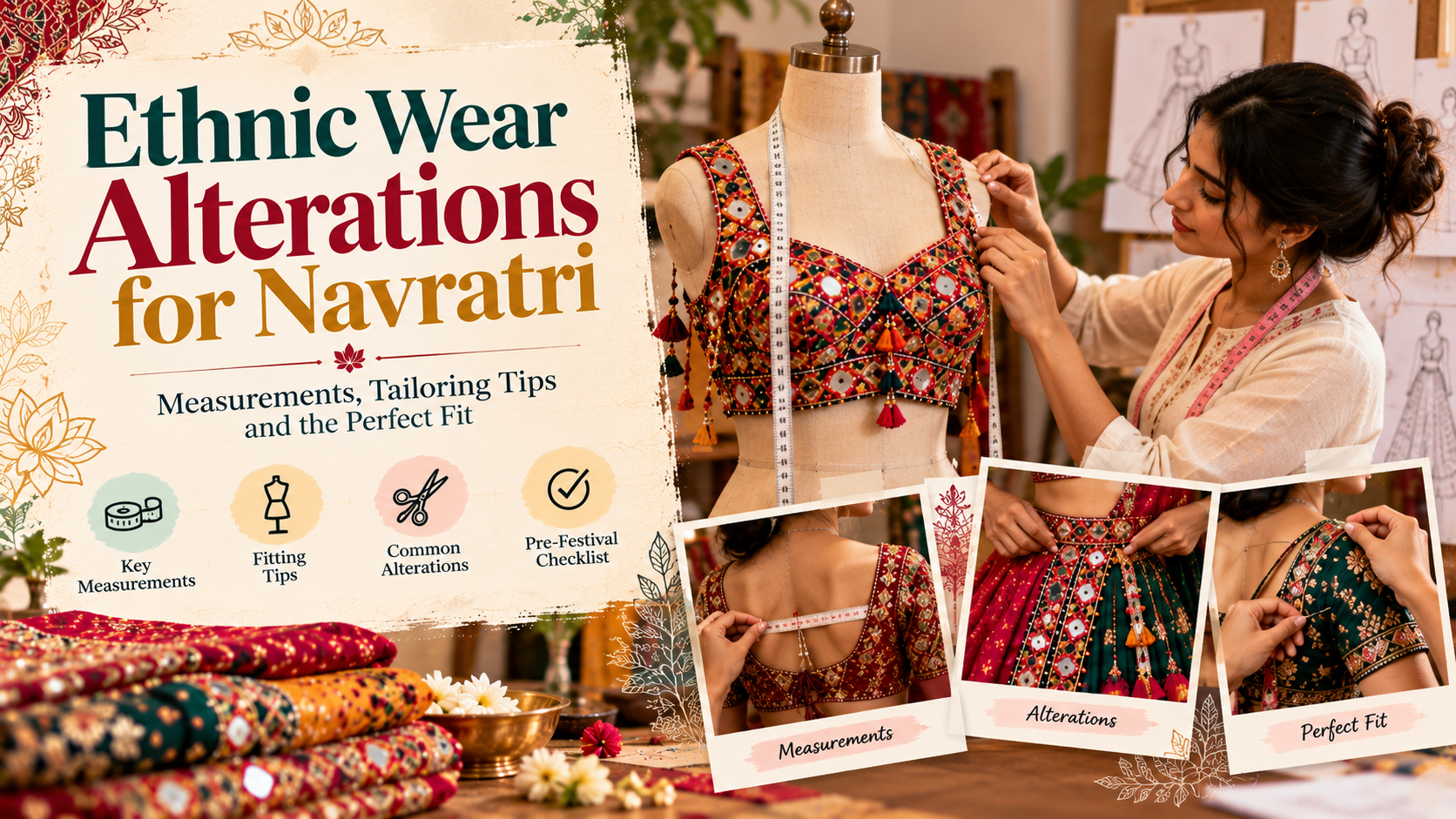
Most fitting problems at Navratri start a week before the festival. A blouse comes back too tight across the arms, a lehenga drags on the floor, a child’s kurta is two sizes too big, and the tailor has a queue out of the door. Ethnic wear depends heavily on fit, and much of it is made to be adjusted, but adjustments take time, a trial or two and a tailor who is not overloaded.
Planning your ethnic wear alterations early gives you room to fix problems properly rather than accepting a rushed compromise. This guide explains when to buy ready-made and when to stitch, which measurements matter for each garment, what to check at a trial and how to plan a tailoring sequence before the festival. If you are still choosing outfits, start with our Navratri Outfit Ideas 2026 guide.
A note before we begin: every garment is constructed differently. How much a piece can be altered depends on the seam allowance left inside, the fabric, the embroidery and how the garment was cut. A tailor who can see and handle the garment is the right person to judge what is possible. This guide helps you prepare and ask the right questions.
Ready-made or custom tailoring?
When ready-made works well
Ready-made clothing suits you if you fall close to a standard size, need the outfit quickly or are buying a simple piece such as a cotton kurta set. Small alterations, like shortening sleeves or adjusting a hem, are usually enough to make it fit well. Ready-made pieces also let you see the finished garment before you pay.
When custom tailoring makes sense
Custom ethnic wear stitching is worth considering when:
- Your measurements fall between sizes or differ between upper and lower body.
- You want a particular blouse design, neckline or sleeve style.
- You have unstitched fabric, such as a saree blouse piece or a dress material set.
- You want a garment you can adjust for several years, with generous seam allowance.
- A ready-made piece would need so many changes that stitching fresh is simpler.
A middle path
Many people buy semi-stitched lehengas or suits, which come with the main pieces cut but leave the final fitting to the tailor. Check what “semi-stitched” means for that particular product, since it varies.
Measurements to check before alterations
Which measurements matter depends on the garment, and tailors take them in slightly different ways. These are the ones most commonly used.
Upper body:
- Bust: around the fullest part of the chest.
- Under-bust: directly below the bust, important for fitted blouses and cholis.
- Shoulder width: across the back from one shoulder point to the other.
- Armhole: around the arm where it meets the shoulder.
- Sleeve length: from the shoulder point to where you want the sleeve to end.
- Sleeve circumference: around the upper arm and at the sleeve opening.
- Front and back neck depth: how low you want each neckline.
- Blouse or kurta length: from the shoulder to where the garment should end.
Lower body:
- Waist: where the lehenga, skirt or trouser waistband will sit, which is not always your natural waist.
- Hips: around the fullest part.
- Skirt or trouser length: from the waistband to the floor or desired hem, ideally measured wearing the footwear you plan to use.
Practical tips:
- Measure over the undergarments you will wear with the outfit.
- Stand naturally; do not pull the tape tight.
- If possible, have someone else measure you, or let the tailor take measurements directly.
- Keep a written record for future orders, but re-measure before each festival.
Saree blouse fitting
Blouses are the most fit-sensitive part of ethnic wear, which is why good blouse fitting tips focus on movement as much as appearance. Our Navratri Blouse Design Ideas guide covers necklines and sleeves; here we focus on fit.
Shoulder fit
The shoulder seam should sit at your shoulder point, not slide off or pull inward. Wide necklines, such as boat necks and deep backs, depend heavily on accurate shoulder width.
Armholes
Armholes that are too tight restrict arm movement and cut in when you raise your arms. Armholes that are too loose make the blouse ride up and gape. A good armhole lets you lift your arms with the blouse staying in place.
Sleeves
Sleeves should allow you to bend your elbow comfortably. Fitted sleeves in non-stretch fabrics need careful sizing at the upper arm. Longer sleeves need extra ease if you plan to dance.
Neckline
Check that the front and back necklines lie flat without gaping or pulling. Deep backs often need a closure or tie at the top for support.
Back closure
Front hooks, back hooks, zips and ties all work, but each changes how adjustable the blouse is. Ties and hooks allow small adjustments; zips are quicker but fixed.
Movement
A blouse that fits standing still can pull when you sit, twist or raise your arms. Always test these movements at the trial.
Saree blouse measurements to give the tailor
Bust, under-bust, shoulder width, armhole, sleeve length and circumference, front and back neck depth, blouse length and preferred closure. Bring a blouse that fits you well as a reference if you have one.
Lehenga and chaniya choli alterations
Waistband adjustment
Waistbands on lehengas and chaniya cholis are often adjustable within limits, depending on the seam allowance and whether the waistband has a drawstring, hooks or a zip. Taking in a waist is usually easier than letting it out.
Skirt length
A lehenga hem alteration is common, but the method depends on the design. A plain hem can usually be shortened at the bottom. A hem with a heavy embroidered border may need to be shortened from the waist instead, so the border is not cut. Ask the tailor which approach suits your skirt.
Flare
Flare is largely decided by the cut and the number of panels. It is difficult to add flare after a skirt is made. Reducing it is sometimes possible but can affect the design.
Blouse fit
The blouse or choli follows the same principles as a saree blouse. Chaniya choli blouses are often short and fitted, so test arm movement carefully if you plan to do Garba.
Lining
Check whether the skirt and blouse are lined. A lining makes heavy embroidery more comfortable and helps the skirt fall properly. Adding or replacing lining is often possible, but discuss it with the tailor.
Kurta, sharara and suit alterations
Shoulders
Shoulder adjustments on kurtas are possible but more complex than side seam changes, especially if the shoulders are embroidered or have a yoke. Buy ready-made kurtas that fit well at the shoulder whenever possible.
Side seams
Taking in or letting out the side seams is one of the most common kurta alterations. How far a seam can be let out depends on the seam allowance inside.
Sleeves
Shortening sleeves is usually simple. Lengthening them depends on spare fabric. Narrowing sleeves is often possible; widening them depends on seam allowance.
Kurta length
Shortening a kurta is generally possible, though side slits and embroidered hems need care. Lengthening is rarely possible without adding fabric.
Trouser and sharara length
Palazzos, churidars and shararas can usually be shortened. Measure the length wearing your festival footwear. Shararas with embroidered hems or flared panels may need to be adjusted from the waist rather than the hem.
Dupatta considerations
Dupattas rarely need alteration, but you may want the edges finished, a border added or the length adjusted. Heavy or delicate dupattas should be handled carefully during stitching.
Children’s ethnic wear
Children move constantly and outgrow clothes quickly, so their festive clothing needs to prioritise comfort and safety. Our Navratri Outfits for Kids guide has outfit ideas; for fitting, keep these points in mind.
- Comfortable fit: clothes should allow free movement for running, sitting on the floor and dancing.
- Safe hems: lehengas, shararas and kurtas should not be long enough to trip over. Check hem length while the child is wearing their footwear.
- Simple closures: elastic waists, large hooks and easy buttons are easier for children than tiny hooks or long ties.
- Soft lining: embroidery and sequins can scratch, so lining is especially useful for children.
- Avoid oversized clothes: buying very large to “grow into” can leave long sleeves and hems that trip or catch. A modest allowance that the tailor can let out later is safer.
- Loose embellishments: check that beads, mirrors and tassels are firmly attached, since small loose pieces can be a hazard for young children.
How to prepare for a tailor appointment
What to bring:
- The garment or fabric.
- A well-fitting blouse, kurta or trousers as a reference, if you have one.
- The undergarments you plan to wear.
- The footwear you will wear at the event, for length measurements.
- Photos or sketches of the design you want.
- Any accessories that affect fit, such as a belt or a heavy dupatta.
How to communicate changes:
- Be specific: “the sleeve should end just above the elbow” is clearer than “a bit shorter”.
- Mention how you plan to use the outfit, for example dancing Garba or sitting through a long puja.
- Ask what is possible given the garment’s construction before deciding.
- Confirm the trial and delivery dates in writing or by message.
Trial fittings
A trial is the most important step. Wear the undergarments and footwear you plan to use, and check:
- Standing: does the garment sit smoothly without pulling or gaping?
- Sitting: sit on a chair and on the floor. Does the waist dig in? Does the blouse ride up?
- Walking: take a few steps. Does the hem drag or catch your feet?
- Raising your arms: lift both arms above your head. Do the armholes cut in or does the blouse lift?
- Bending and twisting: bend forward and turn. Do any seams strain?
- Dancing movements: do a few Garba steps or spins. Does the skirt flare comfortably? Does anything slip or pinch?
Point out every issue at the trial, however small. It is much easier to adjust before the final finishing.
Fabric, embroidery and lining
Some garments need extra care during alteration.
- Embellished seams: if the embroidery runs across a seam, altering it may disturb the design or require re-embroidering. Ask before cutting.
- Delicate fabrics: chiffon, georgette, net and silk can fray, pucker or show old stitch marks. Some fabrics show needle holes if a seam is let out.
- Heavy embroidery: zari, mirror work and gota patti make fabric stiffer and harder to re-stitch neatly.
- Lining: lining needs to be altered along with the outer fabric so the garment sits properly.
- Prints and borders: shortening a garment can cut through a printed border or motif, so plan where the change will be made.
Common alteration mistakes and how to avoid them
- Leaving alterations too late. Book early so there is time for a trial.
- Measuring without the right undergarments or footwear. The fit changes on the day. Bring them to every fitting.
- Skipping the trial. Problems only show when you move. Always ask for a trial.
- Cutting off excess seam allowance. You lose the option to let the garment out later. Ask the tailor to leave allowance.
- Buying too small to “slim into”. Letting out is harder than taking in. Buy for your current size.
- Ignoring how you will use the outfit. A blouse fitted for standing may not work for dancing. Tell the tailor your plans.
- Unclear instructions. Vague requests lead to wrong results. Use photos and specific measurements.
Planning a tailoring timeline before Navratri
Turnaround times vary widely by tailor, garment and season, so ask your tailor directly. A practical sequence looks like this:
- Plan outfits and check what you already have. Try on last year’s pieces to see what needs altering. Our Navratri Shopping Checklist can help you track what to buy.
- Buy new garments or fabric. Leave room for alterations rather than buying the week before.
- Book the tailor. Tailors get busy close to the festival, so contacting them early improves your chances of a timely trial.
- Give measurements and instructions. Bring your references, undergarments and footwear.
- Attend the first trial. Check fit and movement thoroughly.
- Allow time for corrections and a second trial if needed.
- Collect the garment and try it on at home. Do this before the festival starts so any last fix is still possible.
- Prepare accessories and dupattas. Pin, press or finish them while the main garment is being made.
Start with the most complex pieces, such as custom blouses and heavily embroidered lehengas, since they take longest.
Pre-festival tailoring checklist
For adults:
- Try on existing outfits and note changes needed.
- Record current measurements.
- Buy garments or fabric with time to spare.
- Book a tailor and confirm dates.
- Bring reference garments, undergarments and footwear.
- Ask about seam allowance and lining.
- Attend the trial and test sitting, walking, arm movement and dancing.
- Collect and try on before the festival.
For children:
- Measure the child close to the festival, since children grow quickly.
- Choose soft, comfortable fabrics and lining.
- Check hem lengths with footwear.
- Prefer simple, easy closures.
- Check that embellishments are firmly attached.
- Avoid excessively large sizes.
- Let the child move, sit and dance in the outfit before the event.
Garment comparison table
| Garment type | Common alterations | Trial-fitting checks |
| Saree blouse | Bust and side seams, shoulder width, armholes, sleeve length, neckline depth, closures | Raise arms, bend elbows, sit, twist; check neckline lies flat |
| Lehenga | Waistband, hem length, lining, blouse fit | Walk and spin in event footwear; sit on floor; check waist comfort |
| Chaniya choli | Waistband, skirt length, choli fit and closures | Garba steps, arm raises, check skirt flare and blouse stability |
| Kurta | Side seams, sleeve length and width, kurta length | Sit, raise arms, check shoulder seams and slit position |
| Sharara or palazzo | Length, waistband, hem finishing | Walk and sit in footwear; check hem clearance |
| Churidar | Length, leg width, waistband | Sit and bend; check bunching at ankles |
| Children’s outfits | Hem length, waistband, sleeve length, closures | Run, sit on floor, dance; check hems and loose pieces |
Frequently asked questions
1. How early should I start ethnic wear alterations before Navratri? It depends on your tailor and the garment, so ask them directly. Starting early gives time for a trial and corrections, and tailors usually get busy close to the festival.
2. Can a lehenga be made bigger at the waist? Sometimes, depending on the seam allowance inside the waistband. Taking a lehenga in is usually easier than letting it out.
3. How is a lehenga hem shortened if it has an embroidered border? Often the skirt is shortened from the waist rather than the hem, so the border is not cut. The tailor will decide based on the construction.
4. What should I wear to a blouse trial? Wear the bra you plan to use with the outfit and bring the footwear you will wear at the event.
5. Can kurta shoulders be altered? Sometimes, but it is more complex than altering side seams, especially with embroidery or a yoke. Choose ready-made kurtas that fit well at the shoulder.
6. Should children’s festive clothes be bought a size larger? A little allowance is fine, but very large clothes can cause tripping and discomfort. Ask the tailor to leave seam allowance so the garment can be let out later.
7. Why does my blouse ride up when I raise my arms? The armhole may be too low or loose, or the blouse may be too short. Mention this at the trial so the tailor can adjust it.
8. Can embroidered garments always be altered? Not always. Embroidery across seams, heavy embellishment and delicate fabrics can limit what is possible. A tailor should inspect the garment before agreeing to changes.
Conclusion
Good fit makes festive clothing comfortable enough to wear through long nights of Garba and full days of puja and gatherings. The key is planning: decide what you need, buy early, book your tailor in good time and never skip the trial.
Before the festival, make sure you have:
- Tried on every outfit you plan to wear.
- Taken fresh measurements for yourself and your children.
- Booked tailoring appointments with time for a trial.
- Brought undergarments, footwear and reference garments to fittings.
- Asked for seam allowance and lining where needed.
- Tested each outfit by sitting, walking, raising your arms and dancing.
- Collected and checked everything before the first night.
With these steps done, you can enjoy the festival without worrying about pins, pulls or hems.
