Blog
Uppada Jamdani Sarees: How Intricate Motifs Are Woven Into Fine Silk

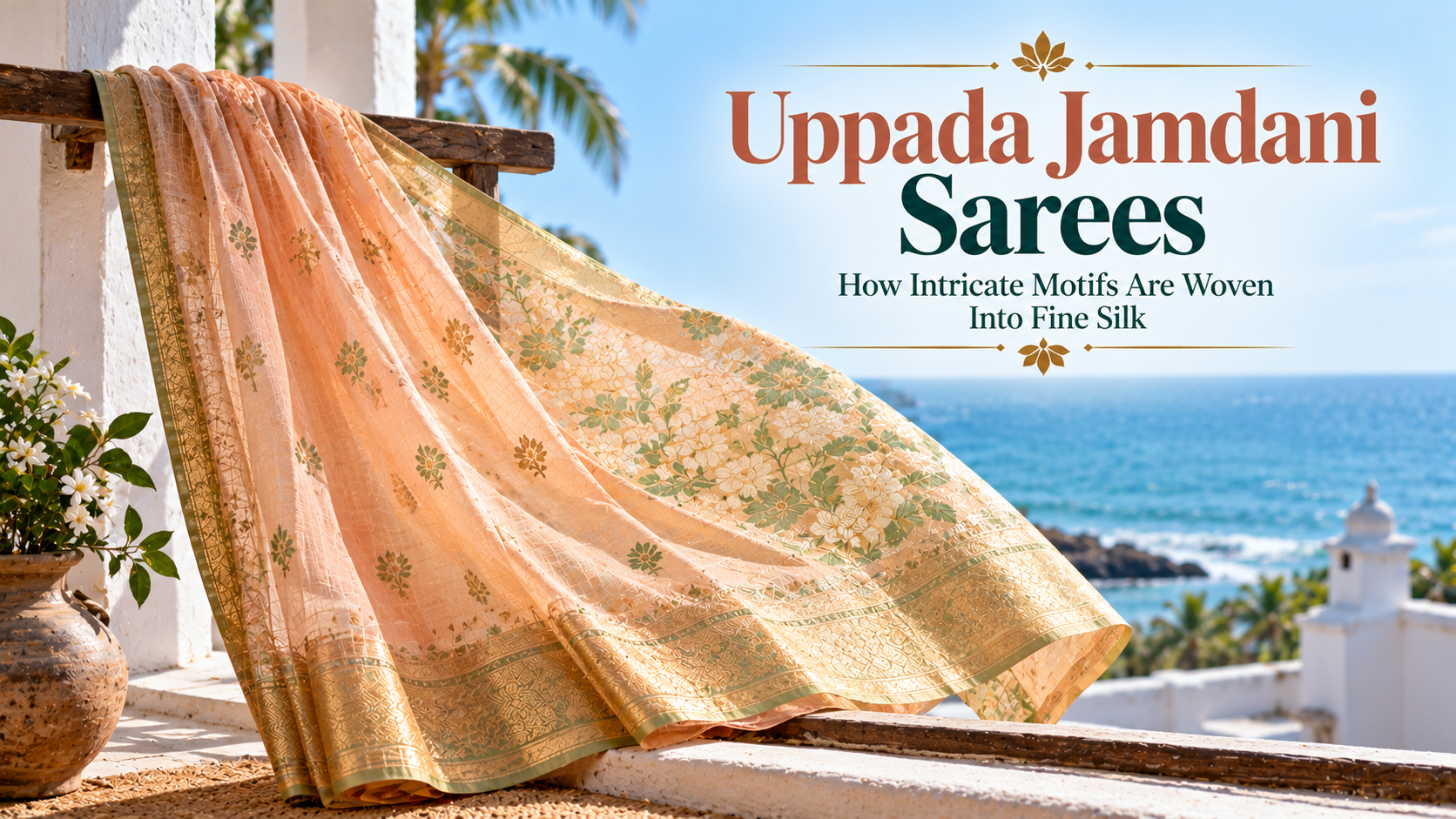
Look at the back of an Uppada Jamdani saree and you may be surprised. On many woven sarees, the reverse of a motif is a tangle of loose floats or cut threads. On a well-made Uppada Jamdani, the motif on the back looks almost as neat as the front. That is because each motif is woven into the fabric, pick by pick, with its thread turned back at the edge of the design rather than carried across the whole width.
This guide explains where the Uppada Jamdani saree comes from, how its motifs are woven, how motif placement shapes the finished look, how fibre compositions vary and how woven motifs differ from printed or embroidered designs.
Uppada and Andhra Pradesh’s weaving tradition
Uppada is a coastal village about 25 km north-east of Kakinada in Andhra Pradesh. It lies in the area formerly part of East Godavari district and now in Kakinada district.
The GI application for “Uppada Jamdani Sarees” defines the production area as Kothapalli (U Kothapalli) mandal, including the villages of Uppada, Kothapalli, Aminabad, Mulapeta, Ravindrapuram and Komaragiri. The application was filed by local weavers’ cooperatives and a master weavers’ association. Uppada Jamdani Sarees received Geographical Indication registration in 2009.
Where the Jamdani technique came from
Jamdani is a weaving technique best known from Bengal (today’s West Bengal and Bangladesh), where it was traditionally used on very fine cotton muslin. Government handloom sources state that the technique is understood to have passed from West Bengal to Uppada. The GI application records that a training programme taught Uppada weavers the Jamdani style, after which the craft flourished again in the region.
Andhra Pradesh also has older connections to Jamdani-style weaving. Accounts mention royal patronage in former estates such as Venkatagiri, Pithapuram and Bobbili, and Venkatagiri remains known for its own Jamdani designs. Bengal itself has a rich family of sarees; our article on types of Bengali sarees covers several of them. Uppada’s version developed its own character, most notably the move from fine cotton to silk.
Local name: Ani Butta
Government handloom documentation records that Jamdani weaving is locally called Ani Butta weaving in Uppada, where ani means “shed”, the opening between warp threads through which the weft passes. The name points directly to the technique: motifs (butta) placed within the shed during weaving.
The Jamdani weaving technique as documented at Uppada
The general description of Jamdani is “extra-weft patterning on a fine ground”. Uppada’s documentation is more specific, and it is worth separating the two.
General Jamdani: discontinuous supplementary weft
In Jamdani weaving generally, motifs are created with supplementary (extra) weft: thicker or coloured threads added only where a motif appears. Unlike a continuous extra weft that runs across the full width, Jamdani motif threads are discontinuous. Each one is worked back and forth only within its motif. Traditionally, in Bengal, weavers inserted these threads with small needles or bobbins and wove designs from memory or simple guides.
Uppada’s documented method
Government handloom sources describing Uppada Jamdani silk sarees give these details:
- Thick extra weft, then thin ground pick: a thick extra-weft thread is introduced according to the design in a plain shed, followed by a thin ground pick in the same shed. This makes the designs look alike on both sides of the saree.
- Turned, uncut weft: the extra weft is not cut. It is interlaced with the warp to form the design from left to right and then back, so it cannot be pulled out. The turning of the design thread at each edge is visible on the back.
- No floats: designs are woven into the plain ground without floats on either side.
- Small spools (thills): the number of small spools used to introduce extra weft varies with the number of colour breaks in the design, which is laborious and keeps production comparatively low.
- Jala and jacquard: a jala (a traditional pattern-lifting harness) is used, and jacquards are now also used because they are simpler and more productive.
In plain terms, the weaver adds motif threads one small area at a time, locks them into the ground cloth and turns them back at the edge of each motif, then continues the plain weave. Repeated across hundreds of picks, the motif builds up inside the fabric.
General saree-making stages are covered in our guide to the saree making process. What sets Uppada apart is this motif-by-motif extra-weft work on a very fine ground.
How motifs and fine fabric work together
The fine ground
The ground of an Uppada Jamdani saree is a fine plain weave. The fineness matters, because a light, slightly translucent ground lets motifs stand out clearly and keeps the saree light even when it carries many designs. Uppada sarees are widely described as lightweight, which is one reason they are popular for long functions.
Motif placement
Uppada Jamdani designs are commonly described in three ways:
- Scattered buttas: small motifs repeated across the body, often in diagonal rows.
- Border bands: continuous floral or geometric bands along the edges.
- Dense pallu work: larger motifs, networks of flowers or repeating bands across the pallu.
Some accounts describe Uppada motifs as predominantly floral and geometric, often arranged diagonally across the fabric. Government sources specifically mention floral patterns, parrots and animal designs woven in bold form using silk or zari.
Floral and geometric designs
- Floral designs: single blossoms, sprays, creepers and networks of small flowers, the last sometimes called jhalar.
- Geometric designs: diamonds, small checks, stepped shapes and lattices.
- Birds and animals: parrots, peacocks and other figures, especially in pallus and borders.
Motif names and styles vary between weavers. Contemporary designs often combine traditional floral forms with modern spacing and colour.
The finished appearance
The combination of a fine ground and woven motifs gives an Uppada saree a layered look. The motifs sit slightly raised in texture and contrast against the sheer ground, while the saree itself stays light and fluid. Zari motifs catch the light; silk-thread motifs give softer colour.
Fibre variations in Uppada sarees
Uppada sarees are not all the same composition, and the name alone does not tell you the fibre.
Uppada silk saree
Government handloom sources describe current Uppada Jamdani silk sarees as woven with 2-ply mulberry silk in the warp and 4-ply mulberry silk in the weft for the ground, with silk or zari for extra-weft designs. This is the form most buyers mean by “Uppada silk saree” or Uppada pattu.
Cotton Uppada
The same sources state that Uppada Jamdani sarees were produced in the past with fine-count cotton yarn. Cotton and cotton-based Uppada pieces are still made and are generally lighter on the budget.
Zari
Zari is used in extra-weft motifs and borders. Some sources describe traditional Uppada zari as gold-plated silver. Today, tested (copper-based) and imitation zari are also widely used, so the type should be stated in any description.
Blends and imitations
Sarees marketed as “Uppada” or “Uppada style” may also be powerloom-made or use art silk, viscose or polyester blends. These can look similar in photographs but are different products from handloom Uppada Jamdani. For more on how fibre composition affects feel and value, see our article on silk saree vs silk blend saree.
Technique, motif and fibre: three separate questions
Product descriptions often mix three different kinds of information. This table separates them.
| Aspect | What it describes | Examples in Uppada sarees | What it does not tell you |
| Weaving technique | How the saree was built | Handloom, Jamdani (Ani Butta) extra weft, jala or jacquard patterning | Fibre content or motif style |
| Motif design | What the decoration looks like | Floral buttas, parrot or peacock motifs, geometric borders, dense pallu | Whether motifs are woven, printed or embroidered |
| Fibre composition | What the saree is made of | Mulberry silk (2-ply warp, 4-ply weft), cotton, zari type, blends | How the motifs were made or whether it is handloom |
A floral motif, for example, can be woven as Jamdani, woven with a jacquard on a powerloom, printed or embroidered. A silk saree can carry any of these. Each aspect needs its own evidence.
Woven motifs vs printed and embroidered designs
Woven Jamdani motifs
- Formed inside the fabric during weaving, from extra weft locked into the ground
- On Uppada work, the motif looks similar on both sides, with no long floats, and the turning of the motif thread is visible on the reverse
- The motif cannot be pulled out without damaging the cloth
- Slight irregularities between repeats are normal
Printed designs
- Colour applied on top of finished fabric
- The pattern is usually paler or absent on the back
- No raised texture; the motif feels the same as the ground
- Repeats are typically identical
Embroidered designs
- Stitched onto finished fabric with a needle
- The back shows stitching, knots or thread carried between motifs
- Motifs sit on top of the fabric and can often be felt as a separate layer
Powerloom extra-weft designs
Powerlooms can also weave extra-weft motifs. These are usually continuous extra weft carried across the width and then cut away, leaving cut ends or floats on the back. This differs from the uncut, turned motif threads of Jamdani work.
These checks help you understand how a saree was made, but none is conclusive on its own. Some skilled machine weaving and finishing can resemble handwork, and some handwoven pieces have untidy backs.
A note on Ikat
Uppada’s motifs are not Ikat. In Ikat, such as Pochampally or Sambalpuri, the pattern is dyed into the yarn before weaving. In Jamdani, the yarn is plain-dyed and the pattern is created by where the extra weft is placed during weaving.
What to look for in an Uppada saree description
Our complete saree buying guide covers general budget, occasion and fabric choices. For Uppada specifically, look for:
- Fibre: pure silk, cotton or blend, and ideally the warp and weft details.
- Weaving method: handloom or powerloom, and whether the motifs are Jamdani (extra weft) or jacquard.
- Zari type: real, tested or imitation.
- Origin: mention of Uppada, Kothapalli or the GI area.
- Labels: Silk Mark for silk content, and the Handloom Mark or GI-linked labels for handloom and origin claims. Their absence, especially from small producers, is a reason to ask rather than proof of imitation.
Caring for an Uppada Jamdani saree
- Dry clean silk and zari pieces.
- Do not pull or snag motif threads; store away from jewellery and rough surfaces.
- Dry in shade if a cotton piece is washed according to its care label.
- Iron on low heat on the reverse, with a cloth over zari motifs.
- Store folded in cotton cloth and refold periodically so zari does not crack along creases.
Conclusion
An Uppada Jamdani saree is built motif by motif. On a fine silk or cotton ground, weavers in the Kothapalli mandal of Andhra Pradesh introduce thick extra-weft threads into the shed, lock them into the ground with a thin pick and turn them back at each motif’s edge, so the design forms inside the cloth and looks neat on both sides. That technique, recorded locally as Ani Butta and protected under the Uppada Jamdani GI, is what gives these sarees their combination of lightness and detailed decoration. Because the name now covers silk, cotton, handloom and powerloom pieces, reading the fibre, weaving method and motif details separately is the clearest way to understand any individual Uppada saree.
Frequently asked questions
Where are Uppada Jamdani sarees made?
They are woven in Uppada and neighbouring villages of Kothapalli mandal near Kakinada in Andhra Pradesh, the area defined in the GI registration.
What is Jamdani weaving?
Jamdani is a weaving technique in which motifs are created with discontinuous extra-weft threads added only within each design, on a fine plain-woven ground.
What is Ani Butta?
Ani Butta is the local name for Jamdani weaving in Uppada. Ani means shed, referring to the way motif threads are placed in the shed during weaving.
Are Uppada sarees made of silk or cotton?
Current Uppada Jamdani silk sarees use mulberry silk, with 2-ply warp and 4-ply weft. Uppada sarees were also traditionally woven in fine cotton, and cotton and blended versions are still made.
Does Uppada Jamdani have a GI tag?
Yes. Uppada Jamdani Sarees received Geographical Indication registration in 2009.
What motifs are common in Uppada sarees?
Common motifs include floral buttas and creepers, parrots, peacocks and other birds, animal figures and geometric borders, often arranged diagonally across the body.
How can I tell woven Jamdani motifs from printed ones?
Woven motifs have texture and appear on both sides; on Uppada work, the turning of the motif thread is visible on the back. Printed motifs are flat and usually faint on the reverse. No single sign is conclusive.
Why are Uppada sarees lightweight?
They are woven on a fine plain ground, and the motif threads are added only where needed, so the saree stays light even with detailed designs.
