
Blog
Kota Doria Sarees: Understanding the Signature Khat Weave and Lightweight Fabric

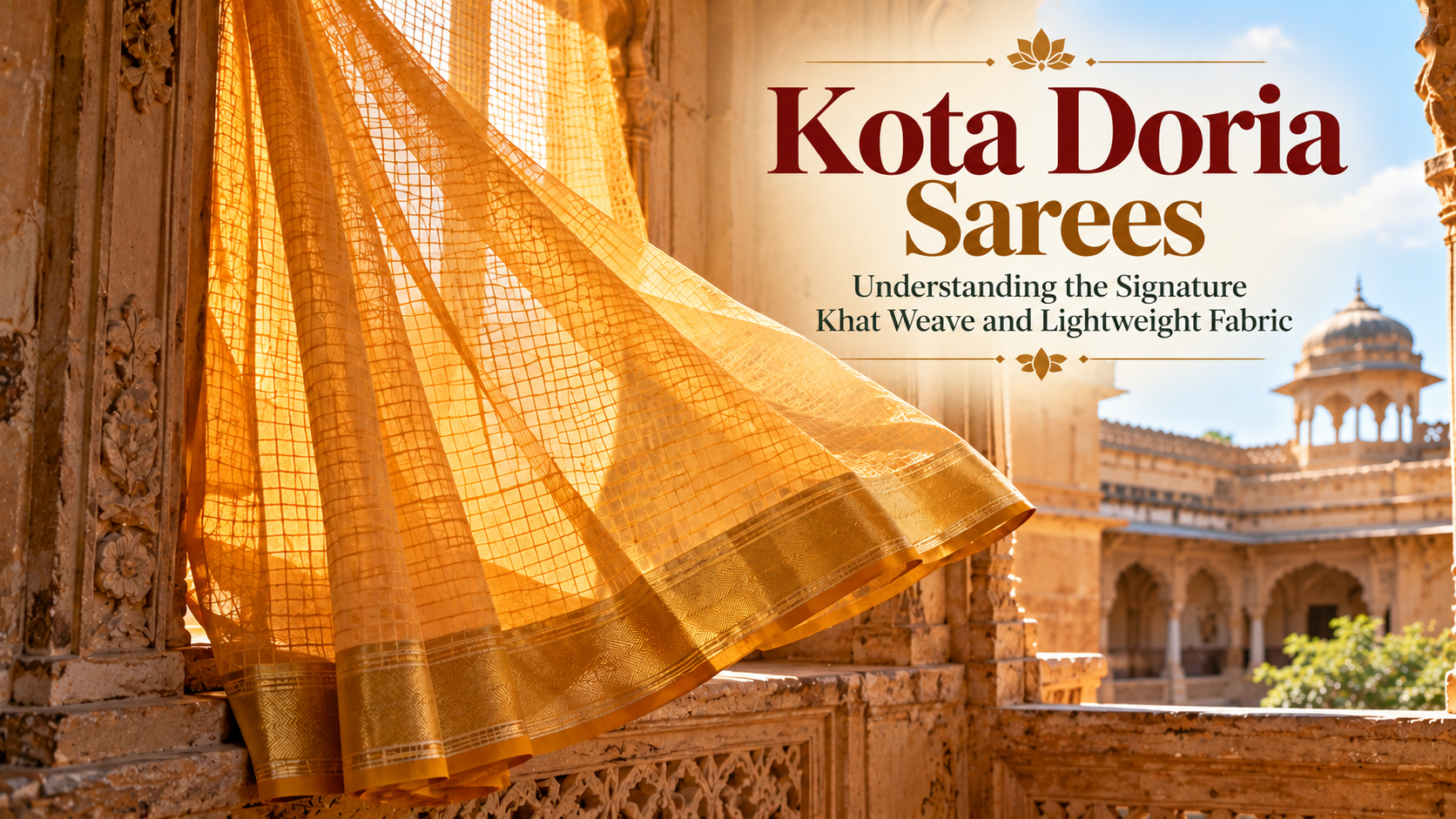
Hold a Kota Doria saree against a window and a fine grid appears across the whole fabric: tiny squares, each framed by slightly denser lines, with open, almost see-through spaces in between. That grid is the khat, and it is not printed, embroidered or added afterwards. It forms as the fabric is woven, through the way two different yarns are arranged on the loom.
This guide explains where the Kota Doria saree comes from, how the khat is built into the weave, how cotton, silk and cotton-silk versions differ, and what to look for in fibre and weaving descriptions.
The Kota Doria weaving tradition
Kota Doria is woven mainly in Kaithoon, a village about 20 km from Kota city in south-eastern Rajasthan, and in surrounding villages of the Kota region. Doria is generally explained as meaning “thread”, a reference to the fabric’s fine, thread-defined structure.
Origins and the name Masuria
The commonly recorded history links the weave to weavers from Mysore who were brought to Kota in the late 17th or early 18th century, often credited to Rao Kishore Singh, a Kota ruler who served as a general in the Mughal army. Locally the fabric has long been called Kota Masuria. Sources explain “Masuria” in two ways: as a reference to Mysore, the weavers’ place of origin, or to masoor (red lentil), because the finest checks were said to resemble lentil seeds. Both explanations appear in published accounts, so it is fair to treat the name’s origin as uncertain.
The fabric was used for turbans (pagri) as well as saris. Over time the saree became its best-known form, and the name “Kota Doria” spread outside Rajasthan.
Geographical Indication
Kota Doria received Geographical Indication registration in 2005, with an application supported by a Kota weavers’ foundation and the United Nations Industrial Development Organisation (UNIDO). The GI application identifies the khat pattern as the main distinguishing feature of true Kota Doria fabric. The GI protects the name for handwoven fabric from the registered Kota region.
What the khat is
The khat is the small square check that runs across the entire fabric. It is a structural feature, not a surface decoration.
How the khat forms
Kota Doria is woven from two kinds of yarn, typically cotton and silk, arranged in groups in both the warp (lengthwise threads) and the weft (crosswise threads).
The traditional arrangement recorded in GI and craft documentation is 14 yarns per khat: 8 cotton and 6 silk, repeated in both directions. Government handloom sources describe the khat as formed by putting cotton and silk yarns in different densities in both warp and weft.
The two yarns behave differently in the fabric:
- Cotton yarns are slightly thicker and more opaque. Grouped together, they form the visible lines of the grid. Government sources describe cotton as giving a stripe effect.
- Silk yarns are very fine and lustrous. Grouped together, they form the more transparent areas between the lines.
Where cotton groups cross in both directions, a denser square outline forms. Where silk groups cross, a sheer, open patch appears. Repeated across the width and length, this creates the grid. Government handloom documentation also notes that each small check contains four micro-checks, which gives the fabric a layered, slightly shimmering visual effect.
Khat count
A good-quality traditional Kota Doria saree is described in government sources as having about 300 to 350 khats across its width. With 14 yarns per khat, that means several thousand warp threads across the fabric. Khat counts vary between pieces and varieties, and the GI documentation records different traditional standards for different fibre combinations.
The weaving process
General saree-making stages are covered in our guide to the saree making process. This section focuses on what is specific to Kota Doria weaving.
Yarn preparation
Fine combed cotton and degummed silk are the traditional base yarns. Craft documentation records cotton counts in the range of 80s to 120s, which is very fine. Zari is used for decorative borders and motifs in some pieces.
Strengthening the yarn
Before weaving, the cotton warp is sized to strengthen it. The traditional sizing is a rice paste known as maandi, and many sources also describe weavers using onion juice with it. This step helps the very fine cotton survive the stress of weaving, and accounts say it leaves the finished fabric firm enough to need little further finishing.
Warping and drafting
Cotton and silk warp threads are laid out in the 8-and-6 sequence across the full width. The threads are then passed through the heald eyes in a planned order, known as drafting, so that the grid structure and any border designs come out correctly.
Weaving on the pit loom
Kota Doria is traditionally woven on a throw-shuttle pit loom. The weaver passes cotton and silk weft in the same grouped sequence, so the grid forms in both directions. Designs such as borders and buttis are added with extra warp or extra weft, controlled by a jala or jacquard system.
Because the yarns are very fine and the sequence must be kept exactly, Kota Doria weaving is slow, careful work.
Texture, transparency and weight
The khat construction gives Kota Doria a distinctive feel:
- Transparency: The silk areas are sheer, so the fabric is semi-transparent overall, more so in cotton-silk and silk versions.
- Texture: The grid gives the surface a subtle, crisp texture. It feels slightly structured rather than limp.
- Weight: Traditional Kota Doria is very light because of the fine yarns and open structure.
- Breathability: The open areas allow air to pass through.
These qualities are typical of traditional pieces. Individual products vary depending on fibre, khat count and how much zari or extra-weft decoration is added. A Kota Doria with dense zari borders and buttis will be heavier and less sheer than a plain one.
Kota Doria fabric variations
The GI documentation lists several fibre combinations for Kota Doria, including cotton x cotton, cotton x silk and tussar silk x tussar silk. “Kota Doria” therefore describes the khat weave and region, not a single fibre.
Cotton-silk Kota Doria
The most traditional and widely made form combines cotton and silk in the khat structure. One commonly cited estimate puts the blend at roughly 80 percent cotton and 20 percent silk, though the proportion depends on the yarns and construction. The cotton gives strength and the grid lines; the silk gives sheen and transparency.
Kota Doria cotton saree
A pure cotton Kota Doria uses cotton in both warp and weft. The khat is still formed by varying yarn grouping and density, but the contrast between grid lines and open areas is softer and the fabric is matte. Cotton Kota Doria is well suited to everyday wear.
Kota Doria silk saree
Silk Kota Doria uses silk throughout, sometimes tussar. It has a stronger sheen and a softer, more fluid drape. Silk versions have become more popular in recent years and are often chosen for festive wear.
Zari and decorated Kota Doria
Many Kota Doria sarees add zari borders, pallus or buttis. Traditional pieces used small, regular buttis; larger and more elaborate designs are now common. The zari may be tested or imitation metallic thread, and older GI-related accounts mention real silver and gold zari in fine pieces.
Blends and synthetics
“Kota Doria” is also used loosely for powerloom fabrics, sometimes in polyester or viscose, that imitate the grid. These are cheaper and easier to care for but are a different product from handloom Kota Doria. For a broader explanation of how fibre blends change feel and value, see our article on silk saree vs silk blend saree.
Woven khat vs printed check
Because the khat looks like a check, printed fabrics can imitate it. The difference lies in where the pattern comes from.
| Feature | Woven Kota Doria khat | Printed check imitation | Woven gingham or yarn-dyed check |
| How the grid forms | Different yarns (or yarn densities) grouped in warp and weft | Colour printed onto finished fabric | Different coloured yarns in warp and weft |
| What creates the lines | Thicker, denser yarn groups | Ink or dye on the surface | Colour contrast, not density |
| Transparency | Varies across the grid: denser lines, sheerer squares | Uniform; the base fabric is the same everywhere | Usually uniform |
| Texture | Subtle raised grid you can feel | Flat; no change in feel | Flat to slightly textured |
| Back of fabric | Grid looks the same, since it is part of the structure | Pattern often paler or faint | Pattern visible on both sides |
| Held to light | Grid stands out clearly as lines and windows | Printed lines show, but no change in sheerness | Little change in sheerness |
The most useful single check is to hold the fabric up to light. In woven khat, the grid appears as lines of denser thread with sheerer windows between them. In a printed check, the lines are only colour, so the fabric’s transparency stays the same throughout. Some powerloom fabrics also weave a khat-like structure, so a woven grid shows the construction type but not, on its own, that the piece is handloom or from Kota.
What to look for in a Kota Doria description
Product listings vary widely. Reading them carefully helps you understand what you are actually buying. Our complete saree buying guide covers general budget, occasion and selection advice across all sarees; the points below are specific to Kota Doria.
Fibre
Look for a clear statement: “pure cotton”, “cotton-silk” or “pure silk”. A listing that says only “Kota Doria” or “Kota” may be any of these, or a synthetic.
Weaving method
“Handloom” or “handwoven” claims hand weaving. “Kota Doria style”, “Kota check” or “Kota print” usually indicate powerloom or printed fabric.
Origin and certification
A description that names Kaithoon or Kota makes an origin claim. GI-linked labels and the Government of India Handloom Mark support handloom and origin claims. Some accounts mention a GI mark woven into a corner of certified pieces. Not every genuine piece from a small weaver carries a label, so its absence is a reason to ask questions rather than proof of imitation.
Zari
If the saree has a zari border or buttis, ask whether the zari is real, tested or imitation.
Construction details
Some sellers mention khat count or yarn counts. These are useful indicators of fineness, though not every listing includes them.
How Kota Doria compares with other light weaves
Kota Doria is sometimes grouped with other light cotton and silk handlooms. The main difference is that its identity comes from the woven grid itself. Bengal’s tant sarees, covered in our article on types of Bengali sarees, are also light cotton handlooms, but their character comes from crisp starched cotton and decorative borders rather than an all-over khat structure. Chanderi and Maheshwari sarees from Madhya Pradesh share the silk-and-cotton fibre mix, but Chanderi is known for its sheer ground and scattered buttis, and Maheshwari for stripes, checks and its reversible border.
Caring for a Kota Doria saree
The fine yarns and open structure need gentle handling.
- Dry clean silk, cotton-silk and zari pieces.
- Hand wash pure cotton Kota Doria gently in cold water if the label allows; do not wring or scrub.
- Many owners re-starch cotton Kota Doria lightly to restore its crispness.
- Dry flat or in shade.
- Iron on low to medium heat, with a cloth over zari.
- Store folded in cotton cloth and refold periodically to protect the fine threads.
Conclusion
A Kota Doria saree is defined by its khat: a grid created not by printing or embroidery but by grouping cotton and silk yarns in both directions on the loom, traditionally 8 cotton and 6 silk per square. That structure gives the fabric its sheer windows, faint texture and light weight, and it is what the GI registration protects. Within the tradition, pieces can be cotton, cotton-silk or silk, plain or decorated with zari, handwoven or machine-made, so the fibre, weaving method and origin details in a description matter as much as the look. Understood this way, Kota Doria is easy to recognise and easy to appreciate.
Frequently asked questions
Where is Kota Doria woven?
Kota Doria is woven mainly in Kaithoon village, about 20 km from Kota in Rajasthan, and in surrounding villages of the Kota region.
What is the khat in a Kota Doria saree?
The khat is the small square grid that runs across the fabric. It forms during weaving by grouping cotton and silk yarns in both warp and weft, traditionally 8 cotton and 6 silk per square.
Is a Kota Doria saree made of cotton or silk?
It can be either or both. Traditional Kota Doria combines cotton and silk, but pure cotton and pure silk (including tussar) versions are also woven.
Why is Kota Doria so light?
It is woven from very fine yarns in an open structure, with sheer silk areas between the cotton grid lines. Pieces with heavy zari or dense motifs are heavier.
How can I tell a woven khat from a printed check?
Hold the fabric to light. In a woven khat, the grid lines are denser and the squares more sheer. In a printed check, the transparency stays the same throughout and the pattern is often paler on the back.
Does Kota Doria have a GI tag?
Yes. Kota Doria received Geographical Indication registration in 2005 for handwoven fabric from the Kota region.
What is Kota Masuria?
Kota Masuria is the traditional local name for the fabric. It is often linked to Mysore, the weavers’ place of origin, or to the lentil-sized checks of the finest pieces.
How should I wash a Kota Doria saree?
Dry clean silk, cotton-silk and zari pieces. Plain cotton Kota Doria can usually be hand washed gently in cold water, dried in shade and lightly re-starched.
