
Blog
Kanjivaram Saree Weaving: Korvai Borders, Zari and Traditional Design Techniques

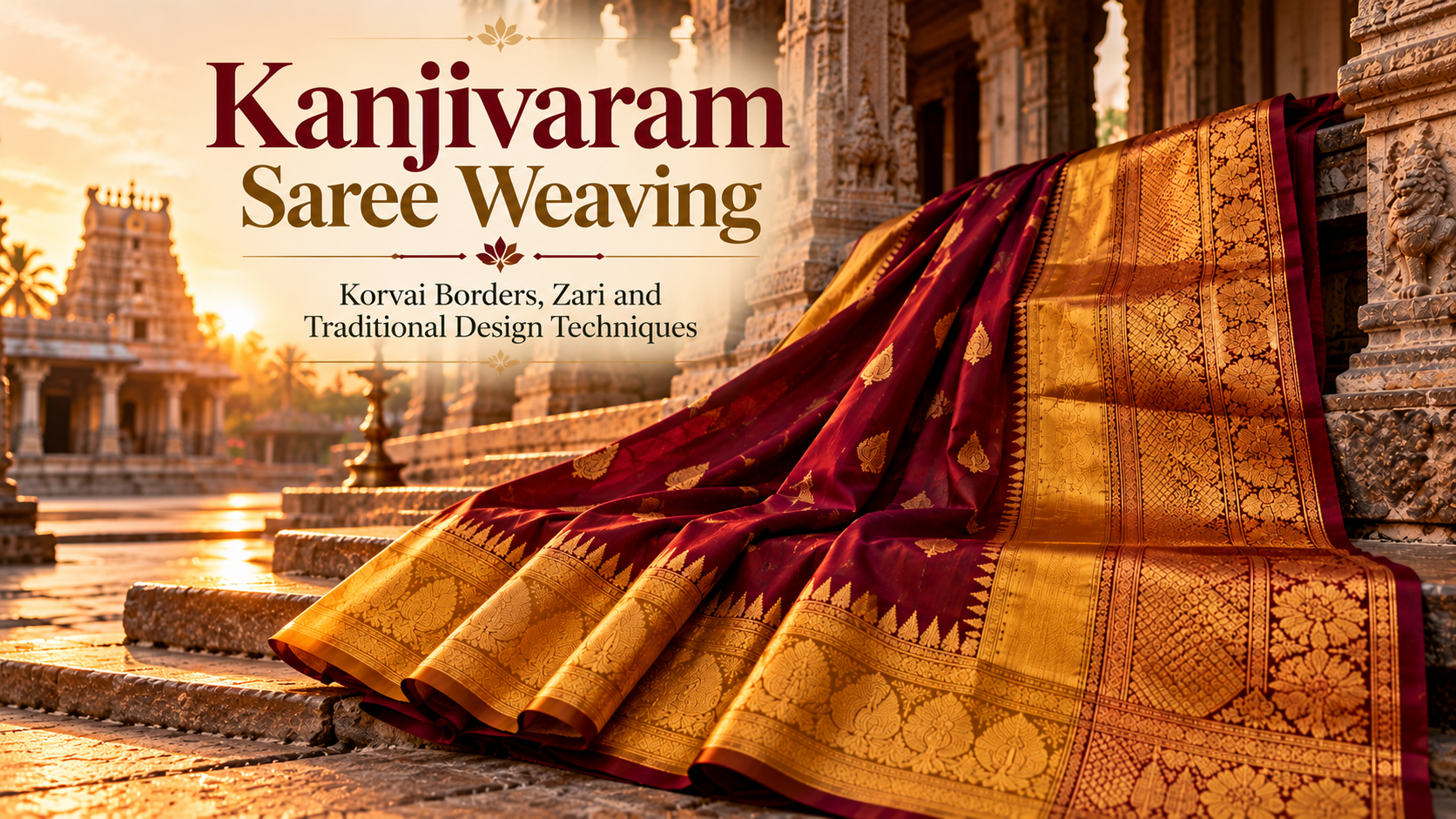
Run a thumb along the edge of a traditional Kanjivaram where a deep maroon body meets a mustard border, and you can feel a faint toothed line. That line is not a seam. It is the point where two separate weft threads, carried by two shuttles, have been hooked into each other on the loom, row after row, for the full length of the saree.
That joint is the best-known feature of Kanjivaram saree weaving, but it is only one of several techniques that give the saree its weight, structure and look. This article explains how a Kanjivaram is built: the loom, the yarns, the korvai border, the petni pallu, the adai zari work, and how each choice affects the finished saree.
The Kanchipuram weaving tradition
Kanchipuram (also spelled Kancheepuram) is a temple town in Tamil Nadu, about 70 km from Chennai. Silk weaving there is closely tied to the town’s temples, and many traditional motifs draw on temple architecture and sculpture. The Devangar and Saliyar weaving communities are among those historically associated with the craft.
“Kancheepuram Silk Sarees” is a registered Geographical Indication (GI No. 15, conferred in 2005). Government handloom sources state that the GI sets standards for the saree, including the region of production, the use of mulberry silk and the composition of the zari. The name “Kanjivaram” is a popular spelling of the same tradition.
The anatomy of a Kanjivaram saree
Before looking at technique, it helps to name the parts, because different techniques are used for each.
- Body (udal): the main field of the saree. It may be plain, checked, striped or covered with small motifs called buttas.
- Border: the band along one or both long edges. Traditional Kanjivarams often have borders in a contrasting colour, frequently with zari patterns.
- Pallu (mundhi): the decorative end piece that falls over the shoulder. It usually carries the densest zari work and may be in a different colour from the body.
- Zari: metallic thread used for borders, pallu and motifs.
The way a weaver joins body and border, and body and pallu, is what separates the main Kanjivaram weaving techniques.
Materials: silk and zari
Silk yarn
Government handloom documentation describes Kanchipuram sarees as woven from mulberry silk, normally with 2-ply silk in the warp (lengthwise threads) and 3-ply silk in the weft (crosswise threads). Plying twists single filaments together into a thicker, stronger thread. The 3-ply weft is a major reason traditional Kanjivarams feel heavier and firmer than many other silk sarees.
Silk weight and ply vary between pieces, and lighter Kanjivarams are also made. Fibre content is a separate question from weaving technique; our article on silk saree vs silk blend explains how fibre changes feel and value.
Zari
Traditional Kanjivaram zari is made by wrapping flattened silver wire around a silk core thread, then electroplating the silver with gold. The GI documentation specifies proportions of silver and gold for zari used in GI-standard sarees, though published figures vary between sources.
Not every saree sold as Kanjivaram uses this kind of zari. Tested zari (copper-based) and imitation metallic thread are widely used in lower-priced pieces. Whether a given saree uses traditional zari is a material question, answered by the product description or certification, not by the weaving technique.
The loom
Pit looms and throw shuttles
The traditional Kanjivaram is woven on a pit loom, where the weaver sits at ground level with their legs in a pit below the loom to work the treadles. Government sources describe the traditional method as weaving on a throw-shuttle pit loom, with two weavers working together for contrast borders.
Jacquard attachments
Today, most Kanjivaram looms carry jacquard attachments. A jacquard uses punched cards (or, in newer setups, electronic controls) to lift selected warp threads, so complex border and pallu patterns can be woven without lifting each thread by hand. Government handloom sources note that many sarees are now woven using two or three jacquards, one each for border, body and pallu.
A jacquard does not make a saree powerloom-made. The loom is still operated by hand; the jacquard only controls pattern selection.
Stage by stage: how a Kanjivaram is woven
1. Yarn preparation and dyeing
Raw silk is degummed, then dyed in the colours planned for body, border and pallu. Because Kanjivarams often use strongly contrasting colours for each part, dyeing is planned around the design from the start.
2. Design and pattern setup
The design is drawn as a graph, and for jacquard weaving it is translated into a set of punched cards that will control which warp threads lift for each pass of the shuttle.
3. Warping
The warp is prepared and set on the loom. Map Academy, a textile research resource, notes that a warp of about 18 metres can weave three 6-metre sarees. For contrast borders, warp threads of the border colour are set along the edges alongside the body-colour warp.
4. Weaving the body and border
The weaver passes the weft across the warp. In a contrast-border saree, this is where the korvai technique (explained below) joins body and border colours.
5. Adding zari patterns
Zari motifs in the border, body and pallu are woven in using supplementary weft threads, traditionally with the adai technique.
6. Changing to the pallu
When the body is complete, the weaver switches to the pallu, often in a different colour, using the petni technique.
7. Finishing
The saree is cut from the loom, trimmed and checked.
Korvai: the contrast border technique
Korvai is a Tamil term generally understood as “joining” or “interlocking”. In weaving, it describes the method of joining a solid contrast-colour border to the body of the saree.
How korvai works
In a plain saree, one weft thread runs all the way across the warp, from edge to edge. In a korvai saree, the border and the body need different colour wefts. So instead of one weft, the weaver uses:
- one shuttle carrying the body-colour weft across the centre, and
- two shuttles carrying the border-colour weft, one for each border.
At the point where body and border meet, the body weft and border weft are looped around each other, so they interlock instead of simply sitting side by side. This happens on every pass, along the entire length of the saree.
Government handloom sources describe this as weaving the contrast border with three shuttles, two for the borders and one for the body. Traditionally two weavers work on the loom at the same time, one on each side, to manage the shuttles.
What korvai looks like
- The border is a solid, separate colour, not a print or dye effect.
- A faint interlocking line or slight toothed edge runs along the join, visible on both the front and back.
- The border colour runs all the way through the fabric, so the back looks similar to the front.
Korvai can be one-sided (contrast border on one edge) or double-sided (both edges). It is labour-intensive and slow, which is why korvai sarees are generally more expensive than sarees where body and border share a single weft.
Petni: joining a contrast pallu
The korvai method changes the weft colour across the width. A different problem arises at the pallu, where the entire warp colour often needs to change.
Petni is the technique used for this. Government handloom documentation describes it as follows: after the body is woven, a separate warp in the pallu colour is joined to the existing body warp. The two warps are woven together for about an inch, then the old body warp is cut off and the ends are neatly trimmed. The pallu is then woven in its own colour.
Map Academy describes the join being made by loop-twisting the new and old warp threads on the heald wires of the loom.
What petni looks like
The join between body and pallu is often visible as a zigzag or toothed line running across the width of the saree. Close up, the trimmed ends of the two warps can sometimes be seen on the reverse.
This line is sometimes called the body-pallu joint. Petni allows a saree to have a pallu in a completely different colour from the body, which is one of the most recognisable features of a traditional Kanjivaram saree.
Adai: extra-weft zari patterning
The ornate zari patterns in Kanjivaram borders and pallus are usually created with supplementary weft: extra zari threads that are added only where the pattern is needed, rather than running continuously across the whole width.
The traditional term is adai. In jacquard weaving, the jacquard lifts the correct warp threads, and the weaver passes the zari weft through to build the pattern row by row. In heavier pieces, the zari is packed densely enough to look embossed. On the back of the fabric, floats of zari can often be seen where the extra weft passes behind the ground between motifs.
Adai is the technique that produces most of what people think of as Kanjivaram zari work: temple borders, mango and peacock motifs in the pallu, and buttas across the body.
How the parts work together in the finished design
The body
A Kanjivaram body may be plain, checked (kattam), striped (vari) or scattered with small zari or silk buttas. A plain or lightly patterned body sets off the heavier border and pallu.
The border
The border frames the saree and often sets its overall character. Traditional borders feature temple towers (gopuram), rudraksha beads (rudraksham), peacock’s eye (mayilkan) and nightingale’s eye (kuyilkan), along with arm-jewel (vanki), mango and creeper motifs. In a korvai saree, the solid contrast border is a strong visual frame in its own right, even before zari is added.
The pallu
The pallu is the showpiece. It usually carries the densest adai zari work and, through petni, may be a different colour from the body. Traditional pallus often use rows of motifs separated by zari bands; contemporary designs sometimes include figurative scenes.
Colour
Traditional Kanjivarams often use deep tones such as arakku (red), manjal (yellow) and peacock blues and greens, with borders in strongly contrasting shades. Contemporary pieces range from pastels to bold, unusual colour pairings, but the contrast between body, border and pallu remains a defining design idea.
Weaving features and their visual effects
| Weaving feature | What it is | How it is done | Visual effect | Effect on structure |
| Korvai | Contrast-colour border joined to body | Three shuttles; body and border wefts interlocked at each pass | Solid contrast border with a faint interlocking line, same on both sides | Very durable join along the length; adds time and cost |
| Petni | Contrast-colour pallu joined to body | New warp joined to old warp, woven together, old warp trimmed | Zigzag or toothed line across the width at the pallu | Firm joint across the width; allows a full colour change |
| Adai (extra weft) | Zari or silk patterns added only where needed | Supplementary weft passed through lifted warps | Raised, often embossed-looking zari motifs | Adds weight and stiffness in patterned areas |
| Jacquard patterning | Mechanical selection of warp threads | Punched cards or electronic control lift warps | Complex, repeatable border and pallu designs | No change in structure; speeds up pattern work |
| 3-ply silk weft | Thicker, stronger crosswise thread | Three silk filaments plied together | Rich, full surface | Heavier, firmer drape |
| Same-warp border (no korvai) | Border and body share one weft | Single shuttle across the full width | Border colour or pattern created by warp or extra weft, no interlocking line | Faster to weave; usually lighter and less costly |
Technique, design and material: keeping them separate
Product descriptions often blur three different kinds of claim. Keeping them apart makes a Kanjivaram easier to understand.
- Weaving technique describes how the saree was built: korvai, petni, adai, jacquard, handloom.
- Design feature describes how it looks: contrast border, temple motifs, checked body, zari pallu.
- Material claim describes what it is made of: mulberry silk, silver-based zari, tested zari, blended fibre.
A saree can have a contrast-coloured border that looks like korvai but is actually woven in a single weft with a different warp colour or extra weft, so a design feature does not prove a technique. Likewise, korvai and petni say nothing about whether the silk is pure or the zari is silver-based. Each claim needs its own evidence, whether from the description, the seller or certification such as the Silk Mark or GI-linked labels.
How construction affects the finished saree
Weight and drape
Heavy 3-ply weft, dense adai zari and korvai borders all add weight. A traditional Kanjivaram is noticeably heavier than many other silk sarees and holds crisp pleats. That weight also affects how it drapes: pleats stay structured and the pallu falls in firm folds. Our saree draping styles for beginners article includes tips that apply well to heavier silks.
Durability
Korvai and petni both create strong, interlocked joins, which is one reason well-made Kanjivarams are known for lasting through years of wear and being passed down in families.
Size
Traditional Kanchipuram sarees were often longer than today’s standard 5.5 to 6.3 metres, and contemporary lengths and widths vary. For how saree dimensions affect draping, see our saree length and width guide.
Caring for a Kanjivaram
Construction shapes care. Dense zari and heavy silk are best dry cleaned. Store the saree folded in cotton or muslin, away from damp, and refold every few months so zari does not crack along fixed creases. Avoid hanging it for long periods, since the weight can stretch the fabric. Keep perfume away from zari, which can tarnish.
You can browse current styles in our saree collection.
Frequently asked questions
What is korvai weaving in a Kanjivaram saree?
Korvai is a technique for joining a solid contrast-colour border to the body. The body and border wefts are carried by separate shuttles, usually three in total, and interlocked at the join on every pass.
What is the petni technique?
Petni is used to give the pallu a different colour from the body. A new warp in the pallu colour is joined to the old body warp, woven together briefly, and the old warp is trimmed off.
Why does a Kanjivaram have a zigzag line near the pallu?
That line usually marks the petni join, where the body warp ends and the pallu warp begins.
What is adai in Kanjivaram weaving?
Adai refers to extra-weft patterning, where zari or silk threads are added only where a motif is needed. It produces most of the zari designs in borders, pallus and buttas.
Is every contrast border on a Kanjivaram woven with korvai?
No. A contrast colour can also be achieved by changing the warp colour along the edge or by using extra weft, without interlocking. Korvai is identified by its interlocking join, not by colour alone.
Does using a jacquard mean a saree is machine-made?
No. A jacquard is an attachment that selects warp threads for patterning. The loom can still be hand-operated, as in most Kanchipuram handloom weaving today.
What is Kanjivaram zari made of?
Traditional Kanjivaram zari is flattened silver wire wrapped around a silk core and electroplated with gold. Many sarees today use tested or imitation zari instead, so the description should state the type.
Why are Kanjivaram sarees heavy?
Heavy 3-ply silk weft, dense zari work and the extra threads used for korvai borders and adai patterns all add weight and stiffness.
