
Blog
Sambalpuri Sarees: Understanding Odisha Ikat Weaving and Traditional Motifs

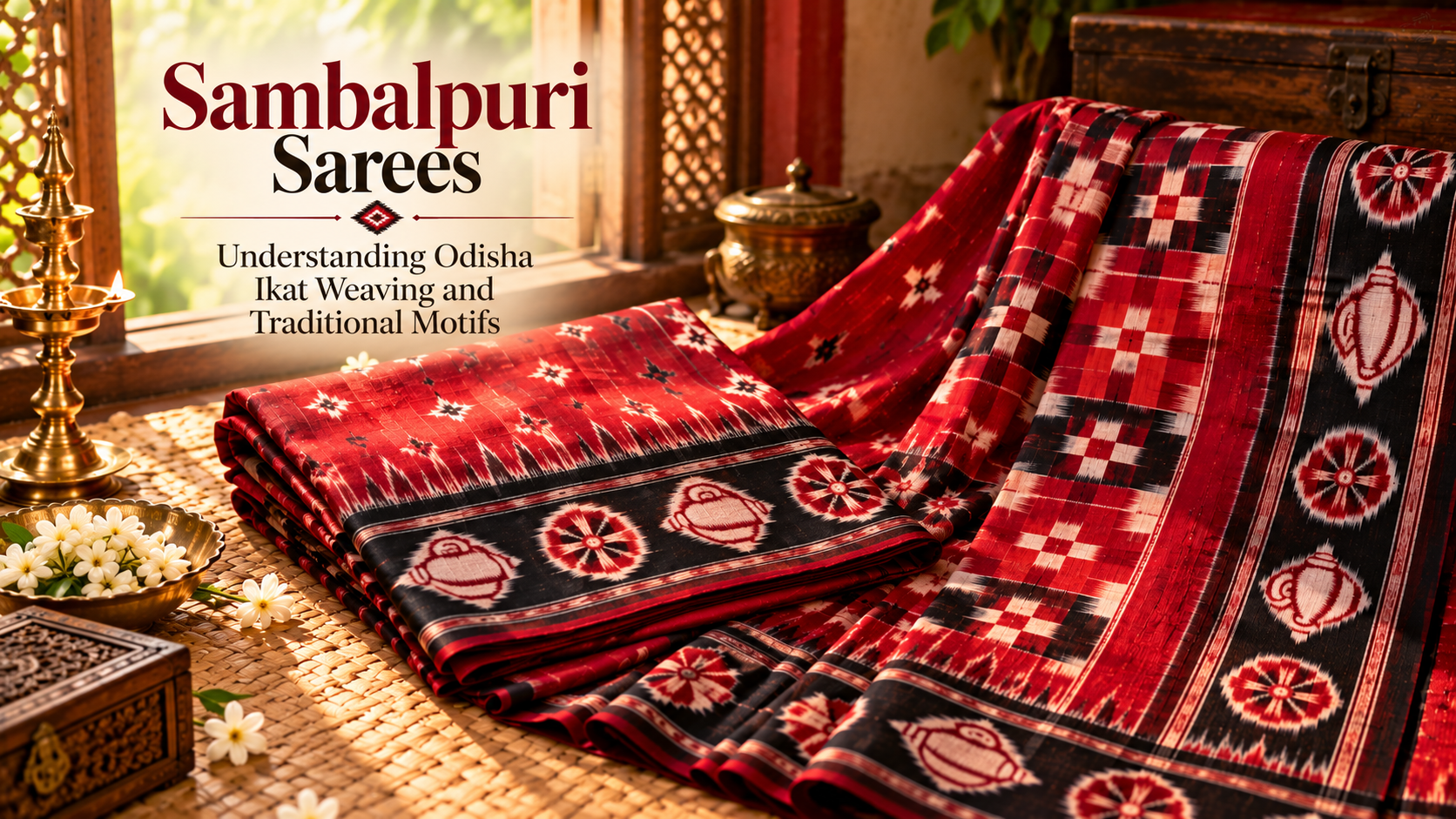
Look closely at the border of a Sambalpuri saree and the edges of each motif seem slightly feathered, as though the colour has softened into the next shade. That soft edge is not a flaw. It is the mark of a technique in which the pattern is dyed into the threads before a single row is woven. The design exists in the yarn first and only becomes a picture when the weaver lines everything up on the loom.
This guide explains where the Sambalpuri saree comes from, how bandha (Ikat) yarn is prepared and woven, what the traditional motifs are, and how to tell woven Ikat from printed imitations.
The Sambalpuri textile tradition
A Sambalpuri saree is a handwoven Ikat saree from western Odisha. Locally the technique is called bandha, an Odia word meaning “tied”, which refers to tying sections of yarn before dyeing.
The tradition takes its name from Sambalpur, but production is spread across several districts of western Odisha, including Sambalpur, Bargarh, Balangir (Bolangir), Subarnapur (Sonepur) and Boudh. Different weaving centres have their own specialities, and several well-known names, such as Sonepuri, Pasapali, Barpali and Bomkai, refer to towns, villages or styles within the wider Odisha handloom tradition.
The craft is closely associated with the Bhulia (also called Meher) weaving community of western Odisha. Popular accounts trace the community’s arrival in the region to a migration from northern India in the medieval period, but these accounts rest largely on oral tradition, so it is fair to treat the exact story with some caution.
Geographical Indication protection
“Sambalpuri Bandha Saree & Fabrics” is a registered Geographical Indication. Intellectual Property India’s GI register lists it as a handicraft from Odisha. Odisha Ikat is registered separately, and other Odisha weaves such as Bomkai and Habaspuri hold their own GI registrations. The GI protects the name for products made in the registered region by the traditional method.
As with most regional weaves, the word “Sambalpuri” is also used loosely in the market for any saree with Sambalpuri-style motifs, whether woven or printed. That is why the later sections on reading product descriptions matter.
What Ikat means
Ikat is a family of techniques in which yarn is resist-dyed before weaving. Sections of the threads are tightly bound so the dye cannot reach them. After dyeing, the binding is removed, leaving a pattern of coloured and undyed sections along each thread. When the weaver sets these threads on the loom and weaves them in the right order, the coloured sections line up to form motifs.
The key point is that the pattern is created in the yarn, not on the fabric. This is what separates Ikat from block printing, screen printing or digital printing, where colour is applied to cloth that has already been woven.
Single Ikat and double Ikat
Ikat can be done on one set of threads or both:
- Warp Ikat: only the lengthwise (warp) threads are tie-dyed. The weft is a solid colour.
- Weft Ikat: only the crosswise (weft) threads are tie-dyed. The warp is a solid colour. Weft Ikat is widely used in Odisha, especially for the body motifs of Sambalpuri sarees.
- Double Ikat: both warp and weft are tie-dyed. The motifs appear only where the dyed sections of both sets of threads meet exactly. This requires precise planning and alignment, and double Ikat weaving is considered one of the most demanding forms of handloom work.
A single Sambalpuri saree may combine these methods, for example a weft Ikat body with a double Ikat border or pallu. Pasapali, the chessboard-style pattern, is a well-known example where double Ikat creates sharp checks.
How a Sambalpuri saree is made
The work divides into two broad stages: preparing the patterned yarn, then weaving it. Most of the skill, and most of the time, goes into the first stage.
Stage 1: Yarn preparation
Designing the pattern. The design is worked out first, either on graph paper or from a master pattern held by the weaver. Each motif is broken down into a grid that tells the tier which sections of thread to tie for each colour.
Arranging the threads. Yarn for the weft (or warp, for warp Ikat) is wound onto a frame so that many threads lie side by side in bundles. Each bundle will later become one or more rows in the woven saree.
Tying (bandha). The tier wraps sections of the bundles tightly, traditionally with cotton thread and now often with rubber or plastic strips, to block the dye. Each tied section corresponds to a spot in the final pattern that must stay undyed for that colour.
Dyeing. The bundles are dyed. For multi-coloured designs, the process is repeated: some ties are opened, new ones are added, and the yarn goes into the next dye bath. A design with several colours needs several rounds of tying and dyeing. Lighter colours are usually dyed first, and darker colours later.
Untying and winding. After the final dye bath, all ties are removed and the threads are carefully separated and wound onto bobbins or pirns in the exact order they will be woven. Keeping this order is essential; if threads are mixed up, the motif will not form.
Stage 2: Weaving
Setting the loom. The warp is set up on the handloom. For double Ikat, the tie-dyed warp threads must be laid in precise sequence so that their dyed sections are in position.
Weaving and aligning. As the weaver passes each weft thread across, they adjust it slightly so its coloured sections land exactly where they should. Pattern alignment happens row by row, by eye and by hand. This adjustment is what produces the characteristic soft, slightly stepped edges of Ikat motifs.
Borders and pallu. Borders are often woven with a separate set of warp threads in a contrasting colour, and some include extra-weft patterning. The pallu is planned as a distinct section of the design, usually with denser or larger motifs.
Finishing. The completed saree is cut from the loom, checked for flaws and finished.
Because each saree depends on planning, tying, multiple dye baths and careful alignment, an intricate Sambalpuri Ikat saree takes considerably longer to produce than a printed one. The exact time varies by design and workshop.
Traditional Sambalpuri saree motifs
Sambalpuri saree motifs draw on the religious and everyday life of Odisha. The motifs most consistently documented in handloom and GI-related sources are:
- Shankha (conch): a sacred object in Hindu worship, associated with Lord Vishnu and with the Jagannath tradition of Puri.
- Chakra (wheel): another symbol linked to Vishnu and Jagannath.
- Phula (flower): stylised flowers, used both as body motifs and in borders.
- Animals and birds: deer, elephants, fish, peacocks and other figures, especially in pallus.
- Temple borders: stepped or spire-like forms often described as temple motifs.
- Geometric patterns: diamonds, checks and lattices, including the Pasapali check.
Pasapali
Pasapali is a chessboard-like pattern of contrasting squares. It takes its name from pasa, a traditional dice and board game, and is often woven in double Ikat. It is one of the most recognisable Sambalpuri designs and is popular in both traditional and contemporary pieces.
Interpretations of symbolism vary. The link between shankha and chakra and the Jagannath tradition is widely documented. Claims that particular motifs bring specific luck or protection are less consistently sourced, so it is reasonable to see them as local belief rather than established fact.
Colour, borders and pallu in Sambalpuri design
Colour
Traditional Sambalpuri sarees often use a strong palette of red, black and white, along with deep blues, maroons, mustards and greens. The red, black and white combination is often connected with the colours of the Jagannath iconography, though this association comes from popular tradition. Contemporary weavers use a much wider range, including pastels.
Because each colour requires its own round of tying and dyeing, the number of colours in a saree directly affects the time and skill involved.
Pattern alignment
In Ikat, alignment is everything. A well-woven Sambalpuri saree shows motifs that repeat consistently, with crisp placement despite the soft edges of each shape. Slight variation is normal and is part of the handmade look, but a skilled weaver keeps the overall pattern even across the saree.
Borders
Sambalpuri borders are often in a contrasting colour and may carry their own Ikat or extra-weft motifs, such as temple shapes or rows of small flowers. Some sarees use a border that contrasts sharply with the body; others keep it tonal.
Pallu
The pallu is usually the most elaborate part of the saree. It may carry larger motifs, animal figures, rows of shankha and chakra, or a dense Pasapali pattern. The pallu often shows the weaver’s greatest technical skill.
Ikat compared with prints and other patterning methods
The comparison table below focuses on how the pattern is formed, which is the clearest way to understand what you are looking at.
| Feature | Sambalpuri single Ikat | Sambalpuri double Ikat | Printed “Sambalpuri-style” saree | Extra-weft woven motifs |
| When the pattern is created | Before weaving, on warp or weft yarn | Before weaving, on both warp and weft yarn | After weaving, on finished fabric | During weaving, with added threads |
| How the pattern forms | Dyed sections of one thread set align on the loom | Dyed sections of both thread sets meet | Colour applied by block, screen or digital printing | Extra threads inserted across the motif area |
| Edge of motifs | Soft, feathered edge, mostly in one direction | Soft edges, often in both directions | Usually sharp and uniform | Raised or defined edge, threads visible on back |
| Back of the fabric | Pattern visible, nearly as strong as the front | Pattern visible, nearly as strong as the front | Pattern often paler or faint on the back | Loose or cut threads around each motif |
| Production time | Long | Longest | Short | Moderate to long |
| Typical price | Higher | Highest | Lower | Varies |
How to tell Ikat from printed imitations
Printed fabrics can copy Sambalpuri motifs closely, and good-quality prints can even imitate the blurred Ikat edge. No single visual check proves authenticity, but several together give you a reasonable picture.
Check the back. In Ikat, the colour runs through the thread, so the pattern on the back is nearly as clear as on the front. In most printed fabrics, the back looks paler or blurred. This is one of the more reliable checks, though some printing methods penetrate the fabric well.
Look at motif edges. Ikat edges are typically feathered or slightly stepped, following the direction of the dyed threads. Printed edges tend to be sharp and uniform. Some prints deliberately copy the Ikat blur, so treat this as a supporting sign.
Look for repeat variation. Handwoven Ikat shows small differences in motif shape and alignment from one repeat to the next. Perfectly identical repeats suggest printing or machine production.
Read the description. Words like “handloom”, “handwoven Ikat” and “bandha” claim a woven product. “Sambalpuri print”, “Ikat print”, “Sambalpuri design” or “Sambalpuri style” usually indicate printed fabric.
Ask about certification. GI-linked labels and the Handloom Mark from the Government of India support a handloom claim. Not every genuine small-producer saree carries them, so their absence is a reason to ask questions rather than proof of imitation.
Consider the price. Ikat is labour-intensive. A very low price for a saree described as handwoven double Ikat should prompt a closer look.
Reading fibre in a Sambalpuri saree description
Sambalpuri sarees are woven in several fibres:
- Cotton Sambalpuri: breathable and suited to daily and office wear, especially in warm weather.
- Silk Sambalpuri (often called Sambalpuri pata): lustrous and used for festive and ceremonial wear.
- Silk-cotton and other blends: a middle ground in feel and price.
The fibre should always be stated separately from the weaving method. A listing might be “handwoven cotton Sambalpuri Ikat” or “silk Sambalpuri print”, and each tells you something different. For a general explanation of how blended fibres affect feel and value, see our silk vs silk blend guide. Cotton Sambalpuri is a good fit if you are building a hot-weather wardrobe; our article on summer fabric trends covers other breathable options.
Caring for a Sambalpuri Ikat saree
Ikat dyes run through the yarn, but natural and some traditional dyes can still bleed, especially in the first few washes.
- Dry clean silk Sambalpuri sarees.
- Hand wash cotton Sambalpuri separately in cold water with a mild detergent for the first few washes, and check for colour bleeding.
- Avoid soaking and do not wring.
- Dry in shade to protect colours.
- Iron on a medium setting for cotton and low for silk, on the reverse side where possible.
- Store folded in cotton cloth and refold periodically.
Choosing a Sambalpuri saree
A cotton Sambalpuri Ikat saree is a comfortable, distinctive choice for work and daily wear. Silk Sambalpuri suits festivals and family functions, and a double Ikat pallu or Pasapali pattern makes a strong statement piece. Before buying, check the fibre, the weaving method and, where available, the certification. Our saree buying guide covers general budget, occasion and fabric choices.
You can browse current styles in our saree collection.
Frequently asked questions
What is a Sambalpuri saree?
A Sambalpuri saree is a handwoven Ikat saree from western Odisha, in which the yarn is tie-dyed (bandha) before weaving so that the pattern forms on the loom.
Which districts produce Sambalpuri sarees?
Production is centred in western Odisha, including Sambalpur, Bargarh, Balangir, Subarnapur (Sonepur) and Boudh districts.
What is double Ikat weaving?
In double Ikat, both the warp and weft threads are tie-dyed before weaving. Motifs appear where the dyed sections of both sets meet, which requires very precise alignment.
What are the traditional Sambalpuri saree motifs?
Common motifs include shankha (conch), chakra (wheel), phula (flower), animals such as deer and fish, temple borders and geometric patterns like Pasapali.
What is the Pasapali pattern?
Pasapali is a chessboard-like pattern of contrasting squares, named after the traditional board game pasa. It is often woven in double Ikat.
How can I tell a real Sambalpuri Ikat saree from a printed one?
Check whether the pattern is clear on the back, look for feathered motif edges and small variations between repeats, read the description for “handloom” or “Ikat print”, and ask about GI or Handloom Mark labels. No single check is conclusive on its own.
Is a Sambalpuri saree made of silk or cotton?
Both. Sambalpuri sarees are woven in cotton, silk and blends. The fibre should be stated separately from the weaving method in any product description.
Does Sambalpuri Ikat have a GI tag?
Yes. “Sambalpuri Bandha Saree & Fabrics” is a registered Geographical Indication from Odisha, listed in Intellectual Property India’s GI register.
