
Blog
Muga Silk Sarees: Assam’s Golden Silk, Production and Heritage

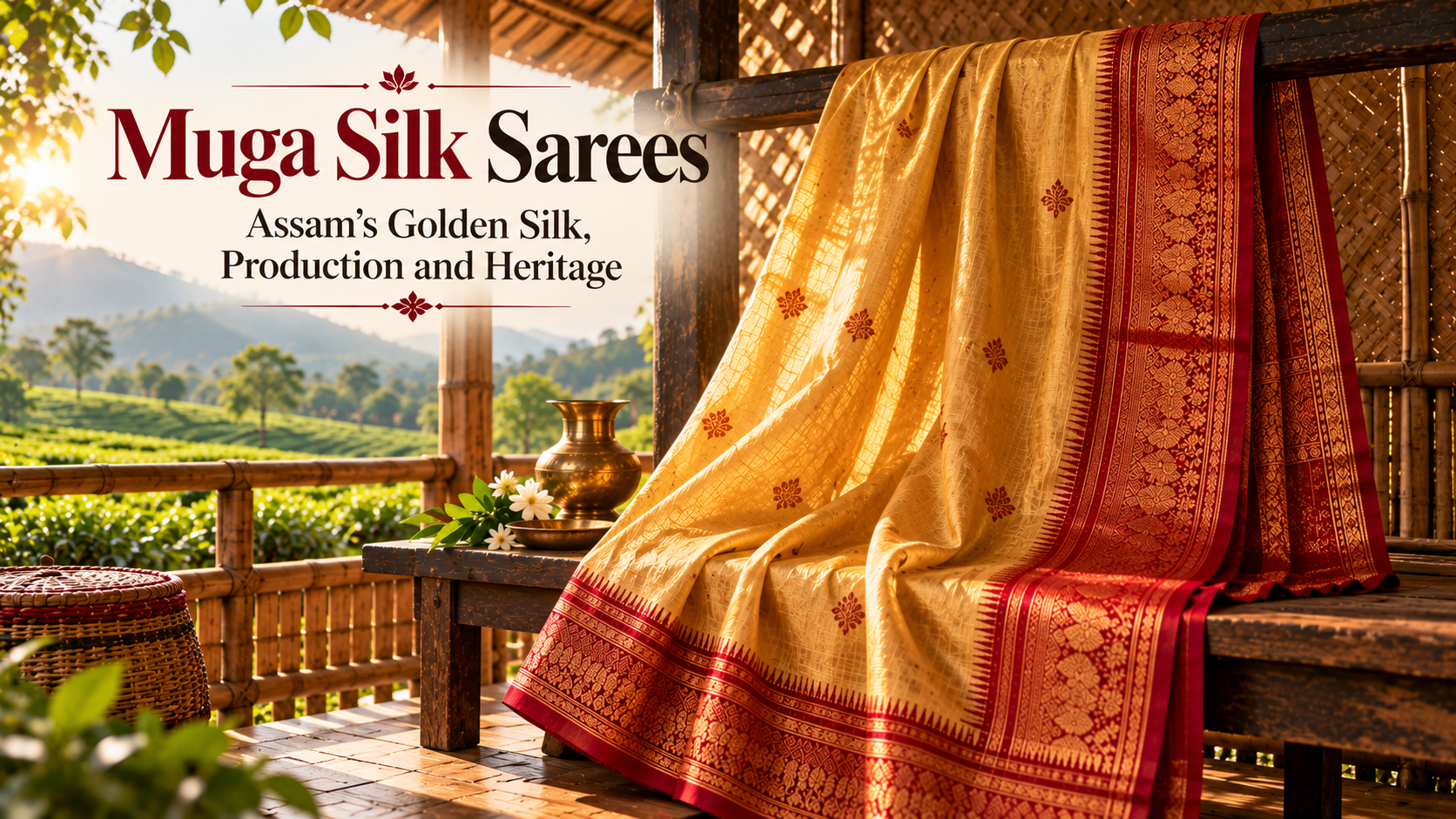
Most silks start out white or cream and get their colour from dye. Muga does not. The thread comes off the cocoon already a warm golden yellow, and a Muga silk saree keeps that colour for years without any dyeing at all. This is why Muga is called the golden silk of Assam, and why it holds a place in Assamese life that no other fabric quite matches.
This guide explains where Muga comes from, how the silk is produced and woven, how it differs from Eri and Pat silk, and how to read product claims when you shop for a Muga silk saree.
What Muga silk is
Muga silk is produced by the silkworm Antheraea assamensis, a species endemic to Assam. It is one of India’s four commercially produced natural silks, alongside mulberry, tasar and eri. Muga, tasar and eri are grouped together as Vanya (non-mulberry or “wild”) silks.
Muga is produced mainly in the Brahmaputra Valley. Government sources state that Assam accounts for about 90 percent of the world’s Muga production. Producing districts named in official programmes include Jorhat, Sivasagar, Lakhimpur, Dhemaji, Dibrugarh, Tinsukia and Majuli, while Sualkuchi near Guwahati is the best-known weaving centre.
Geographical Indication status
“Muga Silk of Assam” is protected as a Geographical Indication (GI). It is widely recorded as receiving GI status in 2007, and a separate GI logo for authentic products was registered later. The Central Silk Board, a statutory body under the Ministry of Textiles, has the authority to inspect Muga products, certify authenticity and permit the use of the GI logo.
In June 2026 the Ministry of Development of North Eastern Region launched Mission Senehjori with the Government of Assam and the Central Silk Board. Its stated aims include regenerating Som and Soalu host plants, modernising reeling and expanding GI authentication of traded Muga silk.
Why Muga silk is golden
The colour of Muga comes from the silk itself, not from any added dye. The silkworm spins a golden-brown cocoon, and the reeled thread carries that natural golden-yellow shade. The Central Silk Board describes this natural golden sheen as Muga’s defining feature.
The silkworm’s diet is closely linked to the fibre. Muga larvae feed mainly on the aromatic leaves of two trees: Som (Persea bombycina, also listed as Machilus bombycina) and Soalu (Litsea polyantha, also listed as Litsea monopetala). Silk from worms raised on different host plants can vary slightly in shade, which is one reason Muga fabrics show natural variation from one batch to another.
Weavers and sellers commonly say that Muga’s lustre brightens with age and washing rather than fading. This is a long-held traditional observation rather than a measured specification, but it reflects real experience: because the colour is not a surface dye, there is little to wash out. Muga is also known as a strong, durable fibre, and well-kept Muga garments are often handed down within families.
One practical consequence of the natural colour is that Muga is usually sold in its own golden shade. It can be bleached and dyed, but this is uncommon, and colour in a Muga saree usually comes from contrast threads used in the motifs or borders.
How Muga silk is produced
A Muga silk saree passes through three distinct stages, usually handled by different people: rearing the silkworms, processing the cocoons into yarn, and weaving the fabric.
Stage 1: Rearing the silkworms
Muga silkworms are semi-domesticated. Unlike mulberry silkworms, which are raised indoors on trays, Muga larvae are reared outdoors on Som and Soalu trees. Rearers place young larvae on the trees and watch them as they feed and grow.
Outdoor rearing makes the crop dependent on weather, host-plant health, pests, predators and disease. Rearers often protect the trees with nets and move larvae to fresh trees when the leaves are used up. The species is multivoltine, meaning it can produce several crops a year, though the yield and quality of each crop vary by season.
When the larvae are ready to spin, they climb down the trees and are collected and placed among dry leaves or twigs, where they spin their cocoons.
Stage 2: Processing cocoons into yarn
Once the cocoons are formed, they are processed so the continuous filament can be unwound. The cocoons are cooked to soften the natural gum (sericin) that holds the filament together, and the filament is then reeled. Several filaments from different cocoons are drawn together to form a single thread of usable thickness.
Reeling is traditionally done on simple hand devices, and newer machines have been introduced to improve speed and consistency. Cocoons that cannot be reeled, such as damaged ones, can be spun into a coarser yarn instead. Reeled Muga yarn is smooth and lustrous; spun Muga yarn is softer and more textured.
Stage 3: Muga silk weaving
The yarn then goes to the weavers. Muga silk weaving in Assam is done mostly on handlooms, traditionally the throw-shuttle or fly-shuttle frame loom, with jacquard attachments used for more complex patterns.
The golden ground of a Muga saree or mekhela chador is plain-woven, and motifs are added with extra-weft threads. Weavers insert coloured, white or zari threads by hand across the motif area as the fabric grows, which is why a densely patterned piece takes much longer to finish than a plain one.
Sualkuchi, with a silk-weaving tradition documented at least since the 17th century, remains the centre of Assam’s silk handloom industry. Its weavers work in both Muga and Pat silk.
Traditional designs and cultural significance
The mekhela chador and the saree
The traditional Assamese garment for women is the mekhela chador, a two- or three-piece set: the mekhela is worn as a wrapped lower garment and the chador is draped over the upper body. Muga is among the most valued fabrics for this set and is worn at weddings, Bihu and other important occasions.
The Muga silk saree is a single-length drape that uses the same fibre, weaving skills and motifs. It has become popular with buyers outside Assam who want Muga in a format they already wear.
Common motifs
Assamese silk weaving has a recognisable set of motifs. These appear in Muga borders, pallus and buttis:
- Floral and creeper motifs: small flowers, vines and stylised blossoms.
- Kalka: a paisley-like form shared with other Indian textiles.
- Jaapi: the shape of the traditional Assamese hat, a symbol strongly associated with Assam.
- Geometric patterns: diamonds, stepped shapes and rows of small repeating forms.
- Birds and animals: stylised birds and other figures, more common in heavier pieces.
Motif names vary between weavers and regions, and contemporary designers add their own patterns. Many traditional Muga pieces leave the golden ground largely plain and place red, white or contrast-coloured motifs along the border, which shows off the natural colour of the silk.
Place in Assamese life
Silk weaving has long been a household skill in Assam, and Muga in particular is associated with ceremony and inheritance. A Muga mekhela chador is a common wedding garment, and well-kept pieces are passed between generations. Government programmes describe the Muga sector as supporting a large number of rearer and weaver families, which makes the fabric important to rural livelihoods as well as culture.
Muga vs Eri silk vs Pat silk
Assam produces three distinct silks, and all three may be sold as “Assam silk.” The differences matter when you read a product label.
| Feature | Muga silk | Eri silk | Pat silk |
| Silkworm | Antheraea assamensis | Samia ricini (also listed as Philosamia ricini) | Bombyx mori (mulberry silkworm) |
| Main food plant | Som and Soalu | Castor (also kesseru and others) | Mulberry |
| Rearing | Outdoors, on trees | Indoors | Indoors |
| Yarn type | Usually reeled filament | Spun (moth usually emerges before processing) | Reeled filament |
| Natural colour | Golden yellow | Off-white to cream, sometimes brick red | White to off-white |
| Feel and look | Lustrous, firm, durable | Matte, soft, textured, warm | Smooth, bright sheen, fine |
| Dyeing | Rarely dyed | Dyes well | Commonly dyed |
| Common uses | Mekhela chador, sarees, ceremonial wear | Shawls, stoles, winter wear, light fabrics | Mekhela chador, sarees, festive wear |
Muga vs Eri silk
Eri is the most different of the three. Because the cocoons are open-ended and the moth usually emerges before processing, Eri is spun rather than reeled, much like cotton or wool. The result is a soft, matte, slightly woolly fabric that feels warm, which is why Eri is popular for shawls. Eri is often marketed as “peace” or “ahimsa” silk because the moth is allowed to emerge. Muga, by contrast, is a lustrous reeled silk with a natural golden colour and a firmer hand.
Muga vs Pat silk
Pat is Assam’s mulberry silk. It is reeled like Muga and has a bright, smooth sheen, but its natural colour is white or off-white and it is commonly dyed in many colours. Pat mekhela chadors are widely worn and are usually less expensive than Muga. Some pieces combine the two, using a Pat ground with Muga motifs or borders, so the label should say which fibre is used where.
How to read Muga silk product claims
Because Muga is valuable and its golden colour is easy to imitate with dyed yarns, it is worth reading descriptions carefully.
“Muga” vs “Muga-look” or “golden silk”
A listing that says “pure Muga silk” claims the fabric is made from Muga yarn. Phrases such as “Muga-look”, “Muga finish”, “Muga-style” or simply “golden silk” do not make that claim. These may describe dyed mulberry, tussar, art silk or synthetic fabrics.
Fibre composition
Check whether Muga is used throughout or only in parts. Common combinations include:
- Pure Muga: Muga yarn in both warp and weft.
- Muga-Pat mix: Muga combined with mulberry silk, often in the ground, border or motifs.
- Muga with cotton or other fibres: used to reduce cost or weight.
None of these is wrong to buy, but the price should match the composition. A pure Muga silk saree is far more expensive than a blend because of the limited supply and labour involved. For a general explanation of how blends affect quality and value, see our silk vs silk blend guide.
Origin and certification
Two marks are useful:
- GI logo for Muga Silk of Assam: indicates that the product is authenticated as Muga from Assam under the GI system.
- Silk Mark: a label from the Silk Mark Organisation of India (under the Central Silk Board) that certifies a product as pure natural silk. It confirms silk content, not region of origin.
A product may be genuine without a tag, especially from small weavers, but certification makes the claim easier to trust. If neither is available, ask the seller where and by whom the saree was woven and what the yarn composition is.
Handloom vs powerloom
Traditional Muga silk weaving is handloom work. A listing that says “handloom” or “handwoven” should be backed by the details you can see: slight irregularities in motifs and extra-weft threads visible on the back of each motif. Perfectly uniform patterns and very low prices are reasons to ask more questions.
Price as a signal
Price alone does not prove authenticity, but a very low price for a saree described as pure Muga with dense motifs should prompt a closer look. Our saree buying guide covers general budgeting and selection.
Caring for a Muga silk saree
Muga is a strong fibre, but it still benefits from careful handling, especially when the saree carries zari or coloured motifs.
- Cleaning: Dry clean pieces with zari or coloured motifs. Plain Muga is traditionally hand washed in cold water with a mild soap, but follow the seller’s care label.
- Drying: Dry in shade and avoid wringing.
- Ironing: Iron on a low to medium setting, with a cloth over zari areas.
- Storage: Store folded in a cotton or muslin cloth, away from damp, and refold every few months.
- Contact with chemicals: Keep perfume and deodorant away from zari, which can tarnish.
Because the colour is natural, colour fading is less of a concern than with many dyed silks. The contrast-coloured motifs and zari are usually the parts that need the most care.
Choosing a Muga silk saree
A pure Muga silk saree suits weddings, festive gatherings and occasions where you want a fabric with meaning as well as beauty. Muga-Pat combinations offer the golden look at a lower price, and lighter pieces with sparse motifs are easier to wear for long day functions. Muga is also a thoughtful gift for weddings and milestones; our saree gift buying guide has more ideas for choosing a saree for someone else.
You can browse our current range in the saree collection.
Frequently asked questions
Why is Muga silk called the golden silk of Assam?
Muga silk comes off the cocoon in a natural golden-yellow colour, without dyeing, and is produced almost entirely in Assam. Both facts together give it the name.
Is Muga silk dyed to get its golden colour?
No. The golden colour is natural to the fibre. Muga can be bleached and dyed, but this is rare, and most Muga sarees keep their natural shade.
Where is Muga silk produced?
Muga is produced mainly in Assam’s Brahmaputra Valley, with Assam accounting for about 90 percent of world production according to government sources. Sualkuchi near Guwahati is the best-known weaving centre.
What is the difference between Muga and Eri silk?
Muga is a lustrous, reeled silk with a natural golden colour. Eri is a spun silk that is matte, soft and warm, usually off-white or cream, and widely used for shawls and winter wear.
What is the difference between Muga and Pat silk?
Both are reeled silks with a sheen, but Pat is mulberry silk with a white or off-white base and is commonly dyed. Muga is naturally golden and rarely dyed. Pat is usually less expensive.
How can I check if a Muga silk saree is genuine?
Look for the GI logo for Muga Silk of Assam and the Silk Mark, ask the seller about origin and fibre composition, and be cautious of terms like “Muga-look” or “golden silk” with no fibre stated.
Is a Muga silk saree suitable for weddings?
Yes. Muga is traditionally worn at Assamese weddings, especially as a mekhela chador, and Muga sarees are a popular choice for weddings and festive occasions elsewhere.
How should I clean a Muga silk saree?
Dry clean pieces with zari or coloured motifs. Plain Muga is often hand washed gently in cold water with mild soap, but always follow the care label. Dry in shade and iron on low heat.
