
Blog
How to Build a Saree Collection on a Budget: Essential Sarees Every Woman Should Own

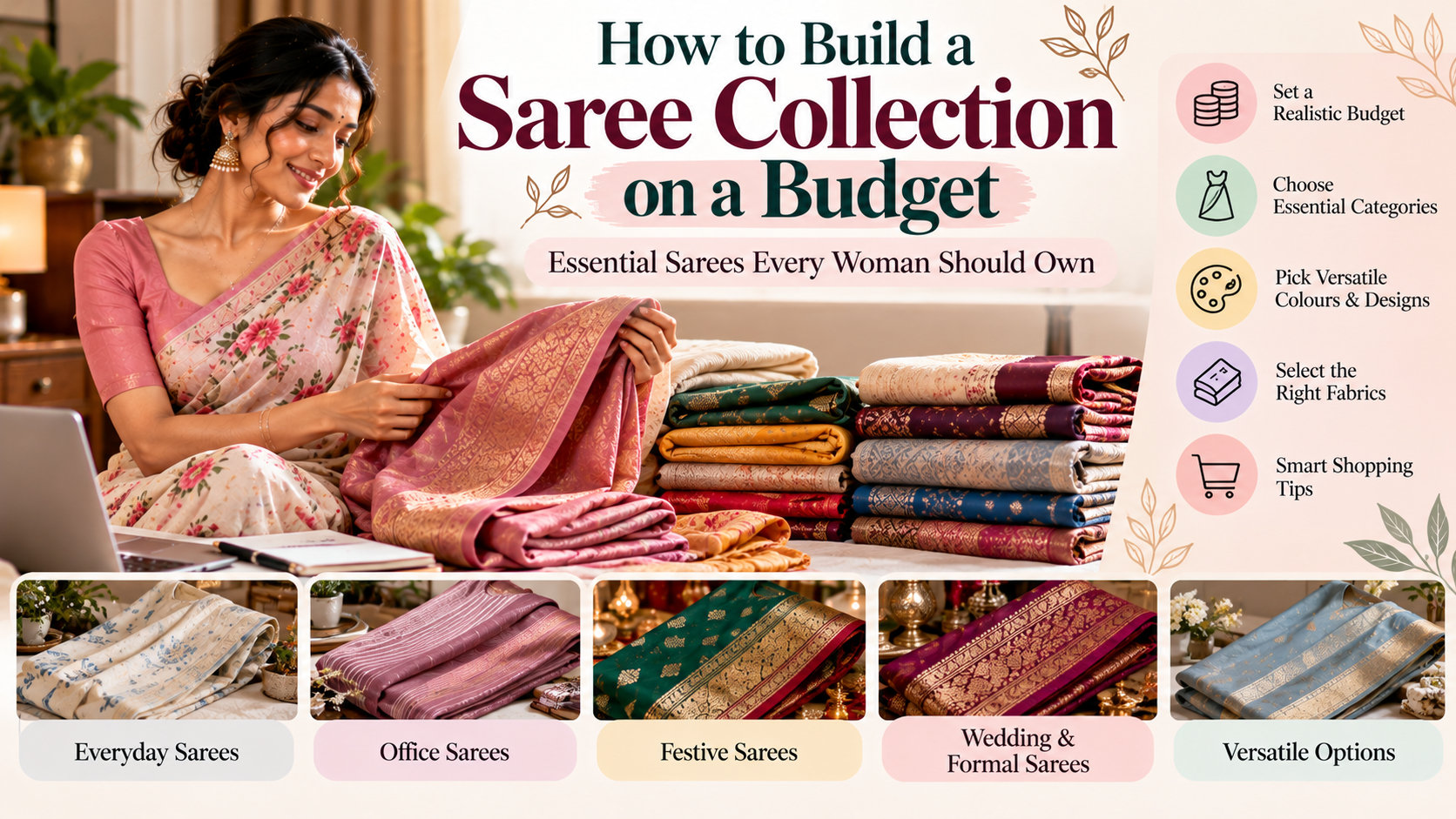
Building a saree collection does not have to mean buying a large number of sarees at once. A thoughtful collection starts with a few pieces that fit your lifestyle, feel comfortable and can be styled for more than one occasion. Whether you are a first-time saree buyer, a student, a young professional or someone refreshing an existing wardrobe, planning your purchases can help you avoid unnecessary spending.
A useful saree collection for beginners is based on how you actually dress. Think about whether you need sarees for everyday wear, office days, family gatherings, festivals or formal events. Consider the climate where you live, how often you wear sarees, which blouses you already own and how much time you can spend on garment care.
There is no universal list of sarees every woman must own. One person may need practical cotton sarees for regular use, while another may prefer versatile designs for occasional celebrations. The goal is to choose pieces you will enjoy wearing repeatedly—not to follow a fixed number or buy something simply because it is trending.
This guide explains how to set a budget, choose useful saree categories, compare fabrics, estimate cost-per-wear and shop carefully without compromising on the features that matter to you.
1. Start with a Realistic Saree-Shopping Budget
Before browsing, decide how much you can comfortably spend without affecting essential expenses or savings. Your budget should reflect your current needs, not pressure from trends, social media or special-occasion shopping.
Set a total limit
Choose a total amount for the collection and divide it according to your priorities. If you need workwear first, allocate more of your budget to everyday and office sarees. If you already have practical sarees but need one for a wedding, focus on that gap instead.
Include the full outfit cost
A saree’s purchase price is only one part of the total. You may also need a blouse, stitching, a petticoat, footwear, accessories or cleaning. Before buying, check what is included and what you will need separately.
Keep a small reserve
Avoid spending the entire budget on the first purchase. Keeping a reserve allows you to cover necessary alterations or choose a complementary blouse later. It also gives you time to see which sarees you actually wear most often.
Use a needs-first list
Make three lists before shopping:
Need now: Sarees required for regular work, daily wear or a confirmed event.
Useful later: Pieces that would expand your options but are not urgent.
Optional: Trend-led or occasion-specific designs you can postpone.
This simple approach can reduce impulse purchases and help you build a collection gradually.
2. Essential Saree Categories to Consider
Rather than buying several sarees that serve the same purpose, think about the situations in which you will wear them. The following categories can help you identify gaps in your wardrobe; you do not need every category immediately.
Everyday sarees
Everyday sarees should suit your routine and be manageable to wash, dry and store. Cotton and other practical fabrics may work well, depending on the weave and local climate. Choose colours and prints you enjoy and can wear regularly.
If you are exploring practical daily options, read Mahavir Cloth Center’s guide to cotton sarees for daily wear.
Office sarees
If you wear sarees to work, consider one or two designs that are comfortable for commuting, sitting and moving throughout the day. Solid colours, subtle prints and lightweight fabrics can be versatile, but the best choice depends on your workplace dress code and personal style.
Festive sarees
A festive saree can add variety to your collection for celebrations and family gatherings. You do not necessarily need a heavily embellished design. A versatile colour, a decorative border or an interesting weave may be enough to create a festive look with the right blouse and accessories.
Formal and wedding-guest sarees
For weddings, receptions or formal events, you may want a saree with richer detailing or a more elevated finish. If you attend such events infrequently, consider whether you can restyle an existing saree before purchasing a new one. A different blouse, jewellery or drape can sometimes create a fresh outfit.
A versatile all-purpose option
Some sarees can work across multiple settings when styled differently. A restrained border, a colour that coordinates with your existing blouses and a fabric suitable for the occasion may make a saree more flexible. Versatility depends on your lifestyle; a saree that works for one person may not suit another’s needs.
3. Choose Colours, Prints and Designs You Can Rewear
A budget-friendly collection becomes more useful when its pieces coordinate with one another. Before buying a saree, think about the blouses, footwear and accessories you already own.
Start with colours you enjoy wearing
Neutrals, deep shades, pastels and bright colours can all be versatile. The best colours are the ones you feel comfortable wearing and can combine with items already in your wardrobe. Do not buy a colour only because it is considered essential or fashionable.
Consider the role of prints
Small motifs, stripes, florals and geometric patterns can offer variety. A plain saree may be easier to style with a detailed blouse, while a printed saree may look balanced with a simpler blouse and accessories. Consider whether the print complements your existing wardrobe.
Think about borders and embellishments
A simple border can make a saree easy to restyle, while a heavily decorated border may suit a more specific occasion. Neither is automatically better. Choose the level of detail that matches how often you expect to wear the saree.
For ideas on coordinating colours, see Mahavir Cloth Center’s guide to saree colour combinations for different occasions.
Use a wardrobe-matching test
Before purchasing, ask yourself:
Can I wear this saree with at least one blouse I already own?
Do I have suitable footwear and accessories?
Can I style it for more than one event or setting?
Does it fill a real gap in my collection?
Would I still want it if it were not currently trending?
If you cannot answer yes to every question, that does not mean you should never buy the saree. It simply helps you decide whether it is a priority.
4. Compare Fabrics by Comfort, Care and Use
Fabric affects the look, feel, maintenance and long-term usefulness of a saree. Price alone does not tell you whether a fabric is right for your needs.
Cotton
Cotton sarees are often considered for everyday wear because they can feel breathable and comfortable in warm weather. Some cotton weaves crease easily or need ironing, so check the finish and care instructions. Cotton can be a useful choice if you want a saree for regular use and are comfortable with its maintenance.
Linen and linen blends
Linen and linen blends can offer a textured, understated look. Creasing may be noticeable, and the exact feel depends on the blend and weave. Consider whether you like that appearance and whether the fabric suits your usual routine.
Lightweight blends
Blended fabrics vary considerably. Some may offer a fluid drape or easier maintenance, while others may need careful washing or ironing. Review the fibre composition and care label rather than assuming all blends behave the same way.
Chiffon and georgette
These fabrics often create a fluid drape and may suit casual or semi-formal outfits, depending on the design. Some can slip or snag more easily than structured fabrics, so consider how comfortable you are managing the drape.
Silk and silk blends
Silk sarees can be suitable for festive and formal occasions, but care requirements vary. If you are working with a limited budget, consider how often you will wear the saree and whether you can maintain it properly. A simpler silk-blend design may meet your needs, but check the actual composition rather than relying only on the product name.
Choose based on use, not assumptions
No fabric is automatically the best or most expensive option. Compare the saree’s weight, texture, transparency, construction and care needs. For more guidance, read how to identify a good-quality saree.
5. Make Your Existing Blouses and Accessories Work Harder
A saree collection becomes more versatile when the pieces coordinate with what you already own. You do not need a new blouse or accessory for every saree.
Audit your blouse collection
Lay out your existing blouses and note their colours, sleeve styles, necklines and fit. Identify which sarees they already match. This can reveal that you have more styling options than you realised.
Choose compatible colours
A blouse that matches a saree’s border can create a coordinated look. A blouse that matches the body colour may make the outfit feel more streamlined. A neutral blouse can work with multiple sarees if the shades and designs coordinate.
Reuse accessories
Jewellery, bags and footwear can change the mood of an outfit. Simple accessories may suit workwear, while a more decorative set can elevate a saree for a celebration. You can create different looks without purchasing a separate accessory set for every saree.
Budget for tailoring when needed
If a saree requires a new blouse, include stitching and fitting in the total cost. A well-fitting blouse can make a saree more comfortable and useful, while an unplanned tailoring expense can push the purchase beyond your budget.
For a broader approach to building a coordinated ethnic wardrobe, explore the guide to an ethnic capsule wardrobe.
6. Understand Cost-per-Wear
Cost-per-wear is a simple way to think about value. It compares the total cost of an item with how many times you expect to wear it. It is not the only measure of value, but it can help you compare a versatile saree with a piece you may wear only once.
Simple formula:
Cost per wear = Total cost of the outfit ÷ Number of times you wear it
For example, imagine two sarees with different total costs. One is worn repeatedly for work and family gatherings; the other is worn once for a specific event. The first may have a lower cost-per-wear over time, even if its purchase price was higher. The actual result depends on the cost and the number of wears, so use your own estimates rather than assuming one type of saree always offers better value.
Include all related expenses
When estimating cost-per-wear, include necessary stitching, a new blouse, cleaning or other expenses associated with the outfit. You do not need to calculate every small cost precisely; a reasonable estimate is enough to help compare options.
Do not let cost-per-wear dictate every decision
An occasion-specific saree may still be meaningful even if you wear it rarely. If you love a design and it fits your budget, that can be a valid reason to buy it. Cost-per-wear is a planning tool, not a rule that every purchase must satisfy.
7. When to Prioritise Quality Over Quantity
Buying fewer sarees can be a sensible approach if it means choosing pieces that fit well, feel comfortable and suit your routine. However, quality does not always mean buying the most expensive saree. It means checking whether the garment is well made for its intended use.
Inspect the fabric and finish
Look at the fabric’s surface, weave, edges, seams and decorative details. Check whether the border lies reasonably flat and whether any embellishments appear secure. For printed designs, inspect the pattern and finish as closely as possible.
Check the details that affect wear
Consider whether the saree is too sheer for your preference, whether the fabric feels comfortable and whether the length and width meet your needs. If buying online, read the product description and look at available photographs carefully.
Think about care costs
A delicate saree may require specialist cleaning or careful storage. This does not make it a poor purchase, but the care requirements should be part of your decision. For everyday use, a garment that fits your maintenance routine may be more useful than a delicate piece you hesitate to wear.
Choose quality for the purpose
A daily-use saree may need durability and easy care. A formal saree may be chosen for its design and finish. The right balance depends on the intended use, not on a single price threshold.
8. Smart Saree Shopping Tips
A few checks before buying can help you avoid disappointment and make better use of your budget.
Check fabric composition and product details
Read the description for the fabric, measurements, border, embellishments and care instructions. If an important detail is unclear, ask the seller rather than guessing.
Check transparency and lining needs
Some sarees may require a particular petticoat or additional planning for coverage. Consider this before buying, especially if you are shopping online and cannot feel the fabric in person.
Review the colour and images carefully
Screens can display colours differently. Look at all available images and read the description. If colour matching with an existing blouse is important, allow for some variation between the image and the actual garment.
Check what is included
A saree listing may or may not include a blouse piece, stitched blouse or accessories. Confirm what comes with the product and add any extra costs to your budget.
Read return and exchange policies
Review the seller’s policy before placing an order, especially for garments where colour, fit or fabric feel matters. Do not assume every item can be returned or exchanged under the same conditions.
Compare similar options
Compare the saree’s construction, fabric details, care needs and overall design—not just the displayed price. Mahavir Cloth Center’s online saree shopping guide can provide additional considerations for shopping online.
9. Common Budgeting Mistakes to Avoid
Buying for an imagined lifestyle
It is easy to buy a saree for an event or routine that rarely happens. Prioritise how you actually dress now, then add pieces for future needs when they become clearer.
Buying several similar sarees
If you already own multiple sarees with the same colour, print and purpose, a new one may add little variety. Before purchasing, check whether it fills a genuine gap.
Ignoring the cost of the full outfit
A saree may seem affordable until you add blouse stitching, a petticoat, accessories or cleaning. Include those costs before deciding.
Following trends without considering personal style
Trends can be fun, but a trend-led saree may not be useful if it does not suit your taste or routine. Choose designs you genuinely want to wear.
Spending the entire budget immediately
Shopping in stages gives you time to learn which fabrics and styles you prefer. It also leaves room for necessary alterations or an important event.
Assuming expensive always means better
A high price does not automatically guarantee that a saree suits your needs. Check the fabric, finishing, comfort and care requirements. A less expensive saree that fits your lifestyle may be the more practical choice.
10. Sample Budget Plans for Building a Collection
The following plans use illustrative budget shares, not current market prices. Adjust them to your own spending limit, local prices and priorities. You do not need to purchase all the suggested categories at once.
| Planning approach | Everyday/office sarees | Festive or formal saree | Blouse, tailoring and care reserve | Best suited for |
| Essentials first | 60% | 15% | 25% | Someone starting with limited options for regular use |
| Balanced collection | 45% | 30% | 25% | Someone who needs both workwear and occasional outfits |
| Occasion-led | 30% | 45% | 25% | Someone with everyday sarees who has an upcoming formal event |
These percentages are examples rather than recommendations for everyone. If you already own blouses and suitable accessories, you may need less for tailoring. If you need a blouse for each new saree, increase that part of your plan. You can also reserve part of the budget for future purchases instead of spending it immediately.
A gradual purchase plan
Stage 1: Cover regular needs. Start with a saree you can wear frequently for daily activities or work.
Stage 2: Add a different look. Choose a colour, print or fabric that gives you a distinct styling option rather than duplicating the first purchase.
Stage 3: Plan for occasions. When you know what events you attend, decide whether you need a dedicated festive or formal saree—or whether an existing saree can be restyled.
Stage 4: Review before expanding. After wearing your sarees for a while, note which ones are most comfortable and which you rarely choose. Use that information to guide the next purchase.
11. Caring for Your Sarees to Extend Their Useful Life
Good care helps keep your collection wearable and reduces avoidable replacement costs. The right method depends on the fabric, dye, weave and embellishments.
Follow the care label
Do not assume all sarees can be washed in the same way. Cotton, silk, blends and embellished designs may need different cleaning methods. Use the seller’s guidance or seek professional care when appropriate.
Store sarees clean and dry
Make sure the saree is fully dry before folding it away. Store it in a clean, dry place away from dampness and direct sunlight. Avoid leaving a saree folded in a bag after wearing it in humid weather or rain.
Handle delicate details carefully
Avoid pulling loose threads or scrubbing borders and embellishments aggressively. Use appropriate heat when ironing and take extra care around decorative details.
Rotate your collection
If you wear sarees frequently, rotate them so one garment is not always taking the wear. Let sarees air out when needed before storing them, and check them occasionally for stains, loose threads or other issues.
12. Checklist: Should You Buy This Saree?
Before purchasing, ask yourself:
Does this saree fit my planned budget, including tailoring and care?
Do I know the fabric composition and care requirements?
Is it comfortable for the occasion I have in mind?
Can I style it with a blouse or accessories I already own?
Does it add something different to my collection?
Have I checked the colour, transparency, measurements and finishing?
Have I reviewed the seller’s return or exchange policy?
Will I realistically wear it more than once, if that matters to me?
Am I buying it because I like it and need it, rather than because of pressure or a trend?
You do not need every answer to be yes for every purchase. Use the checklist to make an informed choice and understand any additional costs or compromises.
13. Frequently Asked Questions
How many sarees should a beginner own?
There is no fixed number. Start with the sarees you need for your real routine, such as daily wear or office use, and add festive or formal options as required. The right collection depends on how often you wear sarees and the occasions you attend.
Which sarees are best for a budget-friendly collection?
Look for sarees that suit your climate, comfort preferences and care routine. Cotton, lightweight blends and versatile designs may be useful for regular wear, while a carefully chosen festive saree can cover special occasions. Check the actual fabric and construction rather than relying only on the category name.
Should I buy neutral colours first?
Neutral colours can be easy to coordinate, but they are not essential for everyone. Choose colours you enjoy wearing and can match with your existing blouses and accessories. A favourite bright colour can be just as useful if it fits your wardrobe.
Is it better to buy one expensive saree or several affordable ones?
It depends on your needs and budget. Consider comfort, construction, care requirements and how often you expect to wear each saree. A higher price does not automatically mean better value, and several inexpensive purchases are not useful if they remain unworn.
How can I make one saree look different for multiple occasions?
Try changing the blouse, jewellery, footwear, pallu arrangement or other accessories. A saree with a versatile colour and design may adapt to different settings, although the fabric and level of decoration will affect where it is most suitable.
What should I check when buying a saree online?
Review the fabric composition, length, width, product images, transparency, care instructions, what’s included and the return policy. If a detail is unclear, ask the seller before ordering. You can also refer to the online saree shopping guide.
How do I know whether a saree is good quality?
Look at the fabric, weave, finishing, border, seams and embellishments. Also consider whether the garment suits its intended use and care requirements. For a more detailed checklist, read how to identify a good-quality saree.
Should I buy a saree specifically for one wedding?
You can, if it fits your budget and you genuinely want it. Before buying, consider whether you could wear an existing saree with a different blouse or accessories. If you choose a new one, think about whether it could also work for future celebrations.
Conclusion
Building a saree collection on a budget is about choosing pieces that suit your life, not reaching a particular number. Start with your regular needs, set a realistic spending limit, consider the full outfit cost and choose fabrics you can comfortably wear and maintain. A few versatile sarees that coordinate with your existing blouses and accessories can offer more practical options than a larger collection of rarely worn pieces.
Review your wardrobe before every purchase, compare product details carefully and give yourself time to discover which styles work best for you. Explore sarees and helpful buying resources at Mahavir Cloth Center as you build a collection that reflects your style and budget.
