
Blog
Handloom vs Powerloom Saree: How to Identify & Buy Wisely

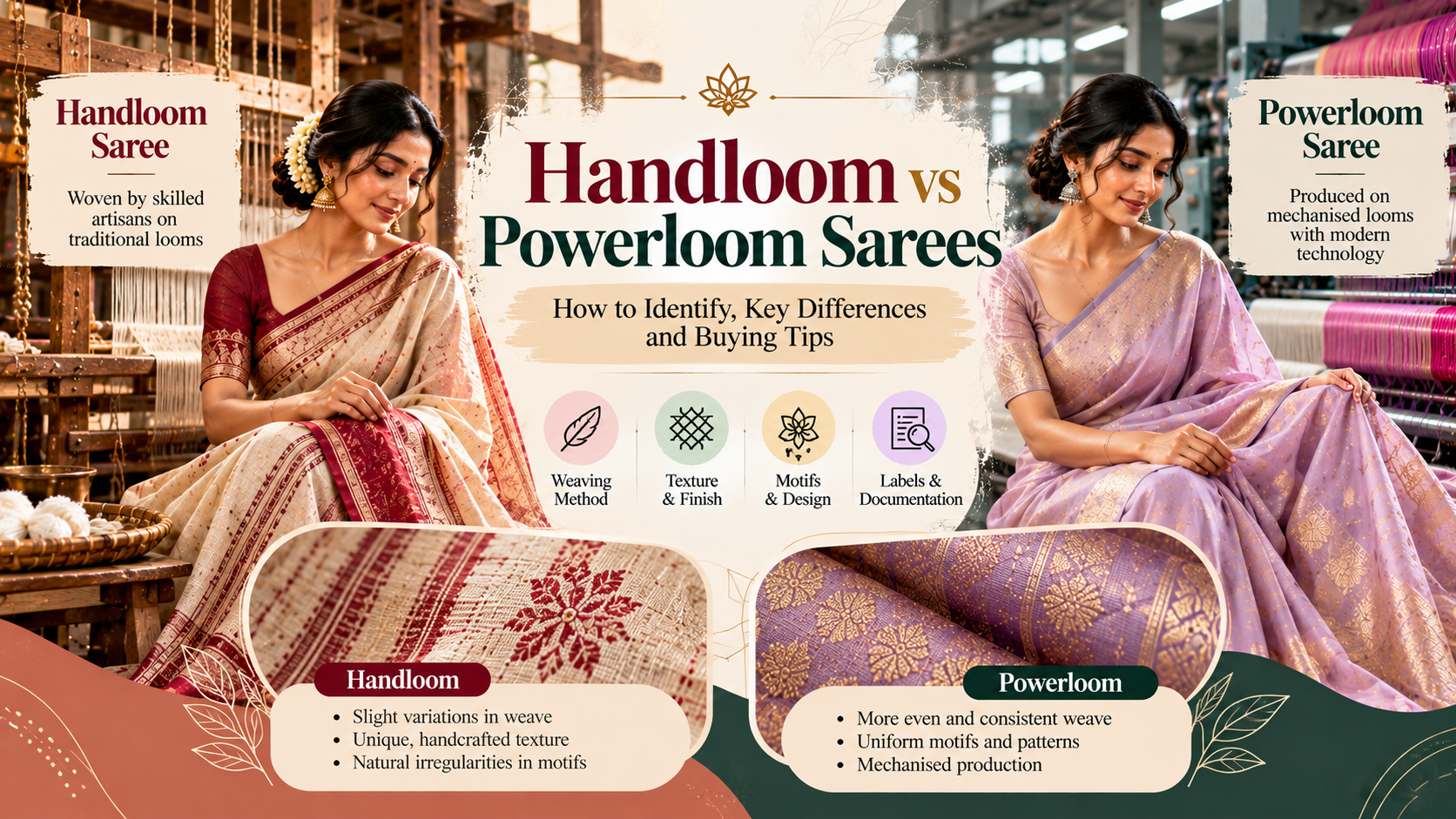
You pick up a saree described as “handloom”. It looks beautiful, the price seems fair and the seller sounds confident. But how can you tell whether it was really woven by hand? And does it matter for what you plan to use it for?
The handloom vs powerloom saree question comes up often, partly because modern powerlooms can reproduce many traditional designs closely. This guide focuses on identification: what each weaving method is, what you can look for in the weave, motifs, edges and reverse side, which labels and documents help, and what to ask the seller. One point is worth stating clearly at the start: visual inspection alone cannot prove whether a saree is handloom. It can give you clues, which you should combine with labels, documentation and seller information.
Handloom and powerloom weaving in simple terms
Handloom
A handloom is operated by the weaver’s hands and feet. The weaver lifts groups of warp threads with foot pedals, passes the weft thread across by hand or with a shuttle, and beats each row into place. Every movement depends on the weaver’s skill, so small variations are a natural part of the fabric.
A handwoven saree can take considerable time to make, depending on its length, fibre and design.
Powerloom
A powerloom is a mechanised loom run by electricity. The machine performs the same basic steps automatically and at higher speed. Powerlooms can produce consistent fabric in larger volumes, and many can weave complex patterns.
Weaving method and fibre are separate
Weaving method describes how the saree was made. Fibre describes what it is made of. A handloom saree can be cotton, silk, linen or a blend, and so can a powerloom saree. “Handloom” does not mean “pure silk”, and “powerloom” does not mean “synthetic”. Always check both details separately. If a listing mentions silk, our guide to pure silk vs art silk sarees explains how to read fibre claims.
Key differences at a glance
These are general tendencies, not fixed rules. Individual sarees vary by weaver, mill, fibre and finishing.
| Aspect | Handloom | Powerloom |
| Production method | Manually operated loom | Electrically powered loom |
| Design consistency | Small variations are common | Usually highly uniform |
| Texture | Often slightly uneven, tactile | Often smoother and more even |
| Finishing | Varies by weaver and cluster | Usually consistent |
| Production speed | Slower | Faster |
| Availability | Smaller volumes | Larger volumes, wider distribution |
| Typical price factors | Weaving time, skill, technique, fibre | Fibre, design, machine setup, volume |
| Identification | Supported by labels, documentation, seller detail | Usually described as powerloom or machine-made |
For a broader look at how the two methods differ in quality and price, see our article on handloom vs powerloom sarees.
What you can inspect
These checks can offer clues. None of them is conclusive on its own, and finishing processes can hide or mimic many of these features.
The weave
- Look for slight irregularities. Handloom fabric may show small variations in thread tension or density. Powerloom fabric is often very even.
- Hold it up to light. Notice whether the density looks uniform or shows gentle variation.
- Feel the texture. Handwoven fabric may feel slightly uneven, but starching and finishing can change this.
Motifs
- Compare repeated motifs. On handloom sarees, motifs may vary slightly in size, spacing or shape. On powerloom sarees, they are usually identical.
- Check the motif edges. Hand-woven extra-weft motifs can show slight irregularity at the edges.
Edges and selvedges
- Look along the length. Handloom selvedges may be slightly less uniform; powerloom edges are often very straight.
- Check for small marks or loops that can appear where the weft turns at the edge, though these vary by technique.
The reverse side
- Look at how motifs are formed. In some handloom techniques, extra threads are woven only into the motif area. In others, threads float across the back and may be cut. Powerlooms can also produce floats.
- Remember the limits. Reverse-side features vary widely by technique and region, so they are useful context, not proof.
What visual checks cannot do
Modern powerlooms can imitate handloom irregularities, and skilled handloom weavers can produce very even fabric. Appearance, touch and price cannot confirm the weaving method with certainty. Avoid destructive home tests: they can damage the saree and do not reveal how it was woven.
Labels and documentation
Handloom Mark
The Handloom Mark is a Government of India scheme intended to identify products woven on handlooms. Where a saree carries a Handloom Mark label, it is a useful indicator. Check the label details, and remember that not every genuine handloom saree carries one.
India Handloom Brand
The India Handloom Brand is another government initiative associated with handloom products that meet certain quality parameters. Where present, check the label details.
Geographical Indication (GI)
Some traditional sarees are registered as Geographical Indications, linking them to a region and traditional methods. A GI claim can provide context about origin, but you should still ask for supporting details.
Seller documentation
Invoices, product descriptions and written details from the seller about weaving method, fibre and origin are valuable, especially for higher-value purchases.
Questions to ask the seller
- Was this saree woven on a handloom or a powerloom?
- Which weaving technique was used?
- What is the fibre content of the body, border and pallu?
- What type of zari is used, if any?
- Where was it woven, and by whom (a weaver, cooperative or mill)?
- Does it carry a Handloom Mark, India Handloom Brand or other label?
- Can you provide written details on the invoice?
- What are the care instructions?
- What is the return or exchange policy?
A reliable seller should be able to answer clearly. Vague answers are a reason to ask more questions.
Choosing by occasion
Weddings
For weddings, many buyers value traditional handwoven sarees for their craftsmanship and heritage. Well-made powerloom sarees can also look rich and offer more consistent finishing. Focus on fibre, zari, weight and comfort as well as weaving method.
Gifting
If the recipient values handloom craft, a documented handwoven saree can be a meaningful gift. If they prefer easy care or a particular design, a good-quality powerloom saree may suit them better. Describe the saree accurately.
Festivals
Both handloom and powerloom sarees work well. Consider comfort, colour and how often the saree will be worn.
Everyday wear
Handloom cotton sarees are popular for daily wear because of their breathability and character. Powerloom cotton and blends offer consistency and often easier availability. Choose based on comfort, care and budget.
Buyer checklist
- Weaving method stated clearly
- Fibre content stated separately
- Handloom Mark, India Handloom Brand or GI details checked where claimed
- Weave and motifs inspected for consistency or natural variation
- Edges and reverse side examined
- Seller questions answered clearly
- Written details included on the invoice
- Price compared with sarees of similar fibre and design
- Care instructions noted
- Return policy confirmed
For more general advice on fabrics, styles and choosing a saree, see our complete guide to buying sarees for women. To inspect finishing, borders and zari in more detail, read our guide on how to identify a good-quality saree.
Frequently asked questions
How can I tell if a saree is handloom?
Look for clear labelling, Handloom Mark or other documentation where available, and ask the seller for written details. Natural variation in the weave can be a clue, but it is not proof.
Is handloom always better than powerloom?
No. Quality depends on fibre, weave density, design, finishing and craftsmanship, whichever method is used.
Can powerloom sarees look like handloom sarees?
Yes. Modern powerlooms can reproduce many traditional designs, which is why documentation and seller details matter.
Does handloom mean pure silk?
No. Handloom describes the weaving method; fibre is separate. Handloom sarees can be cotton, silk, linen or blends.
Why do handloom sarees often cost more?
Hand weaving usually takes more time and skill, and production volumes are smaller. Fibre, design and zari also affect price.
Does every handloom saree have a Handloom Mark?
No. The Handloom Mark is a useful indicator where present, but not every genuine handloom saree carries one.
Which is better for everyday wear?
Both can work. Handloom cotton is valued for breathability and texture; powerloom options offer consistency and wide availability.
Conclusion
Telling a handloom vs powerloom saree apart is rarely about a single clue. Look at the weave, motifs, edges and reverse side for context, but rely on labels, documentation and clear seller information to confirm the weaving method. Treat fibre as a separate question, and choose the saree that suits your occasion, comfort and budget, whichever way it was woven.
Explore handwoven and machine-woven sarees at Mahavir Cloth Center, and use these questions about weaving method and fibre before you buy.
