
Blog
Handloom vs Powerloom Sarees: Key Differences in Weaving, Quality and Price

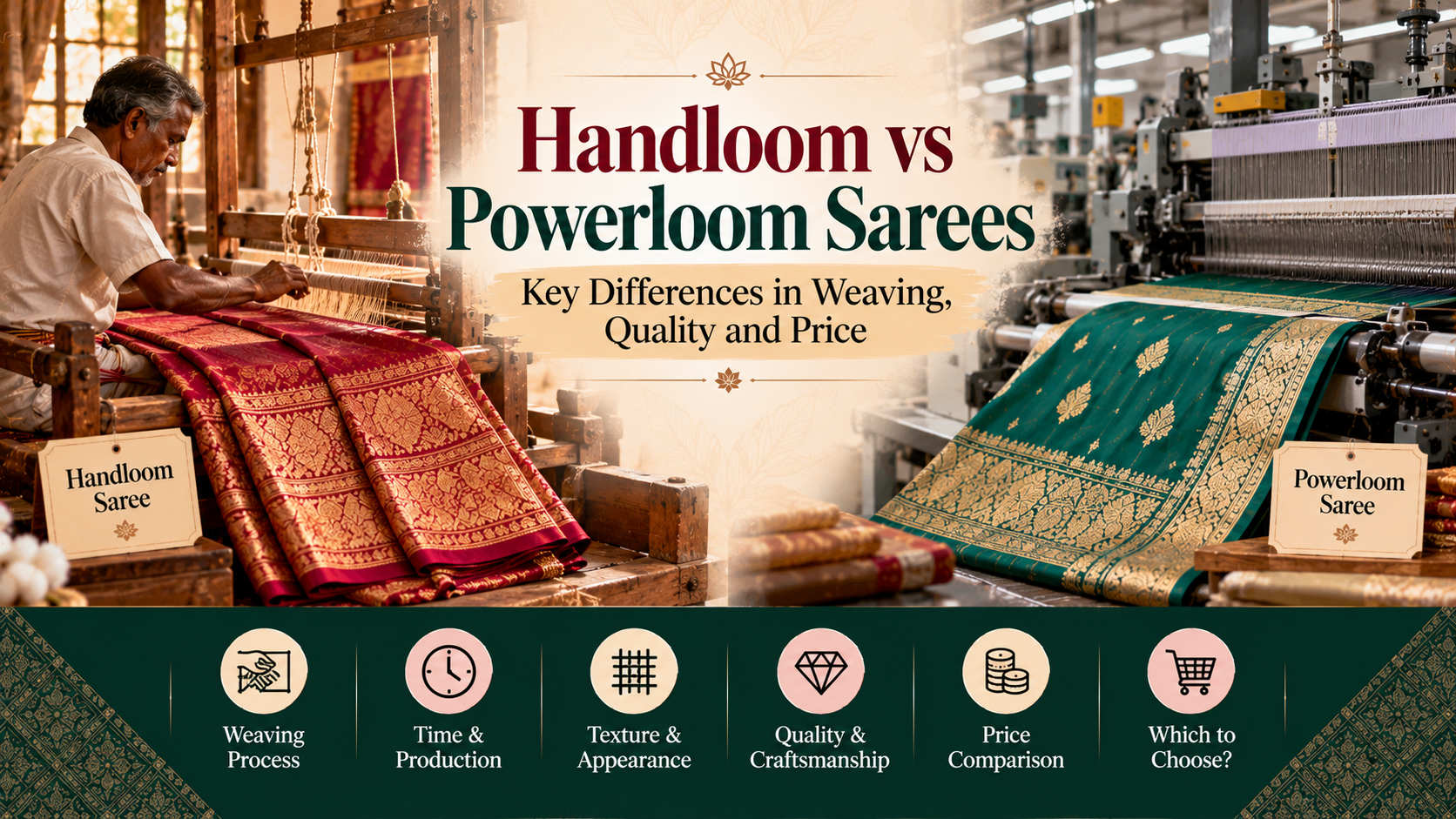
Two cotton sarees can look almost identical in a photograph: the same colour, a similar border, comparable motifs. Yet one may be priced noticeably higher, and the label says “handloom”. The other says “powerloom”, or does not mention weaving at all. For many buyers, the handloom vs powerloom saree question starts exactly here.
The difference lies in how the fabric is woven. A handloom saree is woven on a loom operated by hand and foot, while a powerloom saree is woven on a mechanised loom run by electricity. That difference affects texture, consistency, production time and price, but it does not decide quality on its own. This guide explains both methods, how they compare and how to read labels so you can choose with confidence.
What is a handloom saree?
A handloom saree is woven on a loom that the weaver operates manually. The weaver moves the shuttle carrying the weft thread across the warp, presses foot pedals to lift and lower warp threads, and beats each line of weft into place. Depending on the design, extra threads or attachments may be used to create motifs and borders.
Characteristics often associated with handloom sarees:
- Slower production: each saree can take considerable time, depending on length, fibre and design complexity.
- Human variation: small irregularities in tension, colour or motif spacing are common and are a natural feature of handwork.
- Traditional techniques: many regional weaves, such as various silk, cotton and ikat traditions, are closely linked to handloom weaving.
- Smaller-scale production: often by individual weavers, families, cooperatives or clusters.
Handloom sarees can be made from cotton, silk, linen, wool or blends. The weaving method and the fibre are separate questions.
What is a powerloom saree?
A powerloom saree is woven on a loom powered by electricity. The machine performs the shedding, weft insertion and beating motions automatically. Modern powerlooms can produce complex patterns, including some that resemble traditional handloom designs.
Characteristics often associated with powerloom sarees:
- Faster production: machines can produce larger quantities in less time.
- Greater uniformity: patterns, colours and tension are usually more consistent across the length.
- Larger-scale production: suited to bigger volumes and wide distribution.
- Wide fibre range: powerloom sarees are made in cotton, silk, synthetics and blends.
Powerloom weaving makes many designs more accessible and affordable. A well-made powerloom saree can be durable, attractive and good value.
Handloom vs powerloom saree: comparison table
These are general tendencies. Individual sarees vary by fibre, weaver, mill, design and finishing.
| Aspect | Handloom | Powerloom |
| Production method | Loom operated by hand and foot | Mechanised loom powered by electricity |
| Weaving process | Manual shedding, weft insertion and beating | Automated shedding, weft insertion and beating |
| Design consistency | Small natural variations are common | Generally highly uniform |
| Craftsmanship | Depends heavily on individual weaver skill | Depends on machine setup, yarn quality and mill processes |
| Production scale | Smaller, slower | Larger, faster |
| Price factors | Weaving time, skill, fibre, design complexity | Fibre, design, machine setup, volume |
| Buyer considerations | Character of handwork, supporting weaving traditions, care needs | Consistency, affordability, wide design choice |
How weaving method may influence texture and appearance
Weaving method can influence how a saree looks and feels, though fibre and finishing play an equally important role.
Texture
Handloom fabrics are often described as having a slightly uneven, tactile surface, because hand weaving produces small variations in tension. Powerloom fabrics tend to feel smoother and more even. Finishing processes such as starching, calendering or washing can change texture significantly in both.
Motifs and borders
On handloom sarees, motifs may show slight differences in size or spacing along the length. Powerloom motifs are usually identical. Some traditional handloom techniques, such as certain extra-weft and interlocking methods, produce effects that are harder to replicate exactly by machine, though modern machines can reproduce many patterns closely.
Reverse side
Looking at the reverse of the fabric can sometimes give clues. Hand-woven extra-weft motifs may show threads carried or cut in particular ways. However, construction varies greatly by technique, and the reverse side is not a reliable test on its own.
Selvedge
The edges of handloom fabric may be slightly less uniform. Powerloom selvedges are often very straight. Again, this is an indicator rather than proof.
Colour
Handloom sarees may show subtle variation in colour, especially when hand-dyed yarns are used. Powerloom sarees are often more uniform in colour, though dyeing method also matters.
For example, ikat traditions involve dyeing threads before weaving. Our article on the Pochampally ikat saree explains how this technique shapes the final look.
Why handloom and powerloom sarees can have different prices
Price differences come from several factors working together.
- Time: hand weaving generally takes much longer than machine weaving.
- Skill: complex handloom designs require experienced weavers.
- Scale: powerloom production spreads costs across larger volumes.
- Fibre: silk, fine cotton and other natural fibres affect price regardless of weaving method.
- Design complexity: intricate motifs, dense borders and zari raise cost in both methods.
- Finishing: dyeing, washing and edge finishing add to cost.
- Supply chain: cooperatives, middlemen, retailers and branding all influence the final price.
A higher price does not automatically mean handloom, and a lower price does not automatically mean poor quality. Compare sarees with similar fibre and design complexity before drawing conclusions. For a wider look at price factors and budgeting, read our complete guide to buying sarees for women.
How to read product descriptions and labels before buying
Look for clear weaving information
A useful description states whether the saree is handloom, powerloom or partly both, for example powerloom body with a hand-finished border. Vague phrases such as “handloom look”, “handcrafted feel” or “traditional weave” may not describe the actual method.
Check fibre content separately
Weaving method and fibre are different details. A listing should say both, for example “handloom cotton” or “powerloom silk blend”. For tips on recognising natural fibres, see our guide to identifying pure cotton and silk.
Look for official handloom identification
In India, the Ministry of Textiles has schemes such as the Handloom Mark and the India Handloom Brand that are intended to identify genuine handloom products. Where a saree carries one of these labels, it is a useful indicator, but check the label details and buy from a seller you trust. Not every genuine handloom saree carries a label.
Check regional and Geographical Indication claims
Some traditional sarees are registered as Geographical Indications. If a seller describes a saree as a particular regional weave, ask for details about where and how it was made.
Ask the seller
A reliable seller should be able to tell you the weaving method, fibre, origin and care instructions.
Common misconceptions
“Handloom is always better quality.”
Not necessarily. Handloom sarees vary in quality, like any product. Fibre, weaver skill, yarn quality and finishing all matter.
“Powerloom sarees are always low quality.”
A powerloom saree made with good yarn and careful finishing can be durable and attractive. Weaving method is one factor among many.
“Irregularities mean a defect.”
Small variations in handloom sarees are often a natural part of handwork. Holes, broken threads or weak patches are defects in any saree.
“You can always tell by touch.”
Experience helps, but finishing processes can make fabrics feel similar. Labels and seller information are more reliable than touch alone.
“Expensive means handloom.”
Price reflects many factors, including fibre, zari and branding. Check the description.
“Handloom is only cotton.”
Handloom sarees are woven in silk, cotton, linen, wool and blends.
Practical saree buying checklist
- Is the weaving method clearly stated?
- Is the fibre content stated separately?
- Is there a recognised handloom label or regional information?
- Have I inspected the fabric for consistency, weak spots and broken threads?
- Have I checked the border, pallu and selvedge?
- Have I looked at the saree in natural light?
- Have I compared prices with sarees of similar fibre and design?
- Do I know the care instructions?
- Have I asked the seller about origin and weaving method?
- Do I understand the return and exchange policy?
Frequently asked questions
1. What is the main difference between a handloom and powerloom saree? A handloom saree is woven on a manually operated loom; a powerloom saree is woven on an electrically powered loom.
2. Is a handloom saree better than a powerloom saree? Not automatically. Each can be well made or poorly made. Fibre, design, finishing and craftsmanship matter as much as weaving method.
3. How can I tell if a saree is handloom? Read the description, look for official handloom labels where available, check for natural variation in weave and motifs, and ask the seller. No single physical check is conclusive.
4. Why are handloom sarees often more expensive? Hand weaving usually takes more time and skill, and production is smaller in scale. Fibre and design also affect price.
5. Are powerloom sarees durable? They can be. Durability depends on yarn quality, weave density and finishing.
6. Is a traditional saree for women always handloom? No. Many traditional designs are woven on both handlooms and powerlooms. Check the description for the weaving method.
7. Can a saree combine handloom and powerloom work? Some sarees may combine methods or include hand finishing. Ask the seller for details.
Conclusion
The handloom vs powerloom saree choice comes down to what you value: the character and tradition of hand weaving, or the consistency, range and accessibility of machine weaving. Both can offer excellent saree quality when the fibre, weave and finishing are good. Read labels carefully, ask clear questions, inspect the fabric and compare like with like. A traditional saree for women can be beautiful and long-lasting whichever way it is woven, as long as it suits your needs and is honestly described.
Explore sarees at Mahavir Cloth Center and use this guide to compare weaving, fibre and finishing before you buy.
