
Blog
Types of Bengali Sarees: Tant, Garad, Baluchari and Their Cultural Differences

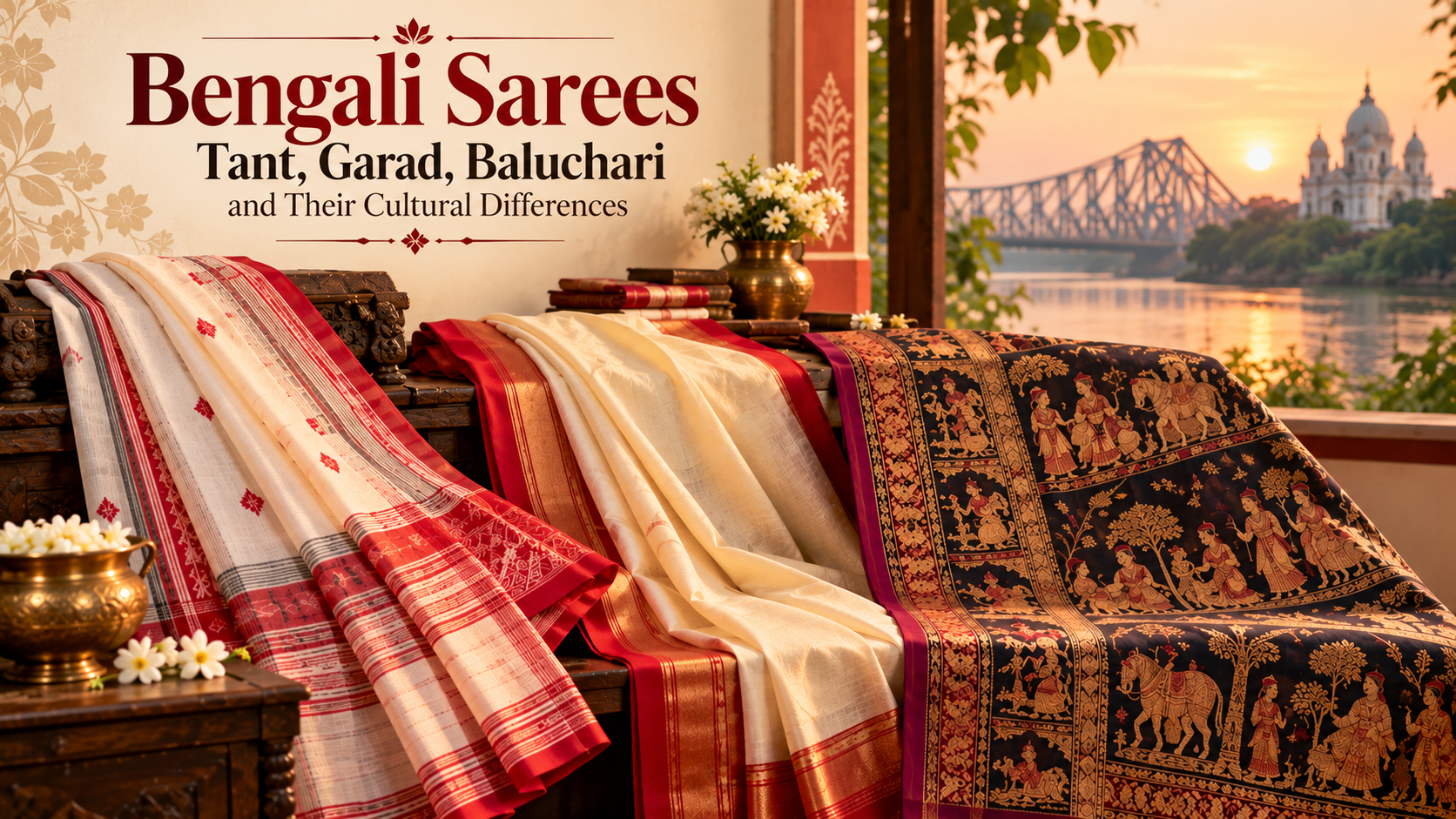
Ask three people in Kolkata what a Bengali saree is and you may get three different answers. One describes a crisp cotton tant with a bold border. Another pictures plain silk with a red edge, worn on the morning of Ashtami during Durga Puja. A third thinks of a silk pallu woven with scenes from the Mahabharata. All three are describing real textiles, and they have little in common beyond a region. The types of Bengali sarees differ in fibre, loom, motif, and the occasions they belong to.
This guide takes the main traditions one at a time: Tant, Garad, Korial, Baluchari and Jamdani, along with the town-based clusters inside Tant such as Shantipur and Dhaniakhali. It compares how each is woven, what the borders and pallus look like, how the cloth feels, and where each sits in Bengali ritual and daily life. Where sources disagree on a date or an origin, the text says so.
The heritage of Bengali saree weaving
Bengal’s weaving reputation rests on cotton and silk, and on rivers that moved yarn, cloth and weavers between towns. The best-known early product was fine cotton muslin from the Dhaka region. Jamdani is the figured form of that muslin, and a Google Arts & Culture feature on the craft says plain muslin was decorated with floral designs during the reign of the Mughal emperor Jahangir (1605 to 1627).
Silk had its own centre. The Geographical Indication (GI) application for Garad notes that Cossimbazar in Murshidabad was the general silk market of Bengal, with goods exported across a large part of Asia, and that the East India Company opened a factory there around 1658. Cotton weaving has a long record too. The GI application for the Shantipuri saree gives 1409 as the oldest date for sarees woven in Shantipur, in Nadia district, and the town’s weavers appear in the Advaita Mangal, a biography of the saint Advaita Acharya (1460 to 1558).
Colonial rule hurt several of these crafts. Jamdani and muslin declined as industrially made imports were favoured, Baluchari faded during British rule, and Shantipur’s weaving industry passed under East India Company control. The 1947 partition then moved weavers along with borders. Heritage accounts say weavers from Tangail, in present-day Bangladesh, settled in Phulia and Shantipur and blended their styles with local ones.
Names add a small puzzle. Some point to a town: Shantipuri, Dhaniakhali, and Baluchari, which comes from the village of Baluchar. Some describe the cloth: tant means loom or handloom in Bengali, and one heritage guide glosses garad as “white”. One names a technique: jamdani. Because the categories overlap, one weaver in Shantipur can make a tant, a silk saree and a jamdani-style piece. This guide covers sarees woven in West Bengal, plus Jamdani, which is woven on both sides of the border and is inscribed by UNESCO under Bangladesh.
Types of Bengali sarees at a glance
| Type | Fibre | Main weaving areas | How the pattern is made | Border and pallu | Feel and finish | Cultural setting |
| Tant (cotton handloom, including Shantipuri and Dhaniakhali) | Cotton, sometimes with zari or art silk in the border | Nadia (Shantipur, Phulia), Hooghly (Dhaniakhali, Begampur) | Pit or frame loom with fly shuttle; dobby or jacquard for borders; extra weft motifs, some added by hand | Contrasting borders, often thick; striped or patterned pallu; Dhaniakhali has a twisted two-colour weft detail called khejur chori | Light and crisp; Shantipur sarees keep faint reed marks | Everyday wear and festive occasions |
| Garad | Silk | Murshidabad, Birbhum | Fly-shuttle pit loom, fine silk yarn; plain, or with extra-warp and jala designs | Classically a white or cream body with a red border; many are plain | Fine, close-set texture; finished in a traditional way and folded in a special shape | Rituals, especially Ashtami and sindur khela in Durga Puja |
| Korial | Mulberry silk | Murshidabad, Birbhum | Hand-thrown shuttle loom with the jala system | Red border; floral and geometric pallu; small motifs on the body | Fine silk, traditional finish | Festive and ceremonial wear |
| Baluchari | Silk | Bishnupur (Bankura); originally Baluchar (Murshidabad) | Jacquard loom driven by punched design cards | Panelled, figured pallu with narrative scenes; woven border | Dense woven figures on silk | Weddings, festivals and other ceremonial occasions |
| Jamdani | Cotton muslin (traditionally) | Dhaka region (Bangladesh); Shantipur and Phulia (West Bengal) | Supplementary (extra) weft added motif by motif, often by two weavers at one loom | Motifs spread across body, border and pallu | Sheer, fine, with motifs that seem to float | Occasion wear; UNESCO-inscribed craft (2013) |
Tant sarees: the cotton handloom of Bengal
What “tant” means and how it is woven
In Bengali, tant (তাঁত) means loom or handloom, so a tant saree is cloth from the hand loom. In everyday use it names the lightweight cotton sarees woven across Nadia, Hooghly and nearby districts. Utsavpedia describes a typical tant as coming in pastel shades with thick borders, with florals and paisleys as common motifs. The cotton is light, which is why tant is often described as suited to Bengal’s humid weather.
Most tant is woven on pit looms or frame looms fitted with a fly shuttle, a shuttle the weaver sends across by pulling a cord instead of throwing it by hand. Border and pallu patterns come from a dobby or jacquard attachment, or from extra weft threads added by hand. “Tant” is therefore an umbrella, and the town clusters below are where the real differences show.
Shantipuri tant
Shantipur sits on the Ganges in Nadia district. Its saree received a GI registration (application 138, recorded as 2009). The specification describes sarees woven on fly-shuttle pit or frame looms from 80s to 100s cotton yarn, with a plain border or one with extra-warp jacquard designs, and a pallu with a typical colour pattern.
Three details help identify the cluster:
- Weavers pass more than one thread through each gap in the reed, which leaves a faint tube-like mark in the cloth. Shantipur weavers choose to keep these reed marks, and the GI application treats this as a difference from Phulia sarees.
- The pallu often carries bands of varying width called sajanshoi, in colours that complement the border.
- The saree is sold in a traditional fold called guti bhanj.
Named varieties include Nilambari, a deep navy saree with silver zari borders and a striped pallu, and the fine striped dure. The poet Dwijendralal Roy wrote a verse about the dure of Shantipur, which shows how long the saree has lived in Bengali popular memory. The jacquard machine reached Shantipur through the weaver Devendranath Mukhopadhyay, and Biren Kumar Basak of Shantipur received the Padma Shri in 2021.
Dhaniakhali tant
Dhaniakhali is a block in Hooghly district, and its saree received a GI tag in 2011. It is woven on pit looms or frame looms from 80s to 100s cotton yarn, with a contrast or matching border made with a dobby (occasionally a jacquard) and a patterned pallu. Border yarn can be artificial zari or art silk. Dobby work gives the cloth small, repeated, geometric designs, including a fish motif that is drawn in straight lines instead of curves.
The signature detail is khejur chori, a twisted two-colour weft arrangement in the pallu that makes an arrow-like effect. Heritage accounts date the cluster to the 1930s, and dyed yarn arrived in 1942. Outlook Traveller’s reporting on the village adds a caution: weavers who could make the older, more varied borders are fewer now, and the saree has lost popularity in cities even as it keeps loyal buyers.
Begampur and Phulia
Begampur, also in Hooghly, is described as specialising in loosely woven, light, translucent sarees in deep, bright colours, in contrast to Dhaniakhali. Phulia, next to Shantipur, is described as combining jacquard and jamdani work based on the Tangail style. Taken together, the clusters show that tant is a family of weaves with local habits.
Cultural context
Tant is often called the people’s fabric of Bengal, which fits its light weight, regular use and range of price and design. It is worn daily and at festivals, and people style it plainly or with heavier borders depending on the occasion. Unlike Garad, it is not bound to one ritual.
For readers comparing hand weaving with machine weaving, the Mahavir Cloth Center guide to handloom vs powerloom sarees explains how the two differ in weave and finish.
Garad sarees: silk for ritual
Fabric, weave and finish
Garad is a handwoven silk saree made mainly in Murshidabad and Birbhum districts. The GI application describes it as woven on fly-shuttle pit looms from fine silk yarn (90 to 92s) and golden zari. The border and ground are either plain or carry extra-warp designs or jala designs. After weaving, the saree gets a traditional finish called khai and is folded into a special shape known as pat.
Heritage sources describe the classic Garad as a white or cream body with a red or maroon border. The close setting of the silk yarns gives the cloth its fine texture. In the past the saree had no design on the border, body or pallu, and that plainness is part of why it carries associations of purity and sanctity.
Origin
According to the GI application, Garad weaving began in the late nineteenth century in Mirzapur, in what is now Murshidabad district, and the saree is credited to the weaver Mrityunjay Sarkar. The same document says the saree became popularly known as Padmaja after Padmaja Naidu, governor of West Bengal from 1956 to 1967, who wore Garad woven by Shyam Sahana. More than 600 looms wove Garad in Murshidabad and Birbhum as of 2024. Garad and Korial both received GI recognition in early 2024, as announced by the West Bengal government in January of that year.
Cultural context
Bengali Hindu women wear Garad for pujas, above all on Ashtami of Durga Puja during the morning anjali, and for sindur khela on the day of immersion. One heritage guide notes that many Bengali women leave Garad without a stitched fall, to keep what they see as its sacred quality. The ritual link is the clearest cultural marker of this saree and the sharpest difference from tant.
Korial sarees: the ornamented relative of Garad
Korial looks close to Garad and the two are often confused. Korial is also silk, made in Murshidabad and Birbhum, and the GI description mentions a red border, designs on the pallu and fine mulberry silk, with 100-count yarn. It is woven on hand looms where the shuttle is passed by hand across the warp, and the jala system builds the floral and geometric designs in the pallu and the small buti motifs on the body.
The usual way to tell the two apart is ornament. The Statesman calls Korial a richer, more ornamented version of Garad, and Boldsky says Korial may carry small, distinct motifs and thread work on the body. The 2024 GI data records 146 weavers for Korial, and the figure is a count of weavers, while the Garad figure counts looms, so the two numbers should not be compared directly. Utsavpedia associates Korial mainly with sindur khela during Durga Puja.
Baluchari sarees: stories woven into silk
From Baluchar to Bishnupur
The name comes from Baluchar, a village on the Bhagirathi river in Murshidabad. One common explanation reads the name as balu (sand) plus char (riverbank). Accounts credit the Nawab of Bengal, Murshid Quli Khan, with patronising silk weavers after he moved his capital from Dhaka to Murshidabad in the early eighteenth century. Sources give dates from 1704 to the 1720s for that shift, so treat any single year with care.
A flood on the river submerged Baluchar, and production moved to Bishnupur in Bankura district, a town already known for silk and for the terracotta temples built under the Malla kings. The Baluchari pallu draws on those temple stories. Gaatha records that Dubraj Das, described as the last known weaver of Baluchar, died in 1903 and signed his sarees like an artist.
The craft declined under British rule. In the mid-twentieth century the artist Subho Thakur worked to revive it, and he brought the Bishnupur master weaver Akshay Kumar Das to learn jacquard weaving, with support from the Silk Khadi Seva Mandal. Sources place this revival in the first half of the twentieth century or the 1950s, and Gaatha gives 1956. Baluchari received a GI tag in 2011 and appeared in India Post’s 2018 set of stamps on GI handloom products.
Weaving, pallu and motifs
Baluchari is woven on a jacquard loom. The weaver’s design is drawn on graph paper, coloured, and punched onto cards that are laced together and fitted to the jacquard. With the jacquard in use, a saree takes five to six days, with two weavers working in shifts. Sarees run roughly 5 to 6.5 metres in length.
The pallu is the defining feature. In the Mughal and British periods it often held a square design with paisley motifs and scenes from Nawabi life: women smoking hookahs, nawabs in horse carriages, and European officers of the East India Company. Later pallus lean towards scenes from the Ramayana and Mahabharata, and nature, folklore and abstract designs also appear. Borders carry their own woven patterns.
Baluchari is usually sorted by thread:
- Baluchari (resham): the pattern is woven in silk thread of a single colour.
- Baluchari (meenakari): the pattern uses two or more colours.
- Swarnachari: the pattern uses gold or silver-coloured zari, often with meenakari colour added.
Cultural context
Baluchari began as a court and elite textile and now serves ceremonial and festive occasions. The GI registration protects the name: Wikipedia’s summary of the registration says the term Baluchari may not be used for similar products made of cotton or other materials from outside the protected area.
Jamdani: woven motifs shared across Bengal
Jamdani is a fine cotton muslin in which the motifs are woven in, not stitched on. The weaver uses a supplementary weft: a thicker thread inserted only where the motif is needed, on top of the standard weft that forms the sheer ground. Two weavers often sit side by side at the loom, adding each motif by hand with fine bamboo sticks and separate spools of thread. The word is usually traced to Persian, with jam meaning flower and dani meaning container.
UNESCO inscribed the traditional art of Jamdani weaving in 2013, listing it for Bangladesh, and Bangladesh received GI status for Jamdani in 2016. The craft is also practised in West Bengal, in the weaving belt of Shantipur and Phulia. Traditionally the saree is white with designs in bleached white, though coloured and gold-threaded versions are common now. Jamdani and Baluchari both carry designs woven into the cloth, but Jamdani is sheer cotton with motifs that seem to float across the body, while Baluchari is silk with its figures concentrated in the pallu.
Other Bengal weaves worth knowing
Two more traditions come up often. Tangail sarees descend from the muslin weaving of the Basak community, who moved from the Dhaka area, and the West Bengal version, woven in Nadia and Purba Bardhaman, received a GI tag in early 2024. That registration has been publicly disputed in Bangladesh, where the Tangail name is also tied to the town. Kantha stitch sarees apply the running-stitch quilting tradition of Bengal to saree cloth, so they are defined by embroidery and not by the loom.
How to tell the types apart at a glance
Start with fibre and weight. A matte, crisp cotton with a thick border points to tant, and a sheer cotton with raised floral motifs points to Jamdani. A silk with a plain cream body and red border is Garad or Korial, and a silk with a panelled, figured pallu is Baluchari.
Then ask where the design sits. Tant places it in the border and pallu. Garad keeps the body quiet. Korial adds small motifs and thread work to pallu and body. Baluchari concentrates its figures in the pallu, and Jamdani spreads them across the whole cloth.
Finally, look at how the pattern was made. Dobby and jacquard borders, extra weft done by hand, jala patterns and punched-card jacquard each leave a different kind of design. The glossary below explains each term. Registration documents and handloom marks also help confirm where a saree was made.
Textile terms in plain language
| Term | Meaning |
| Warp | The lengthwise threads held on the loom. |
| Weft | The crosswise thread that the shuttle carries through the warp. |
| Supplementary (extra) weft | Added weft threads used only where a motif is wanted, on top of the weft that forms the cloth. Jamdani depends on it. |
| Extra warp | Added lengthwise threads used to build border or stripe patterns. |
| Dobby | A loom attachment that lifts chosen warp threads in a set order, suited to small repeated geometric designs, often borders. |
| Jacquard | A mechanism, traditionally run by punched cards, that controls warp threads individually and allows large figured designs such as Baluchari pallus. |
| Jala | A hook-like pattern device used on traditional Bengal looms to weave motifs such as buti. |
| Pit loom and frame loom | Treadle looms: on a pit loom the treadles sit in a pit under the weaver, and on a frame loom they sit on a raised frame. |
| Fly shuttle | A shuttle sent across by pulling a cord, which is faster than throwing it by hand. |
| Reed | A comb-like frame that spaces the warp threads and pushes each weft thread into place. |
| Zari | Metallic or metal-look thread used in borders and motifs. The Korial GI description notes that the zari used is mainly artificial. |
| Anchal or pallu | The decorated end piece of the saree that falls over the shoulder. |
| Paar | The Bengali word for border. |
| Buti | A small motif repeated across the body of the saree. |
| GI tag | Official recognition that a product’s name belongs to goods made in a defined region with set characteristics. |
How traditional techniques and contemporary designs coexist
Bengal handloom has changed for as long as it has existed. In Shantipur, the barrel dobby arrived in the 1920s and the jacquard machine followed, widening the designs a weaver could produce. In Dhaniakhali, the dobby border came into use in the early 1940s and dyed yarn in 1942. The weavers who now work with these tools are using methods that earlier generations adopted for their own reasons.
Current changes show up in three ways. First, weaving cooperatives in Dhaniakhali have been combining the weave with muga silk, jacquard and tie-dye to revive demand. Second, some Baluchari makers use cotton yarn spun with banana fibre and bamboo, coloured with natural dyes from pomegranate, jamun, turmeric and marigold, according to reports on eco-friendly versions, though the GI limits the Baluchari name for such products. Third, Baluchari motifs are printed on other fabrics for contemporary clothing, which gives the look at lower cost but not the woven pallu. Style writers also pair a plain tant with a modern blouse and oxidised silver jewellery.
There are pressures too. Handloom weavers in Dhaniakhali report low pay, and sellers note that some tant-style sarees are now made on power looms, which is why GI documents and the handloom mark matter. Readers interested in how old pieces and new styling meet can read the Mahavir Cloth Center article on blending vintage ethnic wear with contemporary fashion.
Where Mahavir Cloth Center fits
Mahavir Cloth Center is a clothing store based in Shirol, Kolhapur, Maharashtra, with sarees, kurta suits, kids’ clothing and hosiery on its website. Its blog already covers regional weaves from other states, including Maharashtra’s Paithani sarees and Pochampally ikat, and this guide extends that regional reading to Bengal.
Anyone looking for Bengali handloom can check the saree collection for what is listed at the moment. Because stock changes, confirm the fibre, loom type and place of weaving with the store before ordering a specific piece.
FAQs
What are the main types of Bengali sarees?
The main types are Tant (cotton handloom, including Shantipuri and Dhaniakhali), Garad and Korial (silk, linked to Murshidabad and Birbhum), Baluchari (figured silk from Bishnupur), and Jamdani (sheer cotton muslin with woven motifs). Tangail and Kantha stitch sarees are also widely mentioned.
What is the difference between Tant and Garad sarees?
Tant is a lightweight cotton handloom saree with a strong border and a patterned pallu. Garad is a silk saree, classically with a white or cream body and a red border, and it is closely tied to rituals such as Ashtami in Durga Puja.
Is Baluchari the same as Jamdani?
No. Baluchari is silk woven on a jacquard loom, with narrative scenes concentrated in the pallu. Jamdani is traditionally cotton muslin, with motifs added by supplementary weft across the body, border and pallu.
Which Bengali saree is worn for Durga Puja rituals?
Garad is the saree most often linked to Ashtami anjali and to sindur khela on the day of immersion, and Korial is also associated with sindur khela. Tant sarees are worn throughout the festival, because they are comfortable for long days.
What does the GI tag mean on a Bengali saree?
A GI (Geographical Indication) tag recognises that the name belongs to products made in a defined area with set features. Baluchari and Dhaniakhali were registered in 2011, Shantipuri is recorded as 2009, and Garad, Korial and the West Bengal Tangail followed in 2024. The documents on the Intellectual Property India GI portal give the exact entries.
How long does it take to weave a Baluchari saree?
After the jacquard loom came into use, a Baluchari saree takes about five to six days with two weavers working in shifts. The design cards for the pallu are prepared beforehand, so the full process takes longer than the time at the loom.
Are Tant sarees suitable for hot, humid weather?
They are commonly described that way. Tant is woven from light cotton, so it lets air through and feels crisp, and that is a main reason it is a regular choice across Bengal’s humid months.
Conclusion
The types of Bengali sarees are easiest to remember by pairing each with its place and its material. Tant is cotton from Nadia and Hooghly, Garad and Korial are silk from Murshidabad and Birbhum, Baluchari is figured silk from Bishnupur, and Jamdani is woven muslin shared by Dhaka and West Bengal. Each carries its own approach to the border, the pallu and the body, and each has its own place in Bengali ritual or daily life.
When you read about a particular saree, check how it was woven, where, and whether the maker can point to a GI registration or handloom mark. Those details separate a tradition from an imitation of its look, and they tell you more than the name on the label.
