
Blog
Heirloom Sarees: How to Preserve, Restore and Pass Down Traditional Sarees

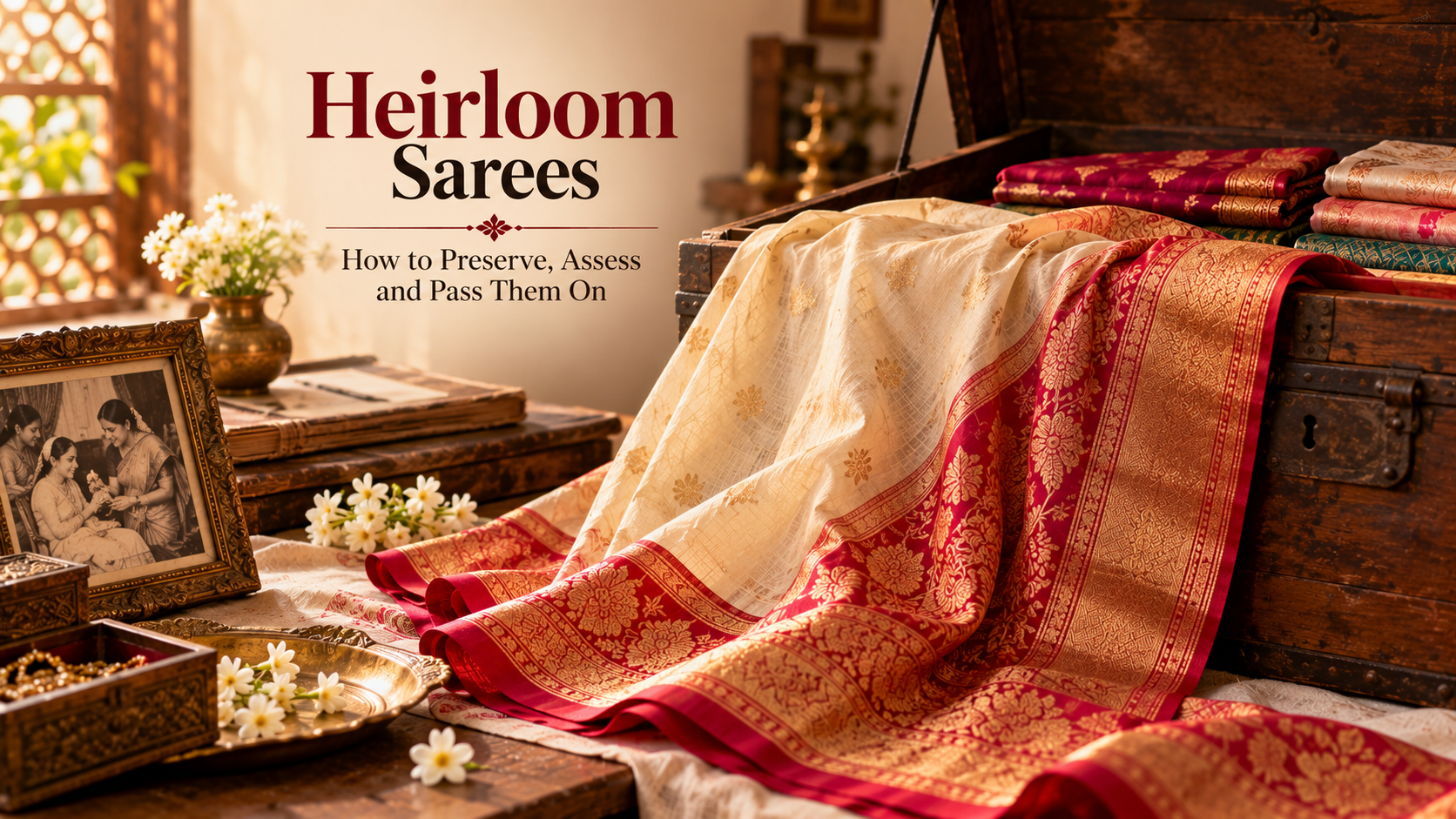
Some sarees are worn a few times and forgotten. Others are folded away with care because of who wore them, when they were given and what they came to mean. If you have inherited one, you may be holding a wedding saree from a trousseau, a border with zari that has gone dark, or a cotton that has softened over decades of wear. Handling it feels different from handling anything else in the wardrobe.
This guide is about heirloom sarees: how to judge their condition, how to keep them from getting worse, when to stop and ask a professional, and how to hand them on with their story intact. It is not a general silk saree storage guide, and it does not cover buying.
A note on where this advice comes from. Mahavir Cloth Center is a saree retailer, not a textile conservation studio, and we do not offer restoration. The guidance below draws on published advice from museum and archive conservation bodies, including the Smithsonian’s Museum Conservation Institute, the Canadian Conservation Institute and the U.S. National Archives. We have adapted it to sarees. Where a step is general preventive care any family can follow, we say so. Where it is a job for a trained conservator, we say that too.
What makes a saree an heirloom?
No official definition exists. In practice, a saree becomes an heirloom when a family decides to keep it and pass it on instead of wearing it out. Several things can lead to that decision:
- A connection to a person or event, such as a wedding, a ceremony, a milestone or a relative who wore it often
- Craftsmanship, such as handwoven structure, fine zari, detailed embroidery or a regional weaving tradition
- Rarity, when a design, dye or technique is hard to find now
- Age, though a saree does not need to be a century old. A saree from the 1980s that a mother wore to every family function can matter more than an older one with no known history
- Market value, which some heirlooms have and many do not
Emotional, cultural and family significance
In many families a saree keeps a person present. It may hold the fold lines of how she tucked it, a faint smell of the cupboard it lived in, or a stain from a particular festival. It also records choices: which colours were worn for which occasions, what a family could afford, who gave it to whom.
These meanings differ between regions and communities, and nobody outside the family can say what a particular saree means. What can be said is that the meaning is easily lost. It disappears when the saree is damaged by well-meant cleaning, and it disappears when nobody writes down where the saree came from. Both are preventable.
Sentimental value and market value are separate questions, and both deserve care. A saree worth little in a shop can be irreplaceable to a family. Good conservation starts by asking what the owner most wants to keep.
Start by assuming it is fragile
The Smithsonian’s Museum Conservation Institute gives one rule for handling antique textiles that is worth taking as a starting point: presume the textile is unique, irreplaceable and fragile. It also explains why old textiles behave differently from new ones. Over time the fibres, dyes and finishes change in chemistry and strength, so an old saree will not react to water, heat or cleaning products the way a modern one does.
That is the reason for most of the advice that follows. Until you know the condition of a piece, treat every action as one you cannot undo.
How to assess an heirloom saree’s condition
An assessment is a careful look and a written record. It is not a test of strength, and it does not involve cleaning.
Set up a safe place to look
- Choose a clean, flat surface at a comfortable height. Cover it with clean cotton sheeting or acid-free tissue.
- Use good light, but not direct sunlight.
- Wash and dry your hands first. Remove rings, bracelets, watches and necklaces that could catch on threads.
- Keep food, drinks, pens and phones with loose cases away from the table. A single water mark can damage a textile.
- Ask a second person to help with a long saree so no part hangs unsupported.
- Work slowly. If unfolding seems to cause cracking or tearing along a fold, stop and photograph it.
Conservators differ on gloves. Some recommend clean cotton gloves for historic pieces, while others prefer clean bare hands because gloves reduce the feel of the cloth. Either way, use two hands and support the textile from below.
What to look for
Fabric weakness. Look for thin or see-through patches, fabric that feels dry, papery or crisp, splits along old fold lines, and edges that shed fibres or powder. Check the places that carry weight or take strain, such as the heavy pallu end, the borders and the edges that were tucked or pinned when it was worn. Do not pull, stretch or flex the fabric to test it.
Fading and discolouration. Compare exposed areas with areas that were folded away from light, such as the inside of a fold or the underside of a border. Strips of different colour along fold lines point to light damage. Ultraviolet light can also turn many fibres yellow, and light exposure can make fibres brittle. Note any place where dye from a border has run into the body of the saree.
Stains. Record where each stain is, its colour and its edges. Brown marks, rings and patches can come from moisture, oils, mould or earlier cleaning, and you usually cannot tell which by eye. A musty smell suggests damp. Record the stain and leave it alone.
Loose threads and seams. Note loose ends, open seams, frayed edges and pulled threads. Do not trim or pull them. Some loose-looking ends may be part of how the weave or the motif is built, and cutting them can start an unravelling.
Damaged embellishments. Look for zari that has darkened, flaked, sagged or come away from its core. Check sequins, beads and embroidery for loose attachments, missing pieces and stitches that have started to pull. Look for any staining around metal parts.
Signs of pests or mould. Check for small holes, grazed patches, fine webbing, insect casings and droppings. Look for fuzzy or powdery growth or a dark bloom on the cloth. Silk and wool fibres attract certain insects, and soiled textiles attract more of them.
Keep a condition record
Take photographs of the whole saree, then close-ups of every issue, with a ruler or coin beside it for scale. Write the date, where each problem is (for example “pallu, 40 cm from the end”) and what you see. This record is useful for you, and it gives a conservator a head start if you decide to consult one. Repeat the check once or twice a year so you can see whether anything is changing.
Safe storage principles for heirloom sarees
This section is general preventive guidance. It lowers risk and slows deterioration. It does not repair existing damage, and it is not a substitute for conservator advice on a fragile piece.
Moisture and temperature
Damp is among the biggest threats. High humidity encourages mould and mildew, and mould stains are difficult or impossible to remove. Swings between damp and dry also make textiles expand and contract. The aim is a stable, moderate room with good air circulation.
- Avoid attics, basements, garages and rooms near kitchens or bathrooms. Keep stored sarees away from heaters, fireplaces and bright lights.
- Choose an inner room or a cupboard on an inside wall rather than an outside wall.
- Many conservation sources cite roughly 45 to 55 per cent relative humidity as a comfortable range, but stability matters more than hitting an exact number.
- In humid or monsoon climates, check your stored sarees after the rains. A moisture absorber or room dehumidifier can help in a persistently damp home. Keep absorbers from touching the cloth.
- Make sure a saree and its box are dry before closing them.
Light
Light causes cumulative and irreversible damage. Sunlight and fluorescent light are the main concerns. Store heirloom sarees in the dark, and never air them in direct sun. If you want to display a piece, ask a conservator about mounting and limit how long it is on show.
Dust, smoke and body products
Dust and gaseous pollutants speed up deterioration. Keep stored textiles away from cigarette smoke, perfume, perspiration and cosmetics. A closed box or a loose muslin cover keeps dust off.
Materials to avoid
Common household habits can do harm. Conservation guidance advises against:
- Wooden drawers, shelves and cupboards in direct contact with the cloth, because wood can give off acidic vapours that yellow and weaken fabric. If a wooden cupboard is all you have, a lidded acid-free box inside it is a safer choice
- Newspaper, ordinary paper and ordinary cardboard, which are acidic
- The thin plastic garment bags that come from dry cleaners, which allow no airflow and no light protection
- Wire hangers, which can rust and mark cloth
- Brass pins, adhesive tape and sticky labels
- Mothballs, which are toxic and not recommended near textiles
- Cedar chests and blocks, because the oils can mark cloth and the protection is limited
Housing the saree
- Store flat, with as few folds as possible. Where folding is unavoidable, pad each fold with acid-free tissue or soft muslin so it does not become a sharp crease. Over the years, refold along different lines.
- Use unbleached cotton muslin, washed first, and acid-free tissue. Line the box or shelf with muslin. Some conservators prefer unbuffered tissue for silk, so ask if you are unsure.
- Do not stack several heirloom sarees together. If you must layer them, put acid-free paper between them and the heaviest at the bottom. One saree per box is better.
- Do not hang heavily decorated or fragile sarees. Conservation sources warn against hanging heavily beaded or decorated items and anything with weak seams. The weight of heavy zari can stretch the cloth.
- Keep metal threads from rubbing the fabric. Interleave tissue where zari borders meet plain cloth.
- Inspect regularly. Open the box a couple of times a year to check for pests, damp and smell. If you suspect insects or mould, separate the saree from the rest and ask a conservator what to do. Do not treat it with home chemicals.
Handling and wearing heirloom sarees
Careless handling causes a great deal of avoidable damage, and it is the easiest cause to prevent.
- Use clean, dry hands, and support the saree with both hands along its length.
- Lift it onto a flat surface instead of letting it hang.
- Unfold gently. Do not shake it out.
- Keep perfume, hand cream and food away.
Wearing and preserving pull in different directions
Wearing a saree stresses it. Perspiration, perfume, pins, tucking at the waist and the weight of the pallu all add strain. If your family wishes to wear an heirloom to a ceremony, have it checked first. Choose sound pieces only, avoid pins through the weave, limit the time worn, and let it rest afterwards in a clean, dry place.
If a saree is too weak to wear, there are other ways to bring it into the day. You can display photographs of it, keep it present on a table in its box, or wear a modern saree and tell its story. Cutting an heirloom to make something new cannot be undone, so we do not recommend it.
When professional conservation is better than home treatment
Three terms are worth separating.
- Preventive care covers storage, handling and environment. Families can do this.
- Conservation treatment is cleaning, stabilising or supporting a textile in a way a trained conservator plans, tests and documents. It aims to do as little as needed, and to be as reversible as possible.
- Restoration means replacing or rebuilding lost areas so the saree looks more complete. It involves more decisions about what to keep original, so discuss it with the conservator before it begins.
What you can do at home
Photograph the saree, record its condition, re-house it in muslin and tissue, move it away from damp and light, and inspect it regularly. That is the full list for a piece in fragile or uncertain condition. For a sound, sturdy piece with light dust, a conservator can advise whether even that needs more than careful storage.
When to see a professional
Contact a conservator before acting if you see any of the following:
- Splitting, powdering, shredding or fibres crumbling when touched
- Metal thread that is flaking, detaching from its core or badly tarnished
- Mould, a persistent musty smell or signs of live insects
- Stains of unknown cause, old dark stains or dye that has run
- Any plan to wash, wet clean or dry clean the saree
- Plans for display or mounting
- Rebuilding lost areas or re-weaving damaged zari
- A piece of high monetary or historical value
Heavy tarnish on metal thread shows why caution matters. Conservators at Historic Royal Palaces, writing about a 300-year-old canopy, noted that removing tarnish would also remove some of the silver-gilt, weakening already fine metal strips and doing more harm than good. Research on silver and gilt silver threads also reports that tarnish can return after a treatment. Metal thread is made of several metals and a fibre core, which is why cleaning it is specialist work.
Mending raises the same question. A conservator will choose thread, supporting fabric and stitching so that tension does not build in the old cloth. Tension can break aged threads.
Choosing a conservator in India
Professionally trained textile conservators are few in India. One Delhi-based conservator interviewed in 2023 described herself as one of the few practising in the country, and she trained through a Master’s in art conservation at the National Museum Institute in New Delhi. Some conservators can give a first opinion from photographs.
When you contact one, ask:
- What is your training, and have you worked on sarees or similar textiles?
- Can you show before-and-after documentation of similar work?
- Will you give a written condition report and a treatment proposal?
- Are your methods reversible or minimal, and how do you handle metal thread?
- Will you test dyes before any wet treatment?
- What will it cost, and what will you not do?
Be cautious about anyone who promises to make an old saree look new.
India also has traditional craft skills in darning, known as rafoogari, and in zari work. These can be valuable, but an heirloom should only go to such a specialist after a conservator has discussed the plan, so that any work is minimal and documented. Ordinary commercial dry cleaning is not conservation. The Canadian Conservation Institute says only very strong textiles in excellent condition should be shown to a dry cleaner, that the cleaner must be willing to do a custom single-item process, and that spot cleaning should not be encouraged. Damage from wet or dry cleaning cannot be reversed.
Why aggressive washing, ironing, stain removal and DIY repair can damage fragile textiles
Each of these feels like care. For an old saree, each can cause lasting harm.
Washing
The U.S. National Archives advises against washing items of antique or monetary value, or items in poor condition. Colours can run or bleed, and agitation can damage the structure of the cloth. The Canadian Conservation Institute adds that home washing machines and dryers are too rough for delicate fabrics. Metal thread adds a further risk: reviews of conservation research note that chemical and mechanical cleaning is usually damaging to the metal strip and to the fibre core inside the thread.
Ironing and steaming
The Canadian Conservation Institute does not recommend ironing historic fabrics. Heat and pressure on aged fibres can scorch or flatten them, and can crush or distort zari. Creases in an old saree are usually better managed by padding the folds and changing fold lines than by pressing them out.
Stain removal
You rarely know what caused an old stain. Home remedies such as lemon, soap, bleach, powders or rubbing interact with aged dyes and finishes in ways nobody can predict. Heat can set some stains for good. Even professional wet cleaning does not remove every stain. The Canadian Conservation Institute notes that how clean a textile looks is less important than preventing damage.
Mending and alteration
Glue, fabric tape and iron-on patches are hard or impossible to remove. A mismatched or too-strong thread can cut through weak fibres. Stitches pulled too tight create tension and can pull the cloth out of shape. Trimming loose threads can start an unravelling. Cutting a saree into a new garment cannot be undone. If you are tempted to try any of these, stop, photograph the problem and ask a conservator first.
Common damage types: prevention and when to consult a specialist
| Damage type | Preventive measures | When to consult a specialist |
| Fabric weakness (thin patches, splits, crumbling fibres) | Store flat, support the whole saree when moving it, avoid hanging, keep out of light, never pull or stretch to test | Any splitting, powdering or shedding fibres, before any wearing, mounting or cleaning |
| Fading and colour change | Store in the dark, never air in direct sun, limit display | When colour loss is spreading, or if you want to display the saree. Lost colour cannot be restored at home |
| Stains and tide marks | Keep food, drink, perfume and cosmetics away, keep it dry, handle with clean hands | For any stain of unknown cause or any old dark stain. Do not rub or treat it |
| Mould and musty odour | Store in a dry, ventilated place, make sure the saree is dry before boxing, check after the rains | At the first sign of mould. Isolate the saree in a sealed bag and call a professional |
| Insect damage | Keep storage clean, check regularly, avoid soiled storage, isolate suspect pieces | For any active insects or holes. Major infestations call for a qualified conservator |
| Fold-line creasing and wear | Pad folds with tissue or muslin, refold along different lines, avoid tight stacking | When fold lines have split or the cloth has started to break along them |
| Loose threads, seams and frayed edges | Do not pull or trim, store flat, photograph and record | Before any repair. A conservator can choose thread and stitching that does not add tension |
| Tarnished or detached zari | Keep dry and dark, avoid rubbing against other fabric, interleave with tissue | For any flaking, detaching or broken metal thread. Do not polish or clean it |
| Loose or missing beads, sequins or embroidery | Keep the pieces in a labelled envelope, store flat with padding, do not hang | For re-attachment and any rebuilding of lost areas |
| Dye bleeding or colour transfer | Store light and dark sarees separately, keep them dry, keep them out of damp | Any bleeding that has already happened, and before any washing |
Documenting the saree and its family history
A saree without a story is a piece of cloth in a cupboard. A saree with a written story can carry its meaning for generations. Documentation does not require special skills, only patience.
Record the object
- Photographs of the whole saree, the border, the pallu, the reverse side, any label and every damaged area
- Measurements of length and width
- Fibre, weave and decoration, if known. If you do not know, write “unknown” instead of guessing. A conservator or an experienced weaver can often tell you more. Our guide to identifying handloom and powerloom sarees covers the basics for modern sarees, but an old piece with a worn weave needs an expert’s eye
- Where and when it was bought or made, and by whom, if you know
- Receipts, gift cards, photographs of the saree being worn and any related papers
Record the story
- Who owned it, who gave it, and on which occasions it was worn
- What family members remember, written in their words, with the name of the person and the date
- What is certain and what is only believed. Keep the two apart
- Names and relationships, written in full, so a reader in thirty years can follow them
When you talk with older relatives, ask permission first, record audio or video if they are comfortable, and let them tell it their way. Some will not remember details. Note that too.
Label it safely
Write identification notes in pencil on acid-free card or good cotton paper, and keep the card with the saree. Do not pin, sew or tape labels onto the cloth. Keep one copy of the record with the saree and another with a family member, plus a digital backup.
Passing heirloom sarees between generations
- Talk early. Who will look after it, and what is the family’s wish for it? These conversations are easier before illness or loss.
- Think of it as stewardship. A short written note with the saree can say what is known, what care it needs and what the family hopes for.
- Decide how it will be used. Will it rest in its box, be displayed occasionally or be worn on certain days? Agree on this together.
- Do not cut a saree to share it. If several people want it, rotate custody, keep it with one person and share photographs and the record, or ask a conservator what is possible.
- Teach handling. Show younger family members how to unfold and fold it. Learning to drape on an everyday saree first helps. Our guide to saree draping styles for beginners is a good place to start.
- Start new traditions too. Not every meaningful saree has to be old. A carefully chosen new saree can carry its own story, and our saree gift buying guide covers choosing one for weddings and family celebrations.
- Consider a valuation if the piece is valuable. A qualified textile appraiser can assess it, and your records help.
- Pass on the storage materials and records with the saree. The box, the tissue and the notes are part of its care.
Frequently asked questions
How can I tell if my old saree is too fragile to wear?
Look for thin patches, splits, crisp or papery fabric, shedding fibres and loose metal thread. If you see any of these, do not wear it. A conservator can examine it. Even sound-looking sarees can have hidden weak points, so a check before any wearing is wise.
Can I dry clean an heirloom saree?
Usually not without professional advice. Dry cleaning uses strong solvents, agitation and heat, and the damage cannot be undone. The Canadian Conservation Institute says only very strong textiles in excellent condition should be considered, using a cleaner who will do a custom, controlled process. Ask a conservator first.
Is it safe to hang an heirloom saree?
For fragile, heavily embellished or very old sarees, no. Flat storage supports the whole textile, with as few folds as possible. Heavy zari can stretch cloth that hangs.
What should I do if I find mould or insects?
Separate the saree from other textiles right away. A sealed bag is the usual way to isolate it, and the Canadian Conservation Institute recommends calling a professional for mould and for major infestations. Do not spray or treat it at home.
Can I clean tarnished zari myself?
It is best not to. Conservators have noted that removing tarnish can remove some of the metal as well, and tarnish can return after cleaning. Ask a conservator who has worked with metal thread.
How often should I check my stored sarees?
A couple of times a year is a sensible habit, and after the monsoon in humid regions. Look for damp, smell, pests and any change since your last photographs.
What if no one remembers the saree’s story?
Write down what you know, and mark what is uncertain. Look at old photographs, ask other relatives and note the dates and names you gather. An incomplete record is still more useful than none.
Preserving the story and the condition
An heirloom saree has two kinds of value that need protecting: the cloth itself and what it means. Looking after the cloth comes down to a few habits. Keep it dry, dark, flat and clean, handle it gently, and resist the urge to wash, press or mend it yourself. When something needs more than that, ask a conservator and give them your photographs and notes.
Looking after the story takes just as much care. Write down what you know, mark what you do not, and put the record in the box with the saree. Each generation that adds a line to that record adds to the saree’s history.
If you want to start a new tradition alongside your inherited pieces, you can browse our range of sarees at Mahavir Cloth Center.
