
Blog
Saree Length and Width Guide: How to Choose the Right Size for Your Height and Draping Style

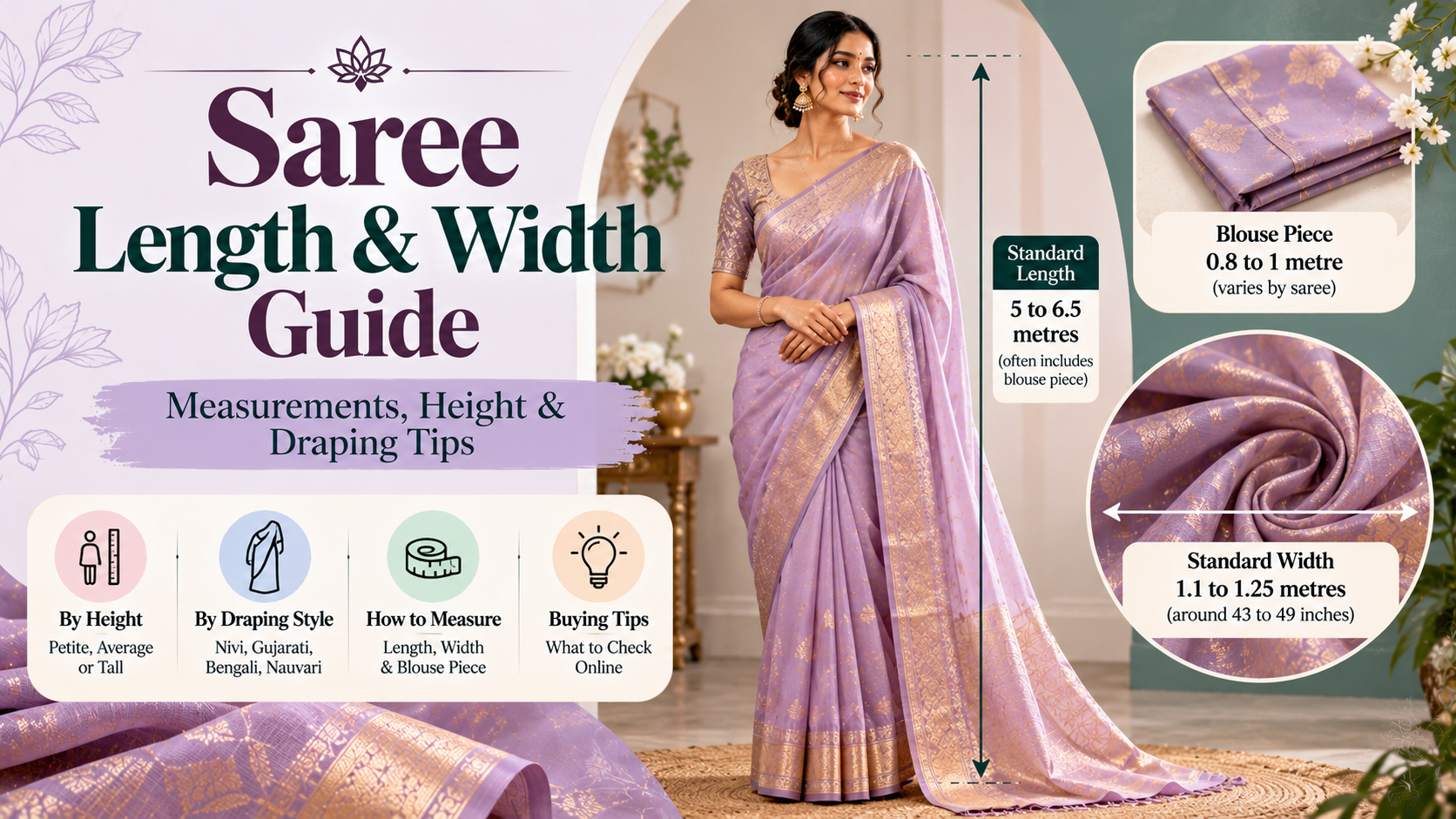
Most product listings mention a saree’s length and width, but few explain what those numbers mean when you actually drape it. Is 5.5 metres enough? Does the blouse piece come out of that length? Will a taller person need more fabric? And why does a nine-yard saree exist at all?
This saree length and width guide answers those questions in plain terms. It explains typical measurements, how height, drape, pleats and footwear affect the fit, and what to check before you buy online. One point to keep in mind throughout: measurements vary by manufacturer, region and design, so always confirm the dimensions listed for the specific saree.
Typical saree measurements
Standard saree length
Many sarees sold for the common Nivi drape are around 5 to 6.5 metres long in total. This often includes a blouse piece. When the blouse piece is attached, the drapeable length is commonly around 5 to 5.5 metres.
These are typical ranges, not fixed standards. Some sarees are shorter or longer depending on the maker and design.
Longer drapes
Some traditional drapes, such as the Nauvari, use a longer saree, commonly described as nine yards (roughly 8 metres or more). If you plan to wear a regional drape, check the length needed for that style specifically.
Saree width
Saree width is commonly around 1.1 to 1.25 metres (roughly 43 to 49 inches). Width affects how far the saree falls from your waist towards the floor.
Blouse piece
A blouse piece is often around 0.8 to 1 metre long, depending on the saree. It may be:
- Attached to the end of the saree and meant to be cut off
- Supplied as a separate piece
- Not included at all
If the listing says the total length includes the blouse piece, subtract it to understand the drapeable length.
Fabric dimensions vs the finished drape
The listed dimensions describe the flat fabric. How the saree looks when worn depends on:
- How many pleats you make and how wide they are
- How long you keep the pallu
- How high you tie the saree at the waist
- How many times the fabric wraps around the body
- Fabric thickness, since heavier fabrics take up more length in pleats
Two people with the same saree can end up with quite different results.
How height, drape and footwear affect the fit
Height
Height affects the width you need more than the length. Saree width needs to reach close to the floor from the point where you tie it.
- If you are on the shorter side, a standard width usually reaches the floor easily. You can tuck any extra width into the petticoat at the waist.
- If you are taller, check that the width is enough to reach the floor with your footwear on.
Length also matters for taller wearers, since wrapping around the body and forming pleats may use a little more fabric.
Preferred drape
- Nivi drape: works with most standard-length sarees.
- Gujarati or seedha pallu: usually similar length; the pallu comes over the front.
- Bengali drape: may use a little more length for the pleats and pallu style.
- Nauvari and some other regional drapes: often need a longer saree.
Pleat style
More pleats, or wider pleats, use more fabric. If your saree is on the shorter side, use fewer or narrower pleats.
Pallu length
A longer pallu uses more fabric. With a shorter saree, you can keep the pallu shorter or pin it at the shoulder.
Footwear
Heels raise you, so the saree may need to fall lower. Always check the drape wearing the footwear you plan to use. For tips on petticoat length and how it supports the drape, see our guide on how to choose a saree petticoat.
Measurement considerations table
| Consideration | What to check | Suitable use case |
| Total length (with blouse piece) | Listed length and whether the blouse piece is included | Comparing sarees online |
| Drapeable length | Total length minus blouse piece | Planning Nivi or other common drapes |
| Width | Whether it reaches the floor from your tying point, with footwear | Taller wearers, heels |
| Longer length (e.g. nine yards) | Length needed for the specific regional drape | Nauvari and similar drapes |
| Blouse-piece length | Enough fabric for your preferred blouse design | Long sleeves, high necks, extra lining |
| Fabric weight | Heavier fabrics use more length in pleats | Silk, brocade, embellished sarees |
Practical advice by height
Petite wearers
- A standard saree width usually reaches the floor comfortably; tuck the extra at the waist.
- Narrower or fewer pleats can look neater.
- A slightly shorter pallu can feel easier to manage.
- If you prefer, choose lighter fabrics that do not add bulk at the waist.
- Petite saree wearers can absolutely wear wide borders and long pallus; try the drape and adjust.
Average height
- Most standard-length, standard-width sarees work well.
- Adjust pleat count and pallu length to your preference.
- Check the drape with your usual footwear.
Taller wearers
- Check the width carefully so the saree reaches close to the floor.
- Check the drapeable length, especially if you like a long pallu or many pleats.
- Look for sarees with a longer listed length if standard ones feel short.
- Tie the saree at a comfortable height; tying slightly lower can help if the width is borderline, as long as it feels secure.
These are suggestions, not rules. Your comfort and preferred look matter most. For more on choosing by height, fabric and silhouette, see our guide on how to choose a saree based on body type, height and comfort.
Checklist before buying online
- Total length stated
- Whether the blouse piece is included, attached or separate
- Blouse-piece length
- Drapeable length (total minus blouse piece)
- Width stated
- Width compared with your waist-to-floor measurement, with footwear
- Length suitable for your preferred drape
- Fabric weight and how it might affect pleats
- Return or exchange policy if the size does not suit
For more on checking listings, photos and seller details, see our online saree shopping guide.
Frequently asked questions
What is the standard saree length?
Many sarees are around 5 to 6.5 metres in total, often including a blouse piece. Lengths vary by manufacturer and design, so check the listing.
What is the usual saree width?
Saree width is commonly around 1.1 to 1.25 metres, though it can vary.
How much fabric is needed for a saree?
For a common Nivi drape, a drapeable length of around 5 to 5.5 metres is typical. Regional drapes such as the Nauvari often need more.
Does the saree length include the blouse piece?
Often, yes. Check the listing to see whether the blouse piece is included in the total length.
What saree length suits short height women?
Standard lengths usually work well. Adjust pleats and pallu length, and tuck extra width at the waist.
Do tall women need longer sarees?
Not always, but taller wearers should check that the width reaches the floor and that the length allows their preferred drape.
Can I adjust a saree that feels too short?
You can use fewer pleats, a shorter pallu or tie it slightly lower. Very short sarees may not suit every drape.
Conclusion
A good saree length and width guide starts with the listed measurements but does not end there. Check the total and drapeable length, confirm the width against your height and footwear, consider your preferred drape and pleat style, and plan for the blouse piece. With those details confirmed, choosing the right size becomes much simpler.
For more help choosing fabrics and styles, read our complete guide to buying sarees for women. Then explore sarees at Mahavir Cloth Center and check the measurements of any saree that catches your eye.
