
Blog
Navratri Hairstyles for Long Dance Nights: Braids, Buns and Festive Hair Accessories

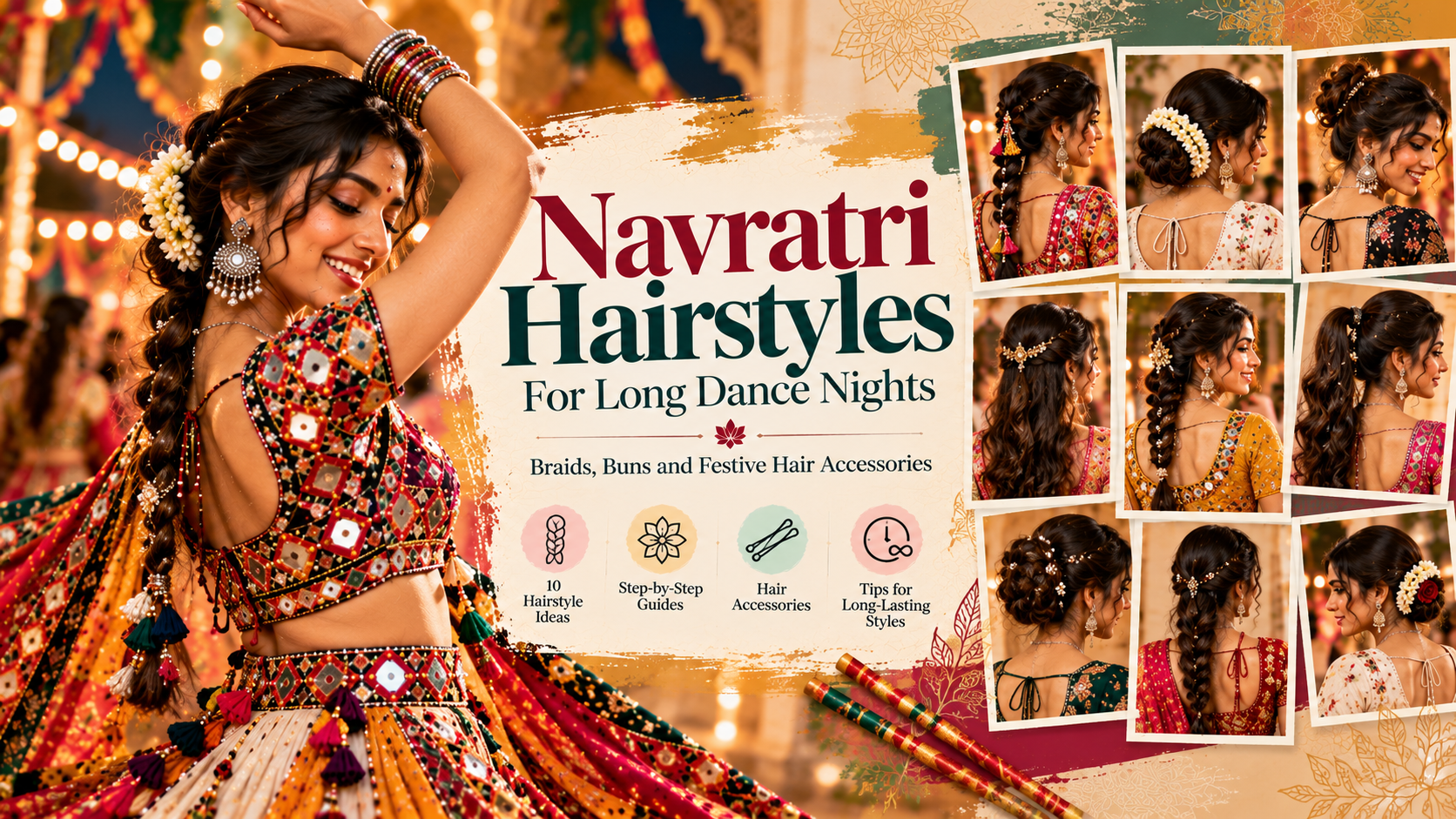
A Navratri hairstyle has to look good in photos at 8 pm and still be in place at 1 am, after hours of spinning, clapping and moving through crowds. Hair that falls in your face during Garba, a bun that loosens halfway through Dandiya, or pins that dig into your scalp can take the fun out of a night you have been planning for weeks. A good festive hairstyle balances three things: it suits the outfit, it is comfortable to wear for hours, and it holds up to movement.
This guide covers ten Navratri hairstyles, from traditional braids to practical ponytails, with preparation steps, styling instructions, suitable hair lengths and outfit pairings for each. It also covers how to choose a style for each occasion, which accessories work best and how to keep your hair in place through a long event. If you are still planning outfits, start with our Navratri Outfit Ideas 2026 guide.
How to choose a hairstyle
Four factors narrow down the options quickly.
Hair length
Short hair (above the shoulders) suits half-up styles, small braids at the front and accessories such as clips. Medium hair (shoulder to mid-back) works with most buns, ponytails and braids. Long hair gives you the full range, but it is also heavier, so styles that secure the weight close to the head are more comfortable for dancing.
Hair texture
Fine, straight hair can be slippery and lets pins slide out, so it often holds better with a little texture added first. Thick or curly hair holds braids and buns well but may need more pins. Wavy hair suits loose, soft styles with secured front sections.
Outfit
A heavy, embroidered lehenga often looks balanced with a neat bun or braid that does not compete with the outfit. A backless or back-tie blouse looks best with hair pulled up or to the side so the back stays visible. A high-neck blouse also looks cleaner with hair up.
Occasion
Garba and Dandiya call for secure, tied-up styles. Puja and family gatherings allow softer styles since you will be moving less. Decide what you will mostly be doing that evening and choose for that.
Hairstyles for Navratri
1. Traditional three-strand braid
Preparation: detangle your hair thoroughly. Lightly dampen very fine hair or apply a small amount of texturising product if you use one; this is optional.
Steps:
- Comb all your hair back and gather it at the nape, or slightly higher.
- Divide it into three equal sections.
- Cross the right section over the middle, then the left over the new middle.
- Repeat down the length and secure the end with an elastic.
- If you like, gently pull the edges of each section outward to make the braid look fuller.
Suitable hair lengths: medium to long.
Outfit pairings: chaniya cholis, traditional lehengas and cotton suits. A long braid with a parandi (a decorative tasselled hair extension) is a classic look with traditional outfits.
Practical advantages: it keeps all the hair together and stays in place well during dancing. It is also easy to redo if it loosens.
2. Fishtail braid
Preparation: detangle and brush smooth. Fishtails hold better on hair that is not freshly washed and slippery.
Steps:
- Gather your hair into a low ponytail and split it into two equal sections.
- Take a thin strand from the outer edge of the right section and cross it over to join the left section.
- Take a thin strand from the outer edge of the left section and cross it over to the right.
- Repeat, keeping the strands thin and even, until you reach the end.
- Secure with an elastic. Remove the initial ponytail tie if you used one, or keep it for extra hold.
Suitable hair lengths: medium to long.
Outfit pairings: Indo-western outfits, sharara sets and lehengas with a contemporary feel.
Practical advantages: the tight weave holds well and looks detailed without accessories. It takes longer to create than a three-strand braid, so practise beforehand.
3. Braided bun
Preparation: detangle and decide where you want the bun to sit.
Steps:
- Gather hair into a ponytail at the height you want.
- Braid the ponytail into a three-strand braid and secure the end.
- Wrap the braid around the base of the ponytail in a coil.
- Tuck the end under and secure with U-pins or bobby pins around the coil.
Suitable hair lengths: medium to long.
Outfit pairings: lehengas, sarees and chaniya cholis, especially with backless or back-tie blouses.
Practical advantages: a braided bun is one of the most secure festive hairstyles because the braid holds the hair before it is even pinned. It works very well for long Garba nights.
4. Low bun with flowers
Preparation: detangle and apply a little hairspray or serum if you want a smoother finish (optional).
Steps:
- Gather hair into a low ponytail at the nape and secure it.
- Twist the ponytail and coil it around its base.
- Pin the coil firmly with U-pins, pointing them into the base of the bun.
- Wrap a gajra (a string of jasmine or other flowers) around the bun and pin it at both ends.
Suitable hair lengths: medium to long.
Outfit pairings: silk sarees, traditional lehengas and suits for puja.
Practical advantages: a low bun is comfortable to wear for hours because the weight sits low. Fresh flowers are heavy and wilt, so pin them securely and remove them if they start to feel uncomfortable.
5. High bun with decorative accessories
Preparation: brush hair smooth and decide whether you want a sleek or textured look.
Steps:
- Brush all your hair up and secure a high ponytail at the crown.
- Twist the ponytail and wrap it around the base.
- Pin with U-pins and a few bobby pins.
- Add decorative pins, a bun cage or a small hair chain around the bun.
Suitable hair lengths: medium to long.
Outfit pairings: Indo-western outfits, lehengas with statement earrings and high-neck blouses.
Practical advantages: it keeps hair completely off the neck and face, which can feel cooler during dancing. Very long, heavy hair can make a high bun feel weighty; split the ponytail into two parts and coil them separately if so.
6. Half-up, half-down hairstyle
Preparation: detangle. Curl or wave the lengths first if you want more volume (optional).
Steps:
- Separate the top section of hair from temple to temple.
- Gather it at the back of the crown.
- Secure it with an elastic, a twist or a small braid.
- Add a decorative clip over the tie.
- Leave the rest of the hair loose.
Suitable hair lengths: short to long.
Outfit pairings: suits, anarkalis and lehengas for family gatherings.
Practical advantages: it keeps hair out of the face while still showing length. The loose section can become tangled during energetic dancing, so it suits puja and gatherings more than Garba.
7. Soft waves with a secured front section
Preparation: wave or curl the hair with heat tools or overnight braids, using a heat protectant if you use heat.
Steps:
- Create loose waves through the lengths.
- Take a section from the front on each side.
- Twist each section back and pin it behind the ears or at the back of the head.
- Finish with light hairspray if you want the waves to last longer (optional).
Suitable hair lengths: medium to long.
Outfit pairings: sarees, Indo-western outfits and evening party looks.
Practical advantages: it looks soft and festive while keeping hair off the face. Waves loosen with movement and humidity, so this is better for gatherings than for long dance sessions.
8. Ponytail with festive detailing
Preparation: brush hair smooth and tie it at the height you prefer.
Steps:
- Tie a mid or high ponytail and secure it tightly.
- Take a thin strand from the ponytail and wrap it around the elastic to hide it, pinning the end underneath.
- Add detailing: a small braid running into the ponytail, beads, gold thread or ponytail cuffs along its length.
Suitable hair lengths: medium to long.
Outfit pairings: chaniya cholis, crop-top lehengas and Indo-western sets. For more ideas, see our Indo-Western Navratri Outfit Ideas.
Practical advantages: quick to create and easy to tighten during the evening. The ponytail swings while dancing, so keep it at mid height if you are near other dancers.
9. Side braid with hair accessories
Preparation: detangle and decide which side the braid will fall on, usually opposite the dupatta.
Steps:
- Part your hair and sweep it to one side.
- Braid it loosely (three-strand or fishtail) over one shoulder.
- Secure the end.
- Add small decorative pins, flowers or a strip of gota along the braid.
Suitable hair lengths: medium to long.
Outfit pairings: lehengas with one-shoulder dupattas, sarees and backless blouses.
Practical advantages: it shows off the hair and accessories at the front, which looks good in photographs. It can rest on a heavy dupatta or blouse embroidery, so check that accessories do not catch on them.
10. Simple low ponytail for practical styling
Preparation: brush hair smooth.
Steps:
- Gather your hair at the nape.
- Secure with a strong elastic.
- Wrap a section of hair or a ribbon around the elastic.
- Add a single decorative clip if you want (optional).
Suitable hair lengths: short-medium to long.
Outfit pairings: ethnic suits, cotton outfits and daytime events.
Practical advantages: it is the quickest style here and works when you have little time or want something low-maintenance after a long day. It looks plain on its own, so add an accessory or a parandi for a festive touch.
Hairstyles by outfit
Chaniya choli: long braids with a parandi, braided buns and ponytails with festive detailing suit the traditional look, and buns show off back-tie blouses. Our Chaniya Choli Styling Guide covers matching jewellery and dupattas.
Sarees: low buns with flowers, soft waves and side braids pair well. A low bun suits the drape of the pallu over the shoulder.
Ethnic suits: half-up styles, low ponytails and simple braids look neat with kurtas and anarkalis.
Indo-western outfits: high buns, fishtail braids and sleek ponytails suit the modern lines of these outfits.
Hairstyles for Garba and Dandiya
The essential goal for dancing is hair that stays tied and away from your face, neck and hands.
- Tie it up. Braids, braided buns and ponytails are the most secure. Leave loose waves for gatherings.
- Anchor the base firmly. A loose elastic is the main reason styles fall apart. Use a strong, snag-free elastic and pin the base of buns.
- Control the front. Pin or braid the front section back so it does not fall in your eyes while you spin.
- Avoid accessories with sharp edges or hooks. Metallic chains and large pins can catch on dupattas, blouse embroidery and other dancers’ clothing.
- Keep long braids from swinging too freely. A very long braid can hit you or someone nearby during fast turns. A braided bun avoids this.
- Pick accessories that are light. Heavy accessories pull on the scalp over several hours.
For more on staying comfortable through the night, read our guide to Comfortable Navratri Outfits for Long Garba Nights.
Daytime puja versus evening celebrations
Daytime puja: keep it simple and neat. Low buns, simple braids and low ponytails suit the setting and allow you to cover your head with a dupatta comfortably. Fresh flowers work well for puja. Avoid tall buns if you plan to cover your head, since the dupatta will not sit properly.
Evening celebrations: you can be more decorative. High buns with accessories, ponytails with detailing and side braids look festive under lights. For dancing, choose a secure style even if it is decorative.
Festive hair accessories
Flowers: gajras and loose flowers suit traditional looks. Fresh flowers smell lovely but wilt and are heavier; artificial flowers last the whole night.
Decorative pins: small embellished pins add detail to buns and braids. Use a few rather than many.
Hair chains: chains draped around a bun or across the back of the head look elegant. Choose lightweight ones and pin them securely.
Clips and barrettes: good for half-up styles and short hair, and easy to add or remove.
Parandi: a traditional tasselled braid accessory that adds length and colour to braids.
Hair cuffs and beads: these suit braids and ponytails and look playful with Indo-western outfits.
Maang tikka and matha patti: these sit on the parting and pair well with buns. Balance them with your earrings so the face does not look crowded.
Whatever you choose, check for sharp edges or hooks that might catch on fabric.
Basic preparation and styling tools
Essential:
- A wide-tooth comb for detangling.
- A paddle brush or bristle brush for smoothing.
- A tail comb for neat partings and sections.
- Snag-free elastics in a colour close to your hair.
- Bobby pins and U-pins. U-pins hold buns; bobby pins secure smaller sections.
Optional:
- Dry shampoo or texturising spray to add grip to fine or freshly washed hair.
- Hairspray for flyaways and extra hold.
- Serum or oil for smoothness on the lengths.
- Heat tools such as a curling iron or straightener, used with a heat protectant.
- A bun donut for a fuller bun if your hair is fine.
How to make a hairstyle last through a long event
- Prepare the hair. Very clean, silky hair is more slippery. Some people find day-old hair or a little texturising product helps styles hold.
- Build on a secure base. A tight ponytail or braid under a bun is more secure than twisting loose hair.
- Cross the pins. Inserting bobby pins in an X shape holds better than a single pin.
- Point U-pins into the base. Push them into the bun and the hair underneath, not just the surface.
- Use hairspray lightly if you like. It can help control flyaways.
- Carry a small touch-up kit. A few pins, an elastic and a mini comb let you fix the style during the evening.
- Test before the event. Wear the hairstyle at home and move around in it to check that it holds.
No hairstyle is guaranteed to last a set number of hours; hold depends on your hair, the weather and how much you dance. Checking it every so often is the practical approach.
Common hairstyling mistakes and practical fixes
- Loose base. The style collapses. Fix: tighten the elastic and pin the base.
- Too many heavy accessories. They pull and give headaches. Fix: choose one or two light accessories.
- Pins only on the surface. The bun loosens. Fix: push pins into the base and cross them.
- Leaving the front loose for dancing. Hair falls in your face. Fix: pin or braid the front back.
- Trying a new style on the day. It takes too long or does not hold. Fix: practise at least once before.
- Ignoring the outfit’s neckline. Loose hair hides a detailed back. Fix: tie hair up or to the side for back-tie blouses.
- Accessories that catch on fabric. They snag the dupatta. Fix: avoid hooks and sharp edges near the dupatta’s side.
Navratri hairstyles compared
| Hairstyle | Suitable hair length | Outfit pairing | Maintenance |
| Three-strand braid | Medium to long | Chaniya choli, lehenga, suit | Low; easy to redo |
| Fishtail braid | Medium to long | Indo-western, sharara | Moderate; takes practice |
| Braided bun | Medium to long | Lehenga, saree, chaniya choli | Low; very secure |
| Low bun with flowers | Medium to long | Saree, traditional lehenga | Moderate; flowers wilt |
| High bun with accessories | Medium to long | Indo-western, high-neck blouses | Moderate; heavy hair needs splitting |
| Half-up, half-down | Short to long | Suit, anarkali, lehenga | Moderate; loose part tangles |
| Soft waves, secured front | Medium to long | Saree, Indo-western | Higher; waves loosen |
| Ponytail with detailing | Medium to long | Chaniya choli, crop-top lehenga | Low; easy to tighten |
| Side braid with accessories | Medium to long | Lehenga, saree, backless blouse | Moderate; check accessories |
| Simple low ponytail | Short-medium to long | Suit, daytime outfits | Very low |
Frequently asked questions
1. What is the best hairstyle for Garba? A braided bun or a firmly tied braid is the most secure, since all the hair is held together and away from your face.
2. Which hairstyle suits a lehenga? Buns suit most lehengas, especially with backless or detailed blouses. Side braids and half-up styles also work, depending on the neckline.
3. How do I keep my bun from falling during dancing? Start with a tight ponytail, wrap the hair firmly and push U-pins into the base of the bun. Cross bobby pins for extra hold.
4. What are easy Navratri hairstyles for short hair? Half-up styles, small front braids pinned back and decorative clips work well with short hair.
5. Are fresh flowers good for long events? They look and smell lovely but wilt and can be heavy. Pin them securely, or use artificial flowers for a long night.
6. Which hair accessories should I avoid for Dandiya? Avoid heavy pieces and anything with hooks or sharp edges that can catch on your dupatta, blouse or other people’s clothing.
7. Do I need hairspray? It is optional. It helps control flyaways and add hold, but a well-secured style can last without it.
8. Should I wash my hair on the day of the event? Very freshly washed hair can be slippery and hard to style. If you wash it the same day, a little texturising product or dry shampoo can add grip.
Conclusion
For Garba and Dandiya, choose a braided bun, a firm braid or a mid-height ponytail, and pin the front back so nothing falls in your face. For puja, a low bun with flowers or a simple braid is neat and easy to cover. For evening parties, high buns, side braids and soft waves give a more decorative finish.
Practise your chosen style once before the event, use strong elastics and properly placed pins, and keep accessories light and free of hooks. Carry a small kit of pins and an elastic, and you will be able to fix your hair quickly if it loosens during the night.
