Blog
How to Choose the Right Kids Clothing Size When Shopping Online

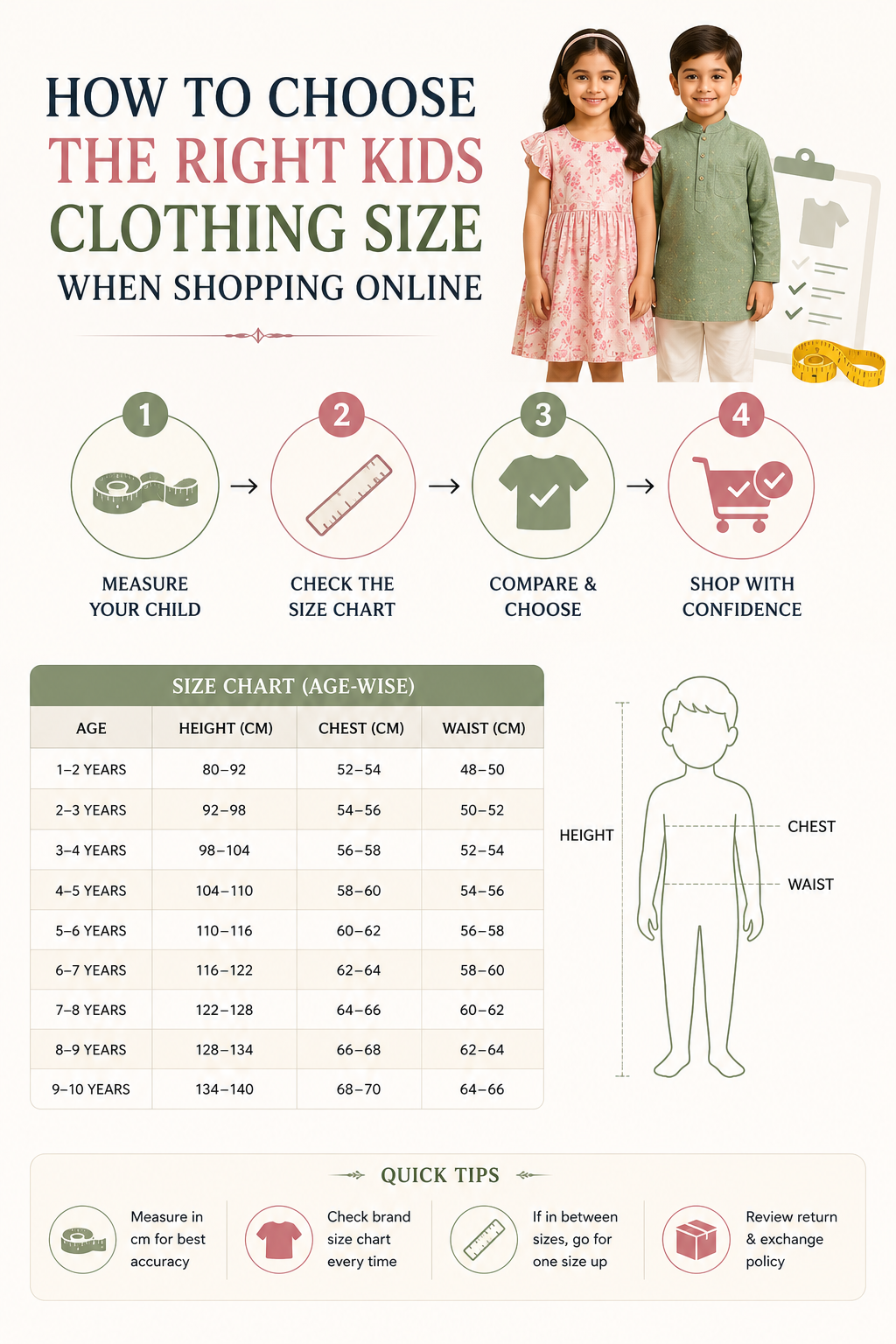
Every parent who has shopped for children's clothing online has had this experience at least once: the package arrives, the outfit looks exactly as beautiful as it did in the photos, and then it does not fit. Too tight at the shoulders. Too short at the ankle. A waistband that needs to be pulled in with a safety pin. The size label said it should fit — and somehow, it does not.
This happens for a very specific and very fixable reason. Children's clothing sizing is far less standardised than adult sizing, and it varies significantly between brands, regions, and even individual product lines from the same store. A "6-7 years" label from one brand can fit a completely different child than a "6-7 years" label from another. Age-based sizing, while convenient, is the least reliable method of all.
This guide walks through exactly how to choose the right size every time you shop for kids' clothing online — removing the guesswork and the frustration, and replacing it with a simple, repeatable process.
Why "Age-Based" Sizing Is the Least Reliable Method
Almost every kids' clothing size label includes an age range — "2-3 years," "8-9 years," and so on. It feels like the most natural way to shop, since you know exactly how old your child is. Unfortunately, it is also the least precise.
| Sizing Method | Reliability | Why |
|---|---|---|
| Age-based (e.g., "5-6 years") | Low | Assumes an average build; ignores individual height and weight variation |
| Height-based (e.g., "110 cm") | Good | More precise than age, but does not account for build or weight |
| Body measurement-based (chest, waist, length) | Best | Matches the actual garment dimensions to your child's actual body |
| Brand-specific size chart | Essential alongside measurements | Different brands cut differently even at the same labelled size |
How to Measure Your Child Correctly Before Ordering
This is the single most valuable five minutes you can spend before placing an online order. A soft tape measure, a wall, and a slightly patient child are all you need.
Height
Chest
Waist
Length (Sleeve, Inseam & Garment)
5 Rules for Reading Online Size Charts Correctly
5 Common Sizing Mistakes Parents Make While Shopping Online
The single most common mistake. Age ranges are a rough guide at best — they ignore your child's actual height, weight, and build, which can vary widely even among children born in the same month.
Children grow quickly, especially during growth spurts. A measurement taken six months ago may already be outdated. Always measure close to the time of purchase, particularly before buying occasion wear for an upcoming event.
Many parents check a brand's general size guide once and assume it applies to every product from that brand. Some specific items — especially heavily embellished or structured pieces — run differently from the brand's standard chart.
An outfit meant to be worn for a few hours at a wedding can be sized closer to exact measurements. An outfit meant for daily school wear over several months should be sized with growing room in mind.
Even with careful measuring, online sizing occasionally goes wrong. Before purchasing, confirm the seller's return or exchange policy for kids' clothing — this is your safety net if the fit is not right.
One of the most reliable shortcuts is measuring a similar garment your child already owns and wears comfortably — lay it flat and measure chest, length, and sleeve directly, then compare to the new product's listed dimensions.
Sizing Up: When It Helps and When It Hurts
- Daily wear and school clothing meant to last several months
- Elasticated or drawstring waistbands — adjust easily to a slightly larger size
- Clothing bought several weeks or months ahead of an event
- Children currently in a known growth spurt
- Layered outfits where a slightly looser kurta still looks intentional
- Fitted occasion wear like sherwanis, lehengas, or structured blouses
- Outfits needed for an event happening very soon — fit should be current, not future
- Garments with fixed buttons or hooks rather than adjustable closures
- Photography-focused occasions where a precise, polished fit matters visually
Sizing Guide by Garment Type
| Garment Type | Key Measurement | Sizing Approach |
|---|---|---|
| Kurta pyjama / Salwar kameez | Chest, height, waist | Match chest first; elasticated waist allows some flexibility |
| Sherwani | Chest, shoulder, height | Size precisely — structured fit needs accurate chest and shoulder match |
| Lehenga choli | Chest, waist, height | Choli (blouse) needs precise chest fit; lehenga length matters for height |
| Sharara / Palazzo set | Waist, height, chest | Elasticated waist forgiving; check length so hem does not drag |
| Dhoti kurta | Height, chest | Dhoti pyjama-style bottoms are size-flexible; kurta chest fit matters most |
| Daily cotton sets | Chest, height | Slight size-up acceptable for extended daily wear over months |
Frequently Asked Questions
Should I size up or size down if my child is between two sizes?
In almost all cases, size up. A slightly larger kids' garment is more comfortable, allows room for growth, and is easy to manage with a belt, tuck, or roll-up of sleeves or hems if needed. A garment that is too small is uncomfortable, restricts movement, and cannot be fixed without alteration. The only exception is highly structured, fitted occasion wear like a sherwani or fitted blouse, where a precise fit matters more for appearance — in that specific case, size as close to exact measurements as possible.
How often should I re-measure my child for online shopping?
Re-measure every three to four months for young, fast-growing children, and roughly every six months for older children and pre-teens whose growth has slowed slightly. Always re-measure just before a significant purchase, particularly for occasion wear tied to a specific upcoming event, since even a recent measurement can be outdated if your child has had a sudden growth spurt.
What should I do if a brand only lists age ranges, not measurements?
Look for the brand's general size chart, usually linked separately from the individual product page — most reliable kids' clothing sellers provide one even if the product listing itself only shows age. If no measurement chart is available anywhere on the site, look at customer reviews for fit feedback, or contact the seller directly to ask for chest, waist, and height equivalents before ordering. Avoid ordering blind from age alone if any other information is available.
Does fabric type affect what size I should choose?
Yes, significantly. Stretchy or knit fabrics like cotton jersey have natural give and are more forgiving if you are between two sizes — the smaller size will often still work comfortably. Stiff, structured, or heavily embellished fabrics like net, brocade, or dense embroidery have little to no stretch, so an imprecise size is much more noticeable and uncomfortable. When in doubt with non-stretch fabrics, always choose the larger of two sizes.
Is it better to buy kids' festival outfits well in advance or closer to the date?
For everyday clothing, buying in advance with a slightly larger size is practical, since the garment will be worn over several months as the child grows into it. For specific occasion wear like a wedding or festival outfit, it is best to measure and buy as close to the event date as reasonably possible — ideally three to four weeks ahead — so the size reflects your child's current measurements rather than a guess about future growth, while still leaving enough time for any exchange if the fit needs adjustment.
Final Thoughts
It is a measurement taken from your own child,
matched honestly against what the seller actually offers —
not guessed from an age range and hoped for the best.
Online shopping for kids' clothing does not have to be a gamble. A tape measure, five minutes of your child's patience, and a habit of checking the specific size chart before every purchase will eliminate almost every sizing disappointment you have experienced in the past. Measure first. Compare carefully. Read the reviews. And always know the return policy before you click buy — just in case.
At Mahavir Cloth Center, our Kids Ethnic Wear collection comes with clear, accurate size guidance for every product — so you can shop online with confidence and find the perfect fit for every age and occasion.
Visit Us & Explore the Collection →Explore our full range of Sarees, Kurta Suit Sets, Sharara Sets, and Kids Ethnic Wear at mahavirclothcenter.com.