
Blog
Paithani Saree Guide: History, Motifs, Weaving and Traditional Significance

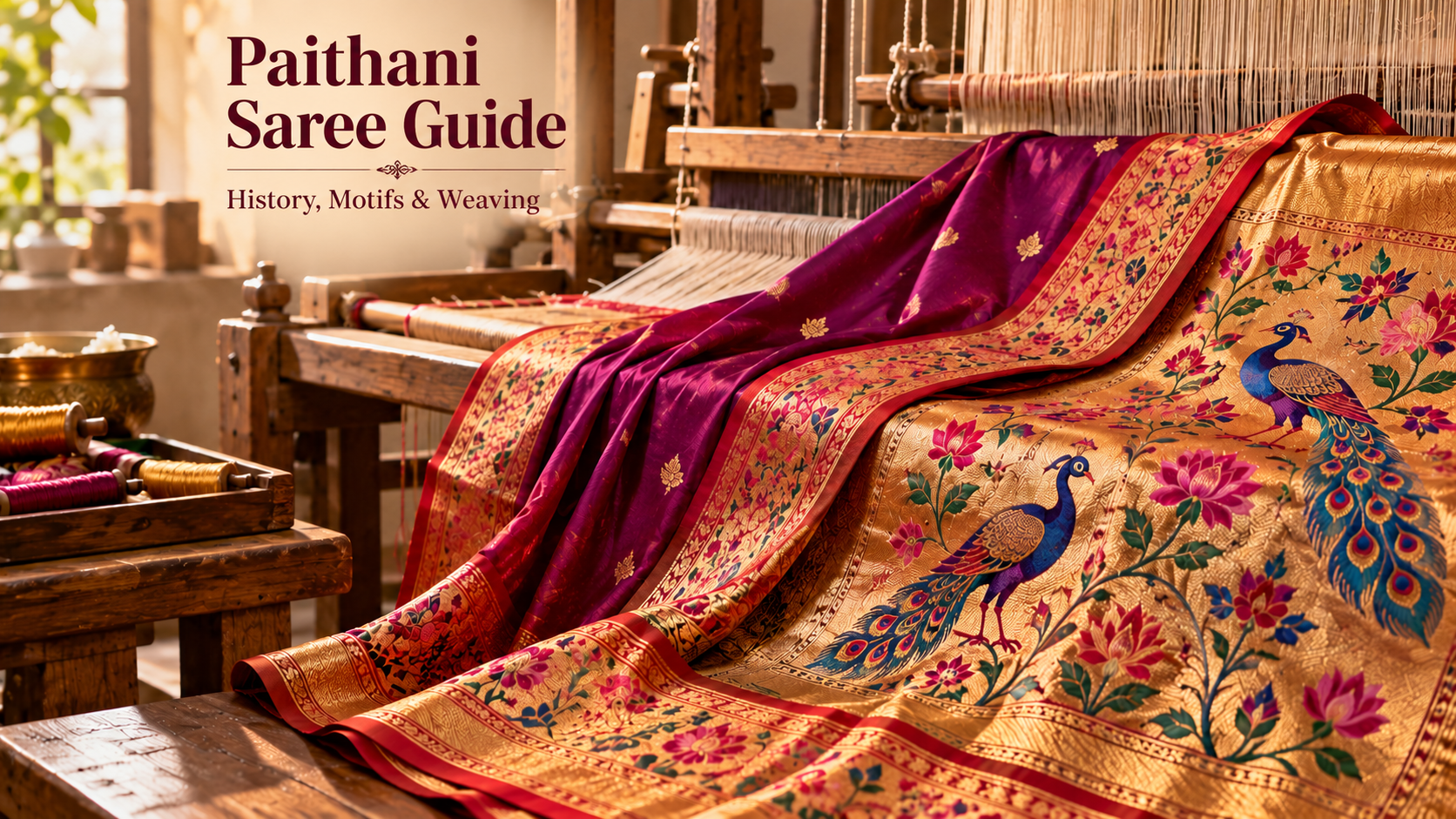
The Paithani saree is one of Maharashtra’s best-known textile traditions. Recognised for its lustrous silk, richly patterned pallu and detailed zari work, it brings together design, technical skill and cultural memory. Its beauty is not defined by colour or shine alone: the arrangement of motifs, the way the decorative weft is woven, and the relationship between the body, border and pallu all contribute to its distinctive identity.
Paithani is closely associated with Paithan, a historic town in Maharashtra, and with the weaving communities that have sustained the craft across generations. Today, the tradition is also strongly associated with Yeola, another important weaving centre. While contemporary designs respond to changing preferences, traditional Paithani motifs and weaving knowledge remain central to the textile’s appeal.
This guide explores the heritage of Paithani, the meaning and structure of its motifs, how silk and zari are used, how a pallu is created, and what readers can look for when learning about the craft. It focuses on the textile’s history and making—not on a general saree-buying checklist.
What Makes a Paithani Saree Distinctive?
A Paithani is a saree tradition associated with Maharashtra, traditionally woven using silk and decorative zari. Its identity comes from a combination of construction and design features rather than any single colour or ornament.
Common characteristics include:
- A silk body: The main field may be plain, checked, striped or decorated with small woven motifs.
- A patterned border, or kath: The border frames the body and may use zari, coloured silk, or both.
- A decorative pallu, or padar: The end section is often the most elaborate part, with carefully arranged birds, flowers, vines or geometric forms.
- Woven motifs: In traditional work, designs are built into the fabric during weaving rather than simply printed on the surface.
- Contrasting colours: Many traditional examples use a body and pallu in contrasting shades, though matching and softer colour combinations are also seen today.
Paithani designs vary by weaver, period, material, and intended complexity. Not every saree carries every traditional feature, and a bright colour or a gold-looking border by itself does not establish that a saree is a traditional Paithani.
A Brief History of Paithani in Maharashtra
Paithan and its textile heritage
The name Paithani comes from Paithan, a historic settlement on the Godavari River in present-day Maharashtra. The town was known historically as Pratishthana and was an important centre of trade and political life in the Deccan. The wider region’s textile history is long, although the exact chronology of particular Paithani design features is difficult to establish with certainty.
Institutional accounts describe Paithani as a heritage weaving tradition with roots extending back many centuries. The craft developed through changing patterns of trade, patronage, materials and artistic influence. It is more accurate to understand its history as an evolving textile tradition than to assign every modern motif to one precise date without evidence.
Royal patronage and changing design
Paithani became especially associated with prestige and ceremonial clothing. Accounts of the tradition describe patronage during the Maratha and Peshwa periods, when elaborate silk textiles and metallic-thread work were valued by affluent households and courts. Motifs and decorative arrangements changed over time as weavers encountered different artistic influences and responded to patrons’ preferences.
The pallu and borders offered space for elaborate design. Birds, flowers, vines and stylised geometric arrangements could be made more intricate through careful placement of coloured silk and zari. Such details were not merely decorative additions: they demonstrated the weaver’s command of the loom and the planning required to keep a complex pattern balanced across the fabric.
Decline, adaptation and revival
Like many handloom traditions, Paithani faced challenges as industrially produced textiles became more widely available and the cost of skilled handweaving remained high. The time, materials and specialist knowledge needed for intricate designs made it difficult for traditional producers to compete solely on price.
Public and institutional efforts have helped support the craft, training and production in Paithan and surrounding weaving areas. Yeola also became a significant Paithani centre as weaving knowledge and production developed in the region. Today, Paithani is both a living craft and a symbol of Maharashtra’s textile heritage. Its continuity depends not only on preserving old designs but also on sustaining skilled work and making the craft viable for newer generations.
Understanding Paithani Motifs
Motifs are among the most recognisable features of Paithani. They may appear on the body, border or pallu, with the pallu often carrying the most elaborate composition. Names and forms can vary between weaving traditions and sellers, so motif descriptions should be treated as useful identifiers rather than a guarantee of a particular origin or date.
Peacock motifs
The peacock, or mor, is one of the best-known Paithani motifs. It may appear as a single bird, as a pair, or as part of a larger symmetrical composition. Peacock designs can be highly stylised: the outline, tail and body are formed through coloured silk and metallic-looking thread, with the final appearance depending on the chosen colours and weaving technique.
One celebrated arrangement is bangdi mor, in which peacocks are organised in a circular or bangle-like composition. This pattern can require careful coordination of multiple colours and small areas of woven detail. The complexity of the design depends on its scale and execution; a motif’s name alone does not tell the whole story of its construction.
Parrots and tota-maina designs
Parrots, often referred to as tota, are another traditional bird motif. In some designs, birds appear in pairs or are combined with other decorative elements. Tota-maina is a familiar name associated with paired-bird patterns in Indian textile traditions, including Paithani.
These motifs can create rhythm across a border or pallu. Their repeated shapes help balance a composition, while differences in colour and placement keep the design from appearing flat. When looking at a saree, notice whether the birds are woven into the fabric and how the motif relates to the surrounding border and pallu.
Lotus and other floral motifs
The lotus, or kamal, is a prominent floral form in many Indian decorative arts. In Paithani, lotus motifs may appear as individual flowers, repeated floral units or part of a larger arrangement. Petals are built from coloured thread, and their shape can be emphasised by contrast with zari.
Other floral and plant-inspired motifs include asawali, commonly associated with a flowering vine, and anarvel, a pomegranate-related vine design. The exact interpretation and spelling of motif names may differ across sources and local usage. Floral motifs bring movement to the design, linking separate elements into a continuous pattern.
Geometric and small repeated motifs
Paithani designs are not limited to birds and flowers. Small butis, dots, checks, stripes, coin-like forms and other repeated patterns may decorate the body. These smaller elements can create texture and visual balance without competing with an elaborate pallu.
A body covered with small motifs can feel very different from a plain silk field, even when both use similar colours. The spacing of motifs, the scale of the pattern and the contrast between silk and zari all affect the overall effect.
Paithani Design Vocabulary at a Glance
| Design element | Common form or name | Where it may appear | What to notice |
|---|---|---|---|
| Peacock | Mor | Pallu, border | Feather shapes, colour changes and composition |
| Circular peacock arrangement | Bangdi mor | Often the pallu | Symmetry and the way birds form a circular pattern |
| Parrot | Tota | Border, pallu or body | Bird shape and repeated placement |
| Paired-bird design | Tota-maina | Border or pallu | Relationship between paired figures |
| Lotus | Kamal | Pallu or decorative field | Petal definition and contrast |
| Flowering vine | Asawali | Border or pallu | Flowing stems and linked flowers |
| Pomegranate vine | Anarvel | Decorative sections | Repeated floral or fruit-inspired elements |
| Small motif | Buti/butti | Body | Spacing, consistency and scale |
| Coin-like medallion | Ashrafi | Body or decorative field | Repeated round forms and metallic-thread detail |
These names describe recognised design vocabulary, but spelling and usage may vary. The table is a guide to common terms, not a definitive catalogue of every Paithani pattern.
Silk, Zari and Colour: The Materials Behind the Design
Silk as the foundation
Traditional Paithani is closely associated with silk. Silk’s sheen helps the body catch the light and gives woven motifs depth. The final appearance depends on the quality and preparation of the yarn, the density of the weave, the colour and the way the decorative threads are incorporated.
The body may be plain or patterned. A plain field can make a detailed pallu stand out, while a checked or motif-filled body creates a more continuous design. Differences in yarn and construction mean that two sarees described as Paithani can vary considerably in weight, texture and visual effect.
What zari contributes
Zari is a metallic-looking decorative thread used to create the gleaming borders and pallu details associated with many Paithani sarees. Traditionally, zari could involve precious-metal content; modern products may use different metal compositions or imitation zari. Therefore, the word zari alone should not be read as proof that a saree contains pure gold or silver.
The amount, quality and placement of zari influence the look and cost of a textile. It can outline a motif, form a border, fill a decorative field or create a strong contrast with coloured silk. The way zari catches light also changes with the angle of the fabric and the surrounding colours.
Colour and contrast
Paithani is known for rich colour combinations, including greens, blues, purples, magentas, reds and gold-toned details. Traditional examples often contrast the body and pallu, while contemporary designs may use tonal combinations, softer shades or unexpected pairings.
Colour alone does not identify a Paithani. The weave structure, motif vocabulary and relationship between the body, border and pallu are more informative. When describing colours for a product page, use clear names and avoid implying that one shade is the only traditional or authentic option.
How Paithani Weaving Works
Paithani’s decorative effects are created through skilled weaving. Traditional examples use tapestry-style techniques in which coloured weft threads are worked into selected areas to build a motif. Instead of relying solely on a printed surface, the design becomes part of the woven structure.
1. Preparing the yarn
The process begins with selecting and preparing the yarn. Silk threads are organised for the warp—the lengthwise threads held on the loom—and the weft, which passes across them. The yarn must be arranged carefully because tension and consistency affect the finished fabric.
2. Setting up the loom
The warp is arranged on the loom and the weaving plan is prepared. For a complex design, the weaver needs to understand how the body, border and pallu will fit together. The chosen motif, the number of colours and the amount of zari all affect the work involved.
3. Building motifs with coloured weft
In tapestry-style weaving, the weaver introduces coloured weft threads into specific areas to create shapes and patterns. Small shuttles or tillis may hold different colours. The weaver follows the design while carefully controlling the placement of each thread.
This is demanding work because the motif must remain legible and balanced as the fabric grows. The weaver must coordinate the design with the underlying structure, keep the edges of shapes clean and maintain consistent tension.
4. Weaving the border and pallu
The border, or kath, frames the saree. The pallu, or padar, often carries the most elaborate decorative work. Its composition may include birds, flowers, vines or geometric forms arranged around a central design.
The pallu can take a significant amount of time to weave, depending on its length and complexity. Intricate designs require more colour changes and closer attention to detail than simpler patterns. The order and method of weaving can vary with the design and the weaver’s practice.
5. Finishing and inspection
After weaving, the saree is checked for visible inconsistencies, loose threads and finishing issues. The body, border and pallu should work together as a coherent piece. A careful inspection also helps identify damage or defects before the textile is presented for sale.
Not every Paithani is made in precisely the same way. Techniques and materials have evolved, and production methods may differ between workshops and product categories. Descriptions should therefore avoid suggesting that every saree follows one identical process.
The Importance of the Border and Pallu
The border and pallu are central to Paithani’s visual identity. The border creates a frame along the edges of the body, while the pallu provides a larger area for detailed design. They often repeat or complement each other through colour, motifs and decorative rhythm.
A border may use geometric forms, birds, vines or zari bands. Some designs have a strong contrast between the body and the border; others use more closely related colours. The pallu may carry a central arrangement, such as peacocks or lotus forms, surrounded by smaller repeated patterns.
When examining a Paithani design, look at the transition from the body to the border and from the border to the pallu. A thoughtfully planned design feels connected rather than like unrelated decorative sections placed together. The reverse side can also provide clues about the weaving method, although it should not be used as the sole test of authenticity.
Traditional and Contemporary Paithani Designs
Paithani remains a living tradition, so its designs are not frozen in one historical period.
Traditional design language
Traditional-inspired designs often feature rich colours, contrasting pallus, zari-rich borders and motifs such as peacocks, parrots, lotus flowers and vines. The emphasis is on the relationship between the woven pattern and the structure of the saree. The complexity of the pallu can be especially important to the overall composition.
Contemporary interpretations
Contemporary Paithani designs may experiment with pastel shades, less conventional colour pairings, simplified motifs, smaller decorative elements or changes in the amount of zari. Some designs retain a traditional motif vocabulary while changing the scale or placement of patterns.
Such variation does not automatically make a saree more or less authentic. What matters is an accurate description of its materials, origin and production method. If a seller uses terms such as inspired, Paithani-style, handloom or handwoven, those terms should be explained clearly rather than treated as interchangeable.
Paithani’s Cultural Significance in Maharashtra
Paithani is valued not only for its appearance but also for its connection to place, skill and family memory. In Maharashtra, it is commonly associated with weddings, religious ceremonies, festivals and other important milestones. It may be selected as bridal wear, worn for family celebrations or preserved as a treasured textile.
The saree also represents the knowledge held by weaving communities: how to prepare yarn, operate a loom, plan motifs and manage intricate colour work. These skills are developed through practice and often passed from one generation to the next. Supporting responsible craft production helps keep that knowledge active.
Paithani can also serve as a cultural gift or an heirloom. In such cases, the textile’s significance may lie in its association with a person, a ceremony or a family story as much as in the materials used. Its continued relevance comes from this combination of skilled making and lived meaning.
Understanding Authenticity Without Relying on One Visual Clue
A product image may show a bright silk body, a peacock pallu and a gold-toned border, but appearance alone cannot establish a saree’s origin or construction. Since the term Paithani is used in different ways in the marketplace, descriptions should be specific and evidence-based.
When reviewing a product or speaking with a seller, consider these questions:
- What is the stated place of production? Ask whether the saree was woven in the Paithan region or another location, and request clear details rather than relying on a vague regional label.
- What materials are used? Look for a specific description of the silk and zari. Do not assume that metallic shine means pure gold or silver.
- How was the design made? Ask whether the motifs are woven, printed, embroidered or produced through another process.
- What does the seller mean by “handwoven”? Request clarification about the production method and which parts are handmade.
- Is documentation available? Where applicable, ask for a bill, product details, origin information or relevant certification. A document should be checked for what it actually confirms.
- Are the photographs detailed and consistent? Close-up images of the body, border, pallu and reverse can help you understand the design, though photographs cannot independently prove authenticity.
A Geographical Indication (GI) registration exists for Paithani sarees and fabrics from Maharashtra. GI status is relevant to the geographical identity of the craft, but a general mention of “GI” in an advertisement is not, by itself, proof that a particular item is certified or compliant. If a seller makes a specific certification claim, ask what documentation supports it.
Avoid relying on a single rule such as weight, shine, price, a particular motif or the appearance of the reverse. Construction varies, and imitations can reproduce some visual features. For a high-value purchase, seek detailed written specifications and, where needed, advice from a knowledgeable textile professional.
Comparison: Key Paithani Design Characteristics
| Feature | Traditional-inspired appearance | What may vary today |
|---|---|---|
| Body | Silk field that may be plain, checked or decorated with small motifs | Colour, pattern density and material blend |
| Border (kath) | Decorative edge, often with zari and woven motifs | Width, motif scale and amount of metallic thread |
| Pallu (padar) | Prominent woven design, often featuring birds or flowers | Complexity, colour contrast and overall size |
| Motifs | Peacocks, parrots, lotus flowers, vines and geometric forms | New arrangements, simplified shapes or different scales |
| Colour palette | Often rich shades with contrasting decorative sections | Pastels, tonal palettes and contemporary combinations |
| Zari | Metallic-thread detailing that creates shine and definition | Metal composition, imitation zari and quantity used |
| Weaving | Traditional tapestry-style work using coloured weft | Methods and production practices may vary by maker |
| Overall effect | A coordinated relationship between body, border and pallu | Minimal, ornate or modern interpretations |
This comparison describes design tendencies, not strict rules. A particular feature should not be treated as conclusive proof of origin or authenticity.
Occasions Where Paithani Has a Special Place
Paithani is often chosen for events where clothing carries cultural or ceremonial meaning. Its woven pallu and decorative border can make it suitable for:
- Maharashtrian weddings: Paithani is closely associated with bridal trousseaux and important wedding rituals.
- Festivals and religious celebrations: Its traditional motifs and rich textile character are often appreciated for ceremonial dressing.
- Family milestones: Anniversaries, significant birthdays and other gatherings may be occasions to wear or gift a treasured Paithani.
- Cultural programmes: The saree can represent Maharashtra’s textile heritage at formal or cultural events.
- Heirloom occasions: Some families bring out a Paithani for a ceremony because of its personal history, not simply because it is elaborate.
The purpose of this list is to explain the cultural context of the textile, rather than provide a general guide to matching sarees with every kind of occasion.
How to Appreciate Paithani Craftsmanship
You do not need to be a textile expert to appreciate the work in a Paithani. Looking closely at a few elements can make its design easier to understand.
- Follow a motif’s outline. Notice how coloured threads define a bird, petal or vine.
- Compare the body and pallu. Consider how the colours and patterns relate to each other.
- Observe repetition. Small butis or repeated border elements reveal the planning behind the design.
- Look at the interplay of silk and zari. Different materials reflect light differently, adding depth to the pattern.
- Ask about the maker and method. Specific information about the weaving process is more useful than broad claims such as “royal quality.”
- Respect the time involved. Intricate woven designs require planning, precision and skilled labour.
Appreciating these details helps move the conversation beyond surface appearance and towards the knowledge embedded in the textile.
Frequently Asked Questions About Paithani Sarees
1. What is a Paithani saree?
A Paithani is a traditional saree associated with Maharashtra, particularly Paithan and the weaving centre of Yeola. It is known for silk, decorative zari work and woven motifs, especially on the border and pallu.
2. Why is Paithani important in Maharashtra?
Paithani is an important part of Maharashtra’s textile heritage. Its history, motifs and weaving techniques connect the saree to regional craft knowledge, ceremonial clothing and generations of weavers.
3. Which motifs are commonly seen on Paithani sarees?
Common motifs include peacocks (mor), parrots (tota), lotus flowers (kamal), flowering vines such as asawali, and arrangements such as bangdi mor. The exact design vocabulary varies by saree.
4. What is the pallu of a Paithani saree?
The pallu, known locally as the padar, is the decorative end section of the saree that falls over the shoulder when draped. In Paithani, it often contains detailed woven motifs and zari work.
5. Is the zari in every Paithani made of real gold or silver?
No. Zari materials vary. Traditional zari could contain precious metals, while contemporary products may use other metal compositions or imitation zari. Check the specific material description rather than assuming based on appearance.
6. How is a Paithani motif woven?
Traditional Paithani motifs can be created using tapestry-style weaving, with coloured weft threads introduced into selected areas of the design. The weaver carefully coordinates the colours and thread placement to build the motif into the fabric.
7. Does a peacock motif prove that a saree is an authentic Paithani?
No. A peacock is a recognised Paithani motif, but a motif alone cannot prove a saree’s origin or weaving method. Consider the full construction, material details, production information and any relevant documentation.
Conclusion: A Living Tradition Woven in Silk
The Paithani saree brings together Maharashtra’s textile heritage, skilled weaving and a distinctive design language. From peacock and lotus motifs to the detailed border and pallu, its visual character reflects decisions made at the loom. Silk and zari create contrast and luminosity, while the placement of each motif gives the fabric its rhythm and identity.
Understanding Paithani means looking beyond its shine to appreciate the craft knowledge, regional history and human work behind it. Traditional motifs continue to inspire contemporary designs, allowing the textile to remain relevant while retaining links to its past.
Readers interested in exploring saree styles can visit Mahavir Cloth Center to discover its website and current collections. For any specific Paithani product, check the listed materials, design details and origin information so that the description clearly matches the item being offered.
