
Blog
Banarasi Saree Buying Guide: Types, Motifs, Quality, Price and Care

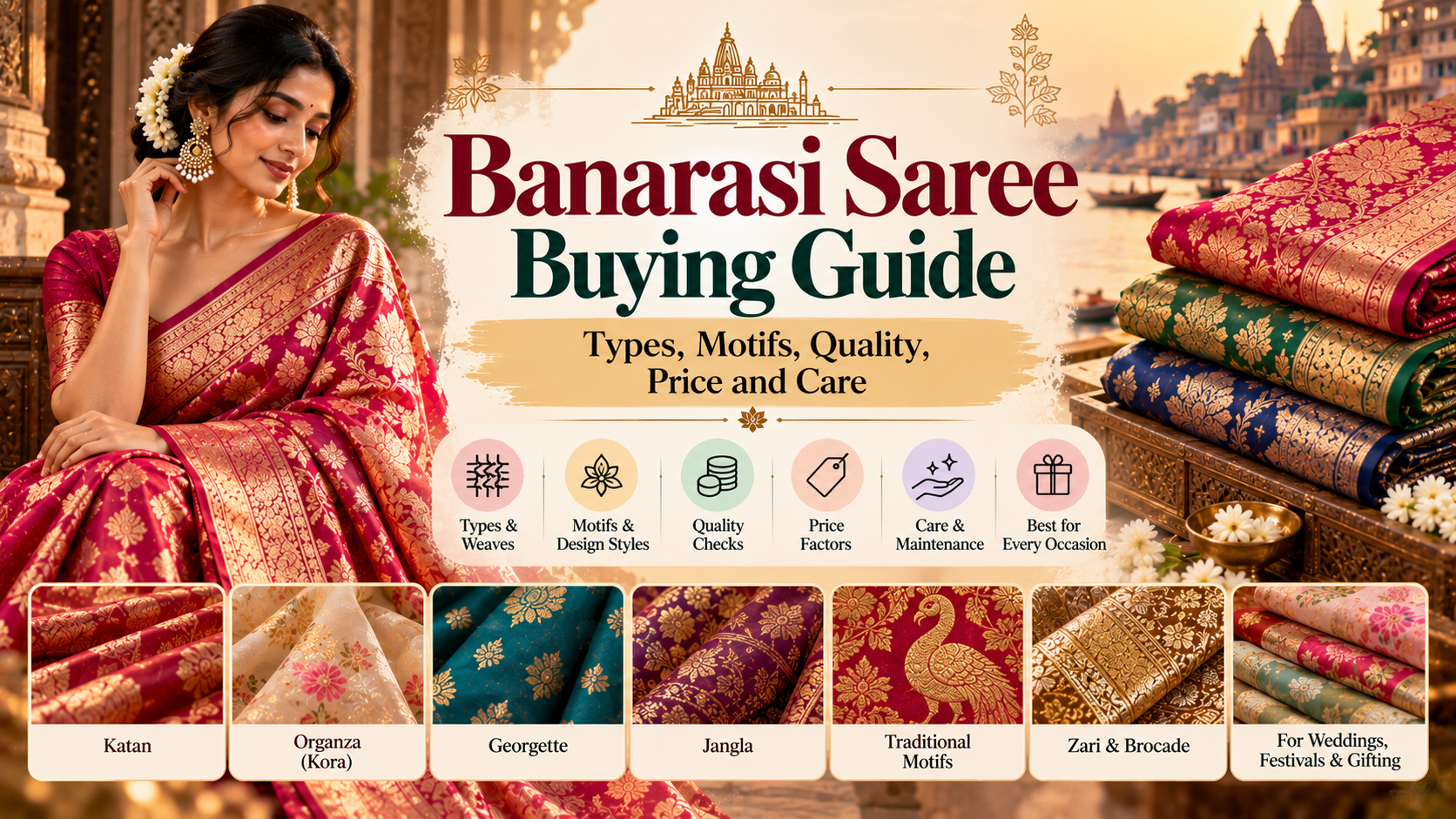
Few sarees carry the same sense of occasion as a Banarasi. The gleam of zari against deep silk, the dense floral borders and the richly patterned pallu have made Banarasi sarees a favourite for weddings, festivals and heirloom gifts. They are also one of the most widely imitated styles in the market, and the name “Banarasi” is used for everything from traditional handwoven silks to machine-made sarees with a Banarasi-inspired look.
This Banarasi saree buying guide helps you understand what you are looking at. It explains common types and motifs, how zari and brocade weaving work, what affects price, how to assess quality and claims carefully, how to choose for different occasions and how to care for your saree once it is home.
What makes a Banarasi saree distinctive
Banarasi sarees are traditionally associated with Varanasi (Banaras) and the surrounding region in Uttar Pradesh, where weaving has a long history. “Banaras Brocades and Sarees” is registered as a Geographical Indication (GI) in India, which links the name to products from a defined region made using traditional methods.
In everyday shopping, however, “Banarasi” is often used more loosely to describe a design style: brocade patterns, zari motifs and rich borders. Some sarees sold as Banarasi are made in the traditional region by handloom weavers; others are powerloom sarees or are made elsewhere in a similar style. Both can be attractive, but they are not the same, and they are usually priced differently.
Banarasi saree types and design characteristics
It helps to distinguish between fibre types, weaving techniques and design styles, since the market often mixes them.
By base fabric
- Katan (pure silk): a plain-woven silk base, widely used for traditional Banarasi silk sarees. It tends to be rich and structured.
- Organza (kora): a sheer, crisp base often woven with zari or silk motifs, giving a lighter look.
- Georgette: a softer, more fluid base, used for lighter Banarasi-style sarees.
- Shattir: a term sometimes used for lighter Banarasi silk fabrics.
- Blends and art silk: many Banarasi-style sarees use silk blends, art silk or synthetic fibres.
By weaving technique (recognised terms)
- Kadhua: each motif is woven separately by hand, so the reverse is relatively neat. This is generally considered labour-intensive.
- Fekwa (cutwork): extra-weft threads run across the width and are cut between motifs on the reverse.
- Tanchoi: a weaving style that creates dense, often multicoloured patterns, with little or no zari in some versions.
- Jamdani-style weaving: motifs woven into a lighter base, sometimes associated with Banarasi organza or cotton.
These terms are used by weavers and specialist sellers, but not every listing will use them accurately. Ask the seller how a saree was woven if the technique matters to you.
By design style (common market descriptions)
- Butidar: small motifs (butis) scattered across the body.
- Jangla: dense, all-over floral or vine patterns.
- Tissue Banarasi: woven with metallic threads for a shimmering, light surface.
- Brocade: a general term for fabrics with raised, woven patterns, often in zari.
Banarasi saree motifs, brocade and zari
Motifs
Banarasi saree motifs are often floral and foliate, drawing on design traditions with Mughal and Persian influences. Commonly seen motifs include:
- Buti and butas: small and larger floral sprigs.
- Kalga and bel: paisley-like shapes and climbing vine borders.
- Jaal: net-like all-over patterns.
- Konia: a corner motif on the pallu.
- Animals and birds: such as peacocks, parrots and elephants.
Motif style, density and arrangement vary between weavers and designs.
Brocade
Brocade refers to a weave in which extra threads, often zari or coloured silk, create patterns that appear raised or embroidered, though they are woven into the fabric.
Zari
Zari is metallic thread used in weaving. Broadly, it may be:
- Real or pure zari: traditionally silver, often gold-plated, wound around a silk core.
- Tested or imitation zari: typically copper-based, plated to look like silver or gold.
- Metallic or polyester zari: synthetic metallic yarn.
Zari type affects shine, weight, durability and price. It is difficult to confirm zari type by appearance alone, so ask the seller for written details.
Banarasi saree price: what affects it
Banarasi saree prices vary widely. Rather than relying on a single price as proof of authenticity, consider what drives cost:
- Fibre: pure silk usually costs more than blends, art silk or synthetic bases.
- Weaving method: handloom weaving generally takes longer than powerloom weaving.
- Technique: kadhua and other labour-intensive techniques usually take more time than cutwork or machine methods.
- Design complexity: dense jangla or detailed pallus require more work than simple butis.
- Zari type: real, tested and metallic zari differ significantly in cost.
- Weight and length: heavier sarees with more zari use more material.
- Origin and seller: traditional regional sourcing, retailer reputation and service add value.
- Finishing: blouse piece, fall and pico and packaging.
Price can give clues, but it cannot confirm authenticity on its own. A high price does not guarantee pure silk or real zari, and a moderate price does not automatically mean poor quality. For a wider look at price factors across saree types, see our complete guide to buying sarees for women.
How to assess quality
No single visual test can prove a Banarasi saree’s fibre, zari or origin. Use several checks together.
Fabric
- Feel the full length for consistent texture and weight.
- Hold it to natural light to check for even density.
- Look for thin patches, holes or rough areas.
Weaving and motifs
- Check that motifs are complete, clear and evenly woven.
- Look at the reverse. Floats of extra-weft thread are common in brocade; in cutwork, they are cut between motifs. They should not be snagged, broken or loose.
- Note that small variations are normal in handwoven sarees.
Zari
- Look for broken, pulled or fraying zari threads.
- Check for tarnishing or dull patches.
- Check that zari is evenly woven along the border and pallu.
Border, pallu and edges
- The border should run evenly without puckering.
- The pallu should be complete and well finished.
- Selvedges should be straight and secure.
Avoid relying on home tests
Burn tests, rub tests and similar checks can damage a saree and are not conclusive, especially for blends and plated zari. Never test a saree you have not bought.
How to read fibre, weaving and origin claims
Fibre
Look for specific terms such as “pure silk (katan)”, “silk blend”, “art silk” or “georgette”. Phrases like “Banarasi silk look” or “Banarasi style” describe appearance, not fibre. For more on this distinction, see our guide to pure silk vs art silk sarees.
Weaving
Check whether the description says handloom or powerloom, and whether a technique such as kadhua or cutwork is named.
Origin
If a saree is described as from Varanasi or as a GI product, ask for supporting details.
Labels and documentation
Where available, labels such as the Silk Mark (for natural silk), the Handloom Mark or GI-related tags can be useful indicators. Check the details on any label, and remember that not every genuine saree carries one.
Questions to ask the seller
- What is the exact fibre content of the body, border and pallu?
- Is it handloom or powerloom?
- Which weaving technique was used?
- What type of zari is used?
- Where was it woven?
- Is there any label, certificate or invoice describing these details?
- What are the care instructions?
- What is the return or exchange policy?
Choosing a Banarasi saree for different occasions
Weddings
Many brides and close family members choose rich katan silk Banarasi sarees with dense zari and heavy pallus. For long ceremonies, consider weight and comfort; a lighter organza or georgette Banarasi may be easier to wear in warm weather.
Gifting
Banarasi sarees are popular gifts for weddings and milestones. Consider the recipient’s taste, how often they wear sarees and how much care they can give. Butidar designs and moderate zari are versatile.
Festivals
Lighter Banarasi silks, georgettes and organzas with butis or narrow zari borders suit festivals without feeling too heavy.
Receptions and evening events
Tissue Banarasis, jewel tones and dense jangla designs stand out under evening lights.
Formal and semi-formal events
Subtle butidar designs in muted tones, or Tanchoi weaves with little zari, can look elegant without being too heavy.
Banarasi saree care and storage
Care depends on the fibre, zari and finishing. Always follow the care label first, and ask the seller if no label is provided.
Cleaning
- Dry cleaning is commonly recommended for silk and zari-heavy Banarasi sarees.
- Spot-clean small stains gently and quickly; avoid rubbing zari.
- Lighter georgette or synthetic Banarasi-style sarees may have different care instructions; check the label.
Ironing
- Use low heat suitable for silk.
- Iron on the reverse side, especially over zari.
- Use a pressing cloth if needed.
Storage
- Wrap in soft cotton or muslin, not plastic.
- Refold periodically along different lines to avoid weakening at fold lines.
- Keep away from damp areas and direct sunlight.
- Air the saree occasionally.
- Store zari-heavy sarees carefully to reduce tarnishing.
For detailed advice, see our guide on how to wash and store silk sarees.
Banarasi saree buying checklist
- Fibre content stated for body, border and pallu
- Weaving method (handloom or powerloom) confirmed
- Technique (e.g. kadhua, cutwork) noted if relevant
- Zari type confirmed with the seller
- Origin claims supported by details or labels
- Fabric inspected for consistency and flaws
- Motifs and reverse side checked
- Border, pallu and selvedges inspected
- Weight and comfort considered for the occasion
- Blouse piece included and suitable
- Care instructions noted
- Invoice and product details saved
- Return and exchange policy understood
Frequently asked questions
1. Are all Banarasi sarees pure silk? No. Banarasi sarees are made in pure silk, organza, georgette, blends and synthetic fibres. Check the fibre content.
2. How can I tell if a Banarasi saree is original? No single visual test is conclusive. Read the fibre, weaving and origin details, look for labels where available, inspect the weave and ask the seller for supporting information.
3. What affects Banarasi saree price? Fibre, weaving method, technique, design complexity, zari type, weight, origin and seller factors.
4. What is the difference between kadhua and cutwork Banarasi? In kadhua, each motif is woven separately, leaving a neater reverse. In cutwork, extra threads run across the width and are cut between motifs on the reverse.
5. Is a Banarasi saree suitable for summer? Heavy katan silk can feel warm. Lighter organza, georgette or shattir Banarasis may be more comfortable.
6. How should I store a Banarasi saree? Wrap it in cotton or muslin, keep it dry, avoid direct sunlight and refold it periodically.
7. Does a GI tag guarantee quality? A GI tag links a product to a region and traditional method. It is a useful indicator of origin, but you should still inspect quality and seller information.
Conclusion
A good Banarasi saree buying guide comes down to looking beyond the name. Understand the fibre, the weaving method and the zari, inspect the motifs and finishing, ask for supporting details about origin and keep your expectations realistic about what appearance alone can tell you. With that approach, you can choose a Banarasi silk saree, or a Banarasi-style alternative, that suits your occasion, budget and care preferences.
If you are comparing Banarasi with other traditional weaves, our comparison of Chanderi, Banarasi and Kanjivaram sarees may also help. Explore sarees at Mahavir Cloth Center and use this guide to ask the right questions before you buy.
