
Blog
Saree Sale Shopping Guide: How to Find Value Deals Without Compromising on Quality

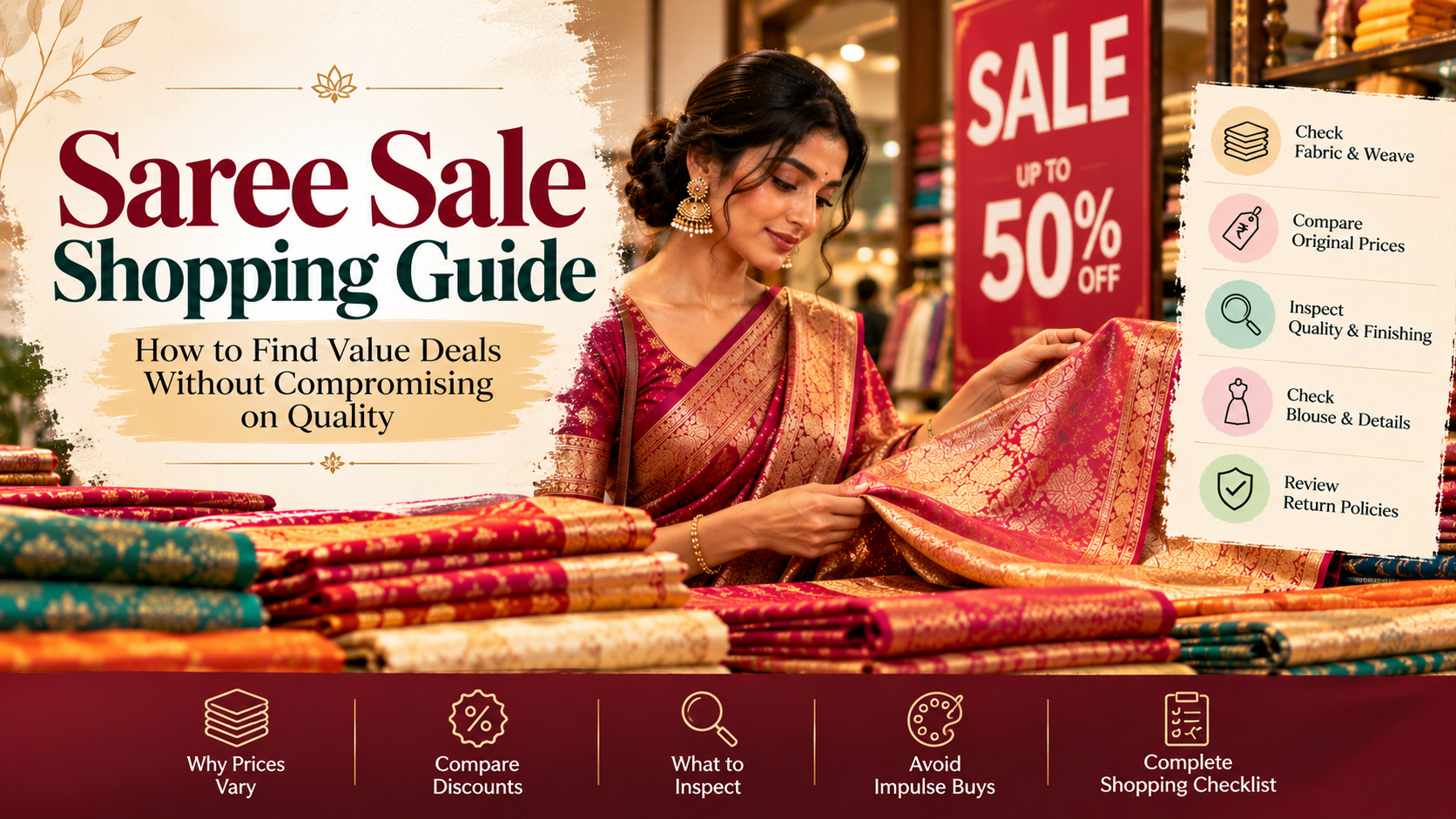
A good saree sale can be the right moment to buy a silk saree you have been eyeing, or to add a few everyday cottons to your wardrobe. It can also be the moment you bring home a saree you did not need, in a colour you will never wear, because the discount looked too good to pass up.
The difference comes down to one question: is this saree good value for you, at this price? This guide helps you answer it. It explains why saree prices vary, how to compare original and sale prices fairly, what to inspect in different types of sarees and how to spot discount claims that need a closer look.
Why saree prices vary
Understanding what drives price helps you judge whether a discount is meaningful.
- Fabric and fibre: natural fibres such as pure silk and fine cotton usually cost more than synthetics or blends.
- Weave: handloom weaving generally takes more time than powerloom weaving.
- Design complexity: dense motifs, wide borders and intricate pallus need more skill and time.
- Zari: real, tested and metallic zari differ in material and cost.
- Embellishment: hand embroidery, mirror work and stone work add labour and materials.
- Finishing: fall and pico, blouse piece quality and edge finishing affect the final product.
- Seller costs: branding, retail location and service also influence price.
Two sarees with the same discount percentage may offer very different value, depending on these factors. For a full overview of fabrics, styles and price factors, see our complete guide to buying sarees for women.
How to compare original and discounted prices fairly
A percentage discount only tells you how much the price has dropped from a reference price. It does not tell you whether the sale price is good value.
Compare like with like
Compare sarees with the same fabric, weave and level of detail. A heavily discounted art silk saree is not directly comparable with a lightly discounted pure silk saree.
Check the reference price
- Is the “original” price one the saree was actually sold at?
- Is it similar to what comparable sarees normally cost?
- If you have been watching a saree, note its price before the sale.
Think about cost per wear
A saree you will wear many times may be better value at a smaller discount than a saree you will wear once at a larger discount.
Include the extras
Add the cost of blouse stitching, fall and pico, a matching petticoat and dry cleaning to the sale price.
| What to compare | Why it matters |
| Final price, not just the percentage | The percentage can hide a high starting price |
| Fabric and weave | Determines the true category of saree |
| Zari and embellishment type | Affects quality and value significantly |
| Blouse piece and finishing | Missing items add cost later |
| Return and exchange terms | Sale items may have different rules |
| How often you will wear it | Determines real value for you |
What to inspect when buying sarees on sale
Sale sarees can include new season stock, older designs, last pieces or display items. Inspect each one regardless of the reason it is discounted.
Silk sarees
- Confirm fibre content: pure silk, silk blend or art silk.
- Check the zari for broken threads, dullness or tarnishing.
- Look at the border and pallu for snags or pulled threads.
- Check fold lines, as old folds can weaken silk over time.
- Ask about any certification or labels where applicable.
If you are unsure how silk types compare, read about the difference between pure silk and art silk.
Cotton sarees
- Check for thin or uneven patches by holding the fabric to the light.
- Look for fading, especially along folds.
- Check whether the saree has been starched and whether that hides softness or flaws.
Embroidered and embellished sarees
- Run your hand over the work to check that sequins, stones and mirrors are secure.
- Look for gaps where pieces are missing.
- Check the reverse of embroidery for loose threads.
Georgette, chiffon and other light fabrics
- Check for snags, pulls and small holes, which are easy to miss on sheer fabric.
- Look at the edges for fraying.
How to assess fabric, stitching, borders, colour and finishing
Fabric
Feel the full length. Look for consistent weight and texture. Our guide on how to identify pure cotton and silk explains a few more checks.
Stitching
If the saree has a stitched border, attached pallu, fall and pico or stitched blouse, check that the stitching is even and secure.
Borders
Check that borders are attached evenly and are not puckered, frayed or lifting.
Colour
- View the saree in natural light.
- Check for fading along folds or edges, which can happen with display stock.
- Check for colour differences between the body, border and blouse piece.
Finishing
Look at the edges, selvedges and pallu end for clean finishing.
Cosmetic flaw or real defect?
A small mark that will wash out, a slight crease or a minor variation in handwork may be acceptable at a good discount. Holes, broken zari, missing embellishments, fading or weak fabric are more serious and may not be worth the saving.
How to identify unclear discount claims and avoid impulse purchases
Discount claims that need a closer look
- “Up to” discounts: the headline figure may apply to only a few items.
- Very large discounts with no clear original price: check what the reference price is based on.
- Vague quality claims: phrases like “premium silk look” may not describe the actual fibre.
- Urgency messages: “only today” or “last few pieces” are designed to speed up decisions. Take the time you need.
- Bundle offers: check whether you actually want every item in the bundle.
How to avoid impulse buys
- Make a list before the sale: occasions, colours and fabrics you need.
- Set a budget and stick to it.
- Ask: would I buy this at full price? If the answer is no, the discount may be the main attraction.
- Check your wardrobe: avoid buying a saree very similar to one you own.
- Do not buy just because a saree is a popular saree style. Make sure it suits your occasions.
- Sleep on bigger purchases if the sale period allows.
Saree sale shopping checklist
Before the sale
- List of sarees needed by occasion
- Budget set, including extras
- Reference prices noted for sarees you are watching
At the sale
- Fibre content confirmed
- Weave and zari type checked
- Full length inspected in natural light
- Borders, pallu and edges checked
- Embellishments checked for security
- Fold lines checked for fading or weakness
- Blouse piece included and matching
Before paying
- Final price compared with similar sarees
- Extras added to the total cost
- Return and exchange terms for sale items confirmed
- Asked: would I buy this at full price?
Questions to ask before purchasing
- What is the exact fabric and fibre content?
- Is this handloom or powerloom?
- What type of zari is used?
- Why is this saree discounted? Is it older stock, a display piece or a last piece?
- Are there any known flaws?
- Is the blouse piece included?
- Is fall and pico done?
- Can sale items be returned or exchanged, and under what conditions?
Frequently asked questions
1. Are sarees in a sale lower quality? Not necessarily. Sales can include new designs, older stock or display pieces. Inspect each saree on its own merits.
2. How do I know whether a saree discount is genuine? Compare the sale price with similar sarees in the same fabric and weave, and check the reference price if you noted it earlier.
3. Is a bigger discount always better value? No. Value depends on the final price, quality and how often you will wear the saree.
4. Can I return sarees bought in a sale? It depends on the seller’s policy. Sale items sometimes have different terms, so check before buying.
5. What should I check on a discounted silk saree? Fibre content, zari condition, snags, fold lines and borders.
6. How can I avoid impulse buying during a saree sale? Make a list, set a budget, check your wardrobe and ask whether you would buy the saree at full price.
Conclusion
A saree sale offers real value when you approach it with a plan. Know what drives price, compare final costs rather than percentages, inspect fabric and finishing carefully and ask clear questions about discounts and policies. Smart saree shopping during a sale means choosing pieces you will wear and enjoy, at a price that makes sense for their quality.
Explore sarees at Mahavir Cloth Center and use this checklist to compare value and quality before you buy.
