
Blog
Online Saree Shopping Guide: How to Check Fabric, Colour, Quality and Seller Details

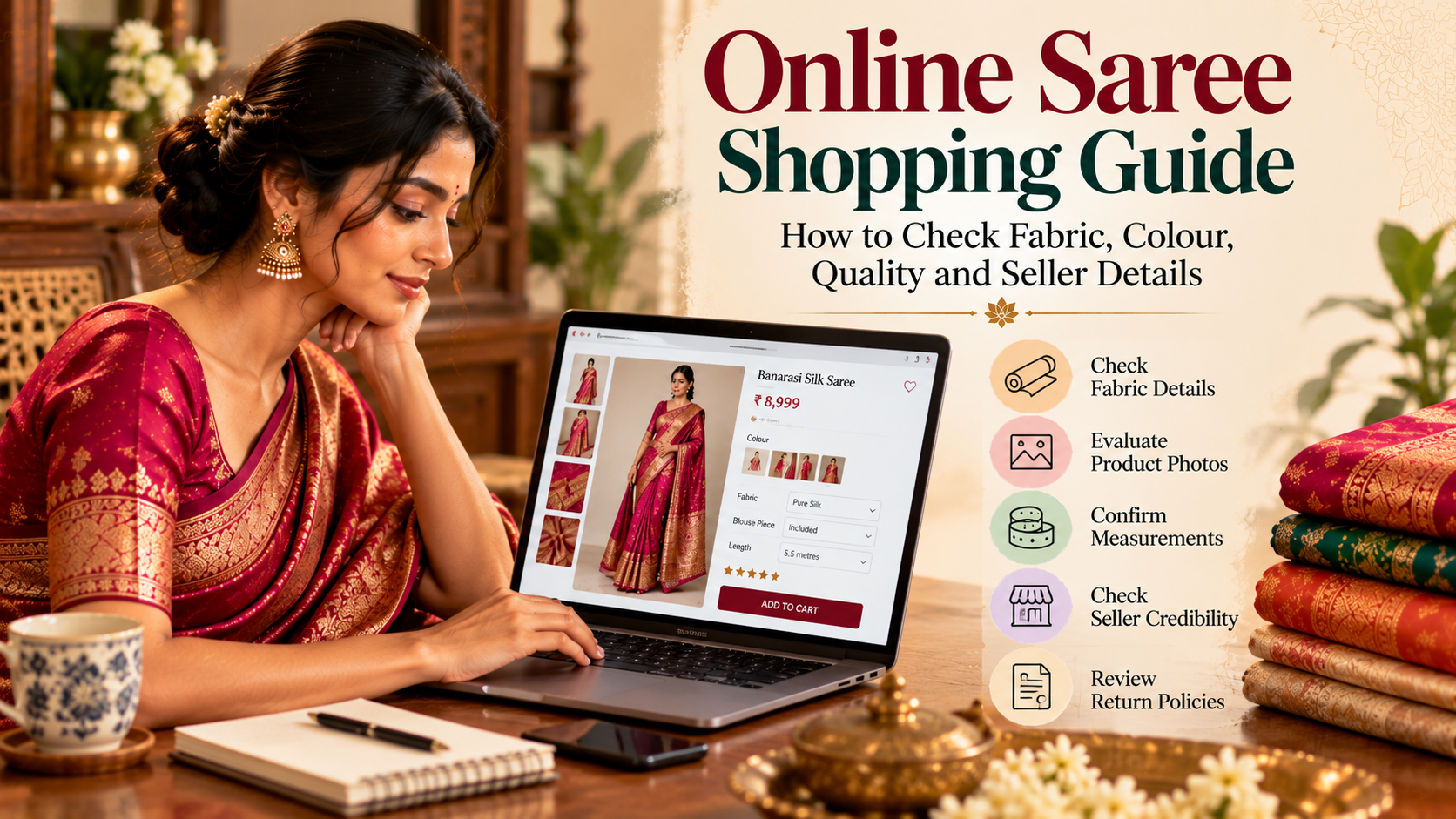
In a shop, you can unfold a saree, feel its weight, hold the pallu up to the window and ask the seller questions on the spot. Online, you have a few photographs, a description and a price. That gap is why online saree shopping can feel uncertain, especially for silk, handloom or occasion sarees where fabric, colour and finishing matter.
The good news is that a careful reading of the listing answers most of the questions you would ask in person. This guide shows you how to read descriptions, judge photographs, check measurements and blouse details, assess the seller and understand policies before you pay, with a checklist to use every time you order.
How to read saree product descriptions
A good description should answer the questions you would otherwise ask at a counter. Read it in full, not just the title.
What a useful description usually includes
- Fabric and fibre content, such as pure silk, silk blend, art silk, cotton, georgette or chiffon.
- Weave or technique, such as handloom, powerloom, printed or embroidered.
- Length and width of the saree.
- Blouse piece details, including whether it is included, its length and whether it is stitched or unstitched.
- Border, pallu and zari details.
- Care instructions.
- Weight, if available.
- What is included, such as a blouse piece, fall and pico or packaging.
Red flags in descriptions
- Only marketing phrases like “premium quality”, “luxurious feel” or “silk touch” without fibre content.
- A title that says “silk” while the description says “art silk” or “silk blend”.
- Missing care instructions.
- Contradictions between the title, description and specification table.
When information is missing or unclear, ask the seller before buying.
How to evaluate fabric composition and weave information
Fabric is the hardest thing to judge from a screen, so the written information matters most.
Look for precise terms
| Description says | What it usually tells you | What to check |
| Pure silk / pure mulberry silk | Main fabric is natural silk | Ask about border, zari and blouse fibre; check for certification labels where applicable |
| Silk blend / silk cotton | Mix of silk and other fibres | Ask for the proportion if it matters to you |
| Art silk | Manufactured silk-like fibre; varies | Ask which fibre (viscose, polyester, blend) |
| Cotton / handloom cotton | Natural cotton fibre | Check whether it is handloom or powerloom |
| Georgette / chiffon / crepe | Weave or fabric type; fibre varies | Ask whether the fibre is natural or synthetic |
| “Silk feel” / “silk look” | Describes appearance, not fibre | Treat as non-silk unless stated otherwise |
Handloom and craft claims
If a listing describes a saree as handloom or as a specific regional weave, look for details such as the weaving region, the technique and any certification or handloom mark. Ask the seller if the information is not shown. Our guide to identifying pure cotton and silk explains some checks you can do once the saree arrives.
For a broader explanation of fabrics and how to choose between them, read our complete guide to buying sarees for women.
How to interpret product photographs, colours and lighting
Photographs are your closest substitute for seeing the saree in person.
What good product photos show
- The full saree laid out or draped.
- Close-ups of the weave, border, pallu and zari.
- The blouse piece.
- The reverse side of woven or embroidered designs, if possible.
- A draped view on a model or mannequin.
How to judge colour
- Screens vary. Phone and laptop displays show colours differently. Check the photos on more than one device if you can.
- Look for natural-light photos. Studio lighting can make colours look brighter or warmer.
- Read the colour name in the description and compare it with the photo.
- Read reviews for comments such as “darker than shown” or “colour as expected”.
- Expect slight variation, especially with hand-dyed and handloom sarees.
Watch for
- Only one heavily edited image.
- Photos that look like catalogue images used across many sellers.
- Close-ups that do not match the full saree photo.
Dimensions, blouse pieces, borders and inclusions
Saree length and width
Check the length and width listed. Saree lengths vary, so compare with sarees you already own. Some regional drapes, such as the nauvari, need a longer saree.
Blouse piece
- Is a blouse piece included?
- Is it attached to the saree or separate?
- Is it stitched, semi-stitched or unstitched?
- How long is it, and is that enough for your preferred blouse design?
- Does it match or contrast with the saree?
Border and pallu
Check the border width and the pallu design in close-up photos. Confirm whether the pallu shown is the actual pallu of that saree.
What is included
Check whether fall and pico are done, whether a petticoat is included and whether there is any special packaging. Do not assume anything is included unless it is listed.
How to assess seller credibility and product information
Seller details
- A clear business name, address and contact details.
- A way to ask questions before buying, such as phone, email or chat.
- Consistent information across the website.
Product information quality
- Detailed, specific descriptions.
- Real close-up photographs.
- Clear policy pages.
Reviews
- Read a range of reviews, not just the top ones.
- Look for reviews with photos.
- Note recurring comments about colour, fabric, stitching or delivery.
- Be cautious of many very short, similar reviews.
Questions to ask the seller
- What is the exact fibre content?
- Is this handloom or powerloom?
- Is the zari real, tested or metallic?
- Is the blouse piece included, and how long is it?
- Is fall and pico done?
- Can you share an additional photo in natural light?
Our general guide on how to shop for ethnic wear online without getting cheated covers wider warning signs for any ethnic wear purchase.
Shipping, exchange, return and refund policies
Read the policies before paying. Policies vary between sellers and sometimes between products.
What to look for
- Shipping: estimated delivery time and charges.
- Returns: whether returns are accepted, the time window and the condition required.
- Exchanges: whether exchanges are allowed for colour, size or defects.
- Refunds: how and when refunds are made.
- Exclusions: sale items, customised sarees, stitched blouses and altered items may have different rules.
- Proof: whether an unboxing video or photos are needed for claims.
Before you order
- Save or screenshot the policy at the time of purchase.
- Note the return window from the delivery date.
- Keep tags and packaging until you are sure about the saree.
Payment security and basic precautions
- Check the website address and look for a secure connection (https and a padlock symbol in the browser).
- Use trusted payment methods that offer some protection.
- Do not share OTPs, PINs or passwords with anyone claiming to be from a seller or courier.
- Be cautious of payment requests through personal messages or unfamiliar links.
- Keep order confirmations, invoices and payment receipts.
- Check your bank or card statements after the purchase.
Pre-purchase online saree shopping checklist
Product
- Fabric and fibre content clearly stated
- Weave or technique described
- Length and width listed
- Blouse piece details confirmed
- Border, pallu and zari shown in close-ups
- Care instructions listed
Photos and colour
- Full, close-up and draped photos available
- Colour name matches the photo
- Reviews checked for colour accuracy
Seller
- Business name and contact details visible
- Questions answered clearly
- Reviews read, including those with photos
Policies and payment
- Shipping time and charges noted
- Return, exchange and refund policy read and saved
- Secure payment method used
- Order confirmation and invoice saved
On delivery
- Unboxing recorded if required by the seller
- Saree checked against the description
- Tags kept until satisfied
Frequently asked questions
1. Is online saree shopping safe? It can be, if you buy from sellers with clear contact details, read descriptions carefully, understand the policies and use secure payment methods.
2. How can I check the fabric of a saree online? Look for specific fibre content in the description, ask the seller for details and check close-up photos. Inspect the saree carefully once it arrives.
3. Why does the saree colour look different from the photo? Screens, lighting and photo editing can change how colours appear. Check reviews and ask for natural-light photos if colour matters.
4. Is the blouse piece always included? No. Check the description for whether a blouse piece is included, its length and whether it is stitched.
5. What should I do if the saree does not match the description? Contact the seller within the return or exchange window, following their policy. Keep the packaging, tags and proof of delivery.
6. Are popular saree styles always good quality? Popularity does not guarantee quality. Check fabric, finishing and seller details for each listing.
7. Should I record an unboxing video? Some sellers require it for damage or defect claims. Check the policy before ordering.
Conclusion
Careful saree shopping online comes down to reading carefully and asking questions: confirm fibre content and weave, study close-up photographs, check dimensions and the blouse piece, look into the seller and read the policies before paying. A popular saree in a photograph is only a good buy if the details match what you need. With the checklist above, choosing a saree for women online can be as confident as buying one in person.
Browse sarees at Mahavir Cloth Center and use this checklist to compare fabric, colour and details before you order.
