
Blog
How to Check Ethnic Wear Stitching Quality Before Buying

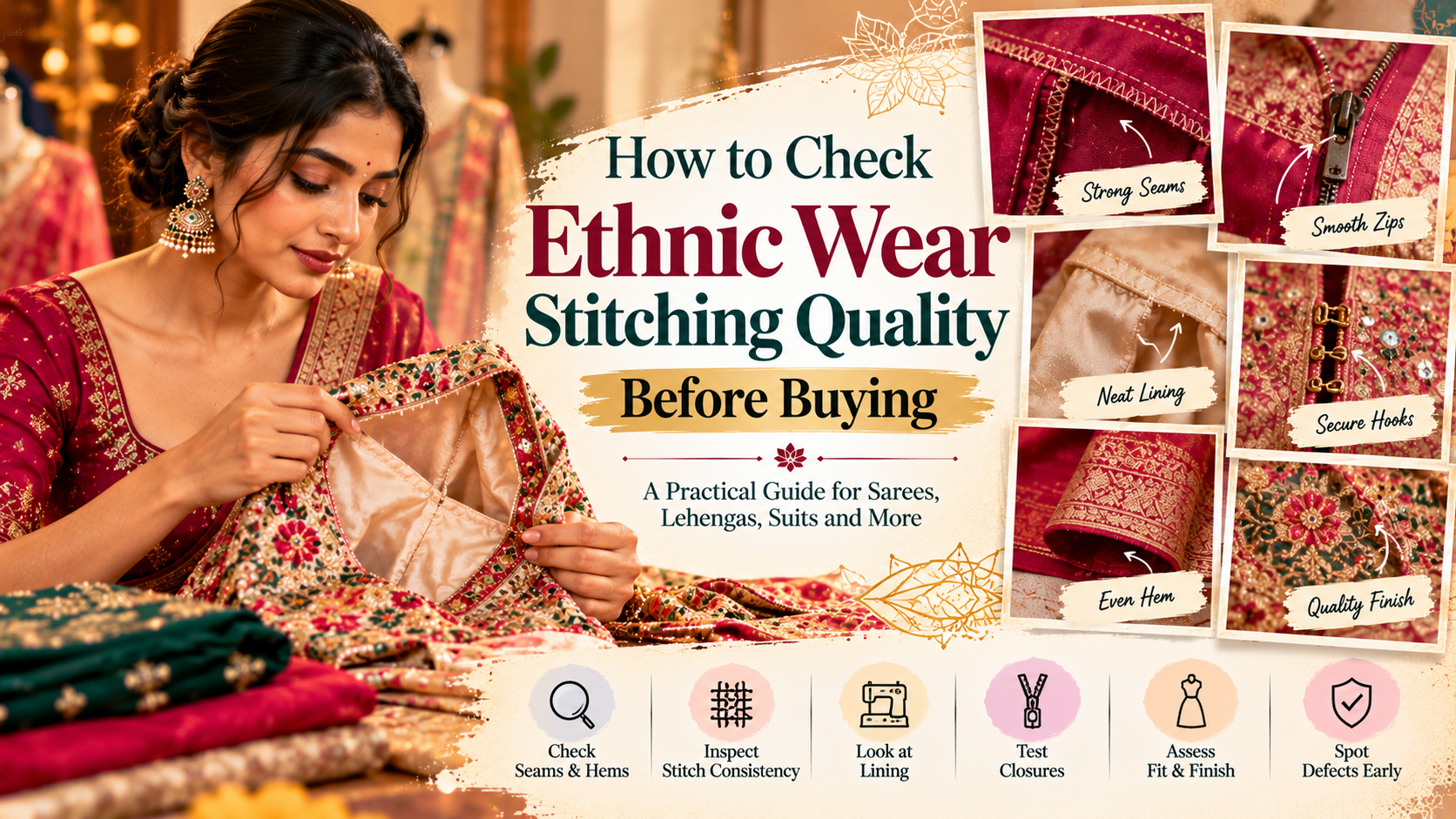
A beautiful fabric can still make a disappointing garment if it is poorly put together. Construction affects how an outfit fits on the first day, how it behaves when you sit, dance or raise your arms, and how well it holds up after repeated wear and washing.
Ethnic wear has more construction points than many everyday clothes. A single lehenga set might include a gathered skirt with dozens of panels, a lined and darted blouse, a waistband with a drawstring or zip, hooks, latkans, embroidery and a finished dupatta edge. Each of these is a place where good or careless work shows.
Learning how to check stitching quality in ethnic wear does not require tailoring training. Most checks are simple: look at the inside as well as the outside, gently pull at seams, test the closures and move in the garment. A few minutes of inspection can help you avoid an outfit that needs repair before its first wear, and can tell you which small flaws are acceptable.
This guide focuses on inspecting construction before you buy. For fabric identification, see our fabric testing guide for pure cotton and silk.
Cosmetic imperfections vs real defects
Not every flaw is a reason to walk away. It helps to separate two kinds of issues.
Cosmetic imperfections affect appearance slightly but not how the garment fits or lasts. Examples:
- A trimmed thread end left on the inside.
- A tiny variation in stitch spacing on an inside seam.
- Minor irregularity in hand embroidery, which is often natural in handwork.
- A slight colour variation in handloom or hand-dyed fabric.
- A small chalk or pencil mark from cutting that will wash out.
Defects that may affect fit or durability are worth taking seriously. Examples:
- Seams that are already pulling apart or have open sections.
- Skipped or broken stitches along a stress point such as the underarm, waist or crotch.
- Raw edges inside that are not finished and are already fraying.
- A zip that sticks, a hook that is loose or a button hanging by a thread.
- Embellishments that are loose or falling off.
- Uneven hems or panels that make the garment hang crooked.
- Very little seam allowance where you might need alterations.
Many cosmetic issues are easy to live with or fix at home. Defects at stress points or in closures are more likely to cause problems, so ask about them before buying.
Inspecting seams, hems and stitch consistency
Garment seams and hems are the backbone of construction. Turn the garment inside out wherever you can.
Seams
- Look along the seam line. It should be straight and follow the shape of the garment without wandering.
- Check stitch length. Stitches should be reasonably even. Very long, loose stitches can be weaker than closely spaced ones.
- Gently pull the fabric on both sides of the seam. It should hold firmly without gaps opening between stitches. Do not pull hard enough to damage the garment.
- Check the seam finish. Inside edges are often overlocked (serged), zigzagged, bound with tape, pinked or enclosed in a French seam. Any of these is better than raw edges that are already fraying.
- Look at seam allowance width. The fabric between the stitching and the edge should not be so narrow that it could pull out.
Hems
- Check that the hem is even all around. Lay the garment flat or hold it up to see whether one side drops lower.
- Look at the stitching. Blind or hand-stitched hems should be secure; machine hems should be straight.
- Check corners and slits. On kurtas, the top of side slits is a stress point. It should be reinforced with a few extra stitches or a small bar tack.
- For lehengas and sarees, check whether the hem has a facing, can-can or border tape, and that it is attached evenly.
Loose threads, skipped stitches and uneven seams
Loose threads
A few trimmed thread ends are common and usually cosmetic. Long loose threads hanging from seams or embroidery suggest less careful finishing. If a loose thread is connected to a seam, avoid pulling it, as this can unravel stitching.
Skipped stitches
Skipped stitches appear as small gaps where the needle missed a stitch, leaving a longer span of thread. One skip on a non-stress area is minor. Several skips in a row, or skips at the underarm, waist, crotch or shoulder, can weaken the seam.
Uneven seams
Check that matching seams align, for example the side seams of a kurta, the panel seams of a lehenga or the shoulder seams of a blouse. Uneven seams can make a garment twist or hang crookedly. Also check that prints, stripes and borders match at seams where you would expect them to.
Puckering
Small ripples along a seam, called puckering, can result from tension or fabric issues. Light puckering on delicate fabric is common; heavy puckering may affect how the garment looks and drapes.
Lining, closures and fastenings
Lining
- Check that the lining is attached evenly and does not hang below the outer fabric.
- Make sure the lining is not too tight, which can cause the outer fabric to pull or bunch.
- Look at whether the lining covers the back of embroidery, which protects your skin from rough threads.
- Check lining seams too; they should be finished like the outer seams.
Hooks and eyes
- Hooks should be stitched firmly with several passes of thread.
- Hooks and eyes should line up when closed.
- Check that closing the hooks does not pull the fabric into wrinkles.
Zips
- Run the zip up and down a few times. It should move smoothly without catching.
- Check that the zip is stitched straight and that the fabric does not bulge around it.
- An invisible zip should be hidden when closed.
- Look at the bottom of the zip, which is a stress point; it should be secured.
Buttons and loops
- Buttons should be sewn firmly with no excess slack.
- Buttonholes should be neatly finished without frayed edges.
- Fabric loops (often used on kurtas and blouses) should be firmly attached.
Drawstrings and ties
- Check that drawstrings move freely through the casing.
- Look at the ends of ties and latkans; they should be knotted or finished securely.
Blouse fit and alteration allowance
Blouse stitching quality affects comfort more than almost any other part of an ethnic outfit.
Fit checks
- Shoulders: the shoulder seam should sit at your shoulder point.
- Armholes: they should not cut in when you raise your arms.
- Bust and darts: darts should point towards the bust without puckering.
- Neckline: it should lie flat without gaping.
- Length: the blouse should not ride up when you lift your arms.
Alteration allowance
Ready-made and semi-stitched blouses often include extra fabric at the side seams so they can be let out. To check:
- Turn the blouse inside out.
- Look at the side seams and centre back seam.
- Measure or estimate the extra fabric beyond the stitching line.
If you are between sizes or expect to need adjustments, more allowance gives you more options. Ask the seller how much margin is included. For a detailed fitting guide, read our article on how to get your ethnic wear tailored.
Embroidery attachment and embellishment finishing
Embroidered and embellished garments need closer inspection. For an overview of different embellishment types, see our comparison of mirror work, gota patti and zari.
Thread embroidery
- Check for loose loops or long floating threads on the surface.
- Look at the reverse; thread ends should be secured, not left as long loose strands.
- Variations in handwork are often natural and not a defect.
Sequins, beads and stones
- Gently run your fingers over the work. Pieces should feel secure.
- Look for gaps where pieces have already fallen off.
- Check whether pieces are stitched individually or attached in a continuous thread that could unravel if one breaks.
Mirror work
- Mirrors should be firmly held by their stitched frame or securely attached.
- Edges should not feel sharp against the skin.
Gota and lace
- Check that strips are stitched down along both edges.
- Edges should not be lifting or fraying.
Comfort
Turn embellished areas over and run your hand across the reverse. If it feels scratchy, check whether there is lining to cover it, especially for blouses.
How the garment hangs and moves
Some construction issues only show when the garment is worn or held up.
- Hold the garment up by the shoulders or waistband. It should hang evenly without twisting.
- Check symmetry. Both sides of a kurta, both halves of a lehenga and both sleeves should look the same length and shape.
- Try it on if possible. Sit, bend, raise your arms and take a few steps.
- Check the flare. A lehenga or Anarkali should flare evenly around the body.
- Watch for pulling. Diagonal wrinkles pointing to a seam can suggest a fit or construction issue.
Garment-specific checks
Lehengas
Lehenga stitching and finishing involves many panels and heavy fabric.
- Check the waistband: it should be firmly stitched and finished inside.
- Look at the panel (kali) seams; they should be even and finished.
- Check that the hem and any can-can or lining are attached evenly.
- Test the drawstring, zip or hooks at the waist.
- Inspect the blouse as described above.
- Check the dupatta edges for finished borders.
Saree blouses
- Check darts, princess seams and the neckline finish.
- Look at the armholes and underarm seams.
- Check the closures: hooks, zips or ties.
- Look for alteration allowance.
- Check the lining.
Salwar suits
- Check the kurta’s side seams and slits.
- Look at the salwar or pants crotch seam, which is a stress point.
- Check waist drawstrings or elastic.
- Make sure the dupatta edges are finished.
Kurtas
- Check the neckline facing and finishing.
- Look at the side slits for reinforcement.
- Check sleeve hems and cuffs.
- Check buttons, loops and placket stitching.
- See whether the kurta hangs straight.
Extra checks for online purchases
You cannot touch the garment online, but you can still look for clues. Our guide to shopping for ethnic wear online covers buying safely in general; here are the stitching-specific checks.
- Zoom into product photos. Look for close-ups of seams, embroidery and closures. Missing close-ups are worth asking about.
- Look for inside or back views. Some sellers show linings or the reverse of embroidery.
- Read the description. Check fabric, lining, closure type, whether the item is stitched, semi-stitched or unstitched, and whether alteration margin is included.
- Check the size chart and garment measurements. Compare them with a well-fitting garment you own.
- Read reviews. Look for comments about stitching, fit and finishing.
- Check return and exchange policies. Note the return window, whether altered or customised items can be returned and who pays return shipping.
- Inspect on arrival. Use the checklist below as soon as the parcel arrives, before cutting tags, so you can return it within the window if needed.
Inspection point comparison table
| Inspection point | What to look for | Possible warning signs | Type of issue |
| Seams | Straight lines, even stitches, finished edges | Gaps, open sections, fraying raw edges | Durability |
| Hems | Even length, secure stitching | Uneven drop, loose hem stitches | Fit and appearance |
| Thread ends | Neatly trimmed | Long loose threads at seams | Usually cosmetic |
| Skipped stitches | Continuous stitching | Several skips at stress points | Durability |
| Lining | Smooth, attached evenly, covers embroidery | Too tight, hanging below, rough edges | Comfort and fit |
| Hooks and eyes | Firmly stitched, aligned | Loose, misaligned, pulling fabric | Function |
| Zips | Smooth, straight, secured at the end | Catching, wavy stitching, bulging | Function |
| Buttons | Firmly sewn, neat buttonholes | Loose buttons, frayed holes | Function |
| Alteration allowance | Extra fabric at side and back seams | Very narrow margins | Fit flexibility |
| Embroidery | Secure threads, finished reverse | Loose loops, missing pieces | Durability |
| Embellishments | Firmly attached sequins, mirrors, gota | Pieces already missing or loose | Durability |
| Symmetry | Matching sides and sleeves | One side longer, twisting | Fit and appearance |
| Hang | Falls evenly | Twisting, diagonal pulling | Fit |
| Hand-work variation | Small natural irregularities | — | Cosmetic, often expected |
In-store inspection checklist
Use this ethnic wear buying checklist when you shop:
- Turn the garment inside out and look at seam finishes.
- Gently tug seams at stress points: underarms, waist, crotch, shoulders.
- Check hems for evenness and secure stitching.
- Look for loose threads and skipped stitches.
- Inspect lining for fit and finish.
- Open and close all hooks, zips and buttons.
- Check side seams for alteration allowance.
- Run your fingers over embroidery and embellishments.
- Check the reverse of embroidery for scratchy areas.
- Hold the garment up to see how it hangs.
- Compare both sides for symmetry.
- Try it on, sit, bend and raise your arms.
- Check dupatta edges and finishing.
- Ask about returns and alterations.
Warning signs worth questioning
These do not always mean a garment is poor, but they are reasons to ask questions or reconsider:
- Seams already pulling apart on a new garment.
- Several missing embellishments.
- A zip that catches repeatedly.
- No alteration margin on a garment you will likely need to adjust.
- Raw edges fraying on the inside.
- Very uneven hems or panels.
- Lining much tighter or looser than the outer fabric.
- Product photos that hide the inside or close details, combined with unclear descriptions.
- Return policies that do not allow you to inspect and return.
Questions to ask before buying
- Is this garment fully stitched, semi-stitched or unstitched?
- Is there alteration margin, and where?
- What lining is used?
- What type of closure does the blouse or skirt have?
- Is the embroidery hand-done, machine-made or a mix?
- Are embellishments stitched or glued?
- Can I return or exchange it if the stitching has a defect?
- Can altered items be returned?
- Do you offer alterations or stitching services?
- Are there close-up photos of the seams, lining and embroidery?
Frequently asked questions
1. How can I quickly check stitching quality in a shop? Turn the garment inside out, look at seam finishes, gently tug stress points, test the closures and check the hems.
2. Are loose threads a sign of poor quality? A few trimmed thread ends are usually cosmetic. Long loose threads at seams or embroidery suggest less careful finishing.
3. What is alteration allowance and why does it matter? It is extra fabric beyond the stitching line that allows the garment to be let out. It gives you more flexibility if you need adjustments.
4. Are irregularities in hand embroidery a defect? Small variations are often natural in handwork. Loose threads, missing pieces or unravelling stitches are more concerning.
5. How do I check quality when buying online? Zoom into photos, read the description for lining and closure details, check reviews and confirm the return policy. Inspect the garment as soon as it arrives.
6. Which parts of a garment are most likely to fail? Stress points such as underarms, waist seams, crotch seams, slit tops and closures are usually under the most strain.
7. Should I buy a garment with a small defect? It depends on the defect. A cosmetic issue may be acceptable, especially if it is easy to fix. Defects at stress points or in closures are worth discussing with the seller first.
8. How can I tell if a blouse will be comfortable? Check the lining, the armholes, the neckline finish and the reverse of any embroidery, and try it on with arm movements if possible.
Conclusion and quick checklist
Knowing how to check stitching quality in ethnic wear helps you buy with more confidence, whether you are choosing a lehenga for a wedding, a blouse for a silk saree or a kurta for everyday wear. Separate cosmetic imperfections from real defects, pay attention to stress points and closures, and do not hesitate to ask questions.
Quick shopping checklist:
- Seams: straight, even and finished inside.
- Hems: even and secure.
- Stress points: underarm, waist, crotch and slits intact.
- Closures: hooks, zips and buttons working smoothly.
- Lining: smooth and covering embroidery.
- Allowance: enough margin to adjust.
- Embellishments: firmly attached.
- Hang: even and symmetrical.
- Movement: comfortable when you sit, bend and raise your arms.
- Policy: clear returns and exchanges.
Browse sarees, suits, kurtas and lehengas at Mahavir Cloth Center and use this checklist when you choose your next outfit.
