
Blog
Best Blouse Neckline Designs for Sarees: How to Match Necklines with Different Drapes

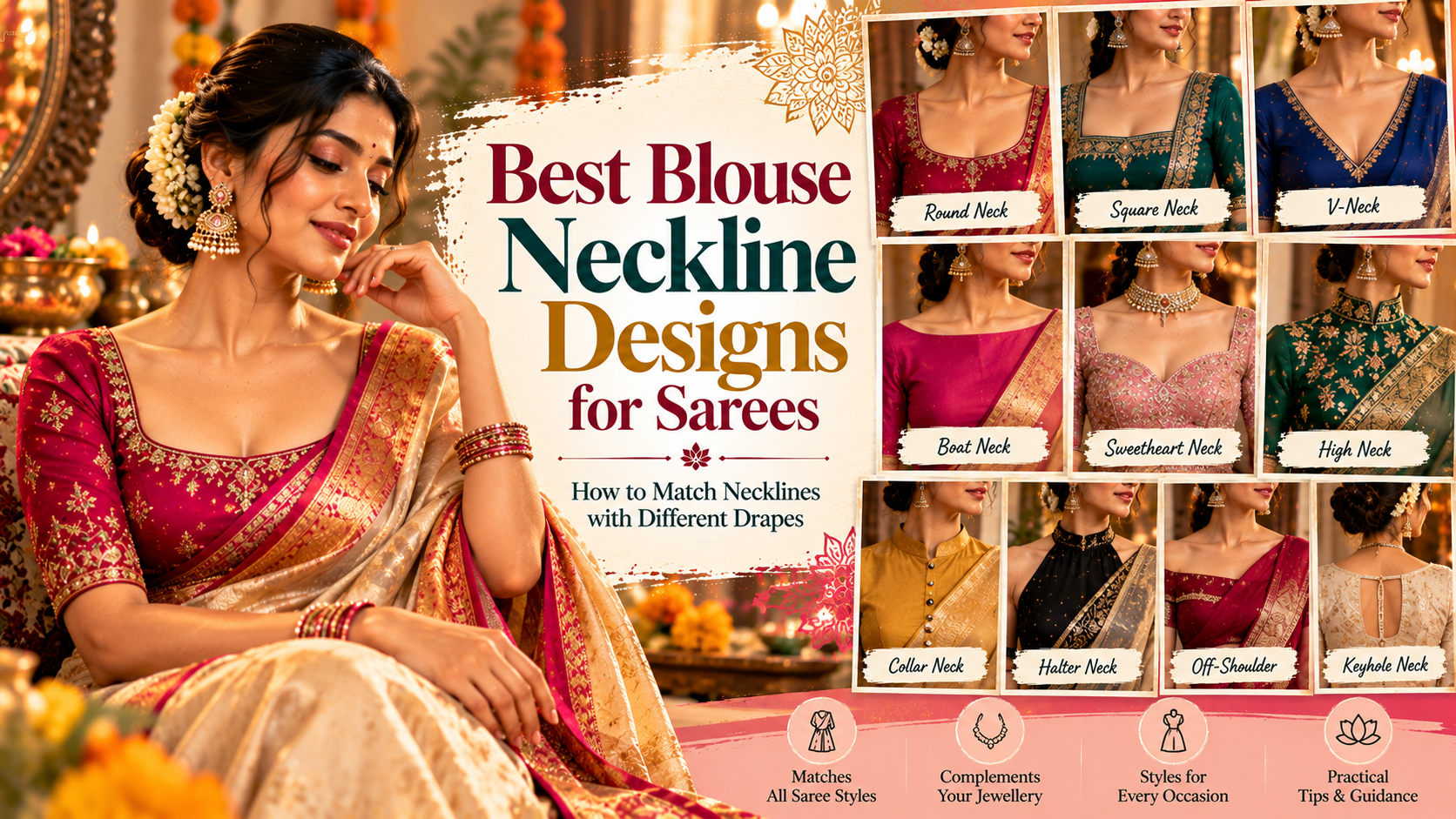
The neckline is the part of a saree blouse you see most. It frames the face, sits right where the pallu crosses the shoulder, and decides how much of a necklace shows. Two women can wear the same saree with different necklines and look completely different.
Choosing among blouse neckline designs for sarees is less about following rules and more about answering a few practical questions:
- How will the saree be draped? A pinned pallu over one shoulder covers part of the neckline; an open pallu or a different regional drape shows more of it.
- What is the fabric like? Stiff silks hold sharp shapes; soft chiffons and georgettes suit gentler curves.
- What jewellery will you wear? A choker, a long haar and a pair of statement earrings each suit different necklines.
- How much coverage and movement do you want? A deep neck feels different from a high neck after five hours at a wedding.
- What do you like? Personal preference is a perfectly good reason to choose a neckline.
There is no neckline that is compulsory for any body type or any occasion. The sections below describe how each style tends to look and behave so you can decide what suits your saree and your plans.
A guide to the main neckline styles
Round neck
A curved neckline that follows the base of the neck, cut shallow or deep.
- Look: classic and versatile. A shallow round neck looks traditional and neat; a deeper round neck looks more dressy.
- Works with: almost every saree, from cotton daily wear to heavy silks.
- Jewellery: suits most necklaces, from a short chain to a layered haar.
- Consider: a very deep round neck may need careful fitting so it does not gape when you bend.
Square neck
A straight-edged neckline with corners at each side. A square neck blouse design can be wide or narrow, shallow or deep.
- Look: structured and slightly vintage, with clean lines.
- Works with: silk, brocade and handloom sarees where a crisp shape is held well. Also striking with embroidered borders along the edges.
- Jewellery: chokers and short necklaces sit neatly inside a square frame.
- Consider: the corners need accurate tailoring; soft fabrics may need lining or interfacing to keep the edges straight.
V-neck
A neckline that dips to a point at the centre.
- Look: elongated and modern. A shallow V looks subtle; a deep V is more dramatic.
- Works with: georgette, chiffon and crepe sarees, as well as contemporary or party wear.
- Jewellery: pendants and long chains that follow the V line.
- Consider: a deep V may need a hook or a small inner panel for comfort and coverage.
Boat neck
A wide, shallow neckline that runs almost horizontally from shoulder to shoulder, often repeated at the back. A boat neck blouse design shows the collarbones without dipping low.
- Look: elegant and minimal; a popular choice with handloom and silk sarees.
- Works with: Kanjivaram, Banarasi, chanderi, ikat and cotton sarees, especially those with a strong border.
- Jewellery: often looks best with statement earrings or a short, close-fitting necklace, since a long necklace can sit oddly on the flat line.
- Consider: depends heavily on accurate shoulder measurement, otherwise it may slip off the shoulder. Bra strap holders inside the shoulder can help.
Sweetheart neckline
A neckline with two curves at the front that meet in a dip at the centre, resembling the top of a heart. A sweetheart neckline blouse is feminine and slightly glamorous.
- Look: soft and decorative.
- Works with: georgette, net, chiffon and embellished party sarees; also suits lehenga-style sarees.
- Jewellery: pendants and short necklaces that sit above the dip.
- Consider: needs precise shaping and good support; some prefer padding or built-in cups.
High neck
A neckline that rises close to the base of the neck, sometimes with a band collar. A high neck blouse design is one of the most distinctive options.
- Look: polished and formal, sometimes with a regal or vintage feel.
- Works with: sheer sarees such as organza, net and chiffon, where the blouse becomes a strong focal point; also plain silks for a formal look.
- Jewellery: usually paired with earrings rather than a necklace.
- Consider: can feel warm in heavy fabrics and needs a back opening, usually hooks, a zip or a keyhole.
Collar neck
A shirt-style collar, such as a Peter Pan or mandarin collar, on a blouse.
- Look: crisp and contemporary.
- Works with: cotton, khadi, linen and handloom sarees for office or day wear; also works with printed sarees.
- Jewellery: minimal, often just earrings.
- Consider: front-button or front-hook openings often work well with collars.
Halter neck
A neckline with straps that fasten or wrap around the neck, leaving shoulders and often the back open.
- Look: modern and glamorous, suited to evening events.
- Works with: chiffon, georgette, sequinned and party-wear sarees.
- Jewellery: earrings and bracelets; necklaces are usually skipped.
- Consider: needs good support and a well-fitted back.
Off-shoulder and one-shoulder
Necklines that sit below the shoulders or cover only one shoulder.
- Look: contemporary and fashion-forward.
- Works with: lightweight party sarees and pre-stitched or drape sarees.
- Consider: needs precise fitting and often elastic or boning to stay in place; may feel less practical for long events.
Keyhole and pot neck variations
A keyhole is a small cut-out, usually at the front or back of a high or round neck. A pot neck, also called a matka neck, has a rounded shape that widens below the collarbone.
- Look: decorative details that add interest without changing the overall coverage much.
- Works with: silk and festive sarees.
- Consider: the cut-out edges need neat finishing and sometimes piping.
Back necklines
Front and back necklines are chosen separately. Deep U, deep V, square, keyhole, tie-up dori backs and boat backs can be paired with almost any front. Our Navratri Blouse Design Ideas cover back necklines and embroidery in more detail, so this article focuses mainly on the front neckline and how it works with the drape.
How necklines interact with the saree drape
This is where blouse neckline and saree styling come together. The drape decides how much of the neckline is visible and where.
Nivi drape with a pinned pallu
In the common Nivi style, the pallu is pleated and pinned on the left shoulder. It covers part of the left side of the neckline and crosses diagonally over the chest.
- Round, V and sweetheart necklines stay partly visible on the right side.
- A boat neck shows clearly along the right shoulder and back.
- Square necks can look uneven if one corner is hidden; some people prefer a slightly wider square so both corners remain visible.
Nivi drape with an open pallu
An open, loosely draped pallu shows more of the neckline and blouse. This suits decorative necklines, such as sweetheart, embellished square or keyhole designs.
Pallu draped over both shoulders or as a shawl
Wrapping the pallu around the shoulders covers most of the neckline at the back and sides. A high neck or collar can peek out neatly; deep backs are hidden.
Regional drapes
Regional drapes, such as the Nauvari, Bengali, Gujarati seedha pallu and others, each place the pallu differently.
- Gujarati or seedha pallu: the pallu comes over the right shoulder and spreads across the front, covering much of the front neckline. Back necklines become more noticeable.
- Bengali drape: the pallu is draped across the front and over the left shoulder, often with a key bunch tucked; round and boat necks work well with its traditional look.
- Nauvari: the drape is fitted and practical; shorter, well-fitted blouses with round or boat necks are commonly worn.
For a closer look at a traditional regional drape, see our guide to Marathi Saree Draping Style.
Pre-stitched and contemporary drapes
Pre-stitched sarees often have a fixed pallu position, which makes it easier to plan the neckline. Contemporary drapes, such as a belted pallu, dhoti saree or cape saree, often pair well with off-shoulder, halter, high-neck or collar blouses. If you are deciding between styles, our comparison of Pre-Stitched Saree vs Traditional Draping may help.
A quick way to check
Before finalising a neckline, drape the saree the way you plan to wear it and look in the mirror. Notice which parts of the blouse remain visible. Choose a neckline that looks good in those visible areas.
Necklines for different saree fabrics
These suggestions describe how different fabrics usually behave. They are options, not rules.
Silk sarees
Silk holds structure well, so crisp necklines tend to look sharp. Blouse neck designs for silk sarees often include boat necks, square necks, round necks with a border edge, high necks and pot necks. With heavy silks such as Kanjivaram or Banarasi, many people choose a simpler neckline so the saree remains the focus, or repeat the saree’s border along the neckline. Our article on Cotton Saree vs Silk Saree explains how the two fabrics differ in feel and care.
Cotton and handloom sarees
Cotton is breathable and practical for daily wear. Round necks, boat necks, collar necks and simple V-necks work well. Collar and boat necks give a contemporary, office-friendly look; a round neck is easy for everyday wear.
Chiffon sarees
Chiffon is soft and light. Sweetheart, V-neck, halter and round necks suit its fluid drape. Structured necklines can look stiff against a very soft saree unless the blouse fabric is heavier, such as velvet or brocade.
Georgette sarees
Georgette has a little more body than chiffon and drapes well. V-neck, sweetheart, round and halter necks work, as do high necks with sheer sleeves for evening events.
Embroidered and embellished sarees
When the saree is heavily embroidered or sequinned, a simpler neckline often keeps the look balanced. A plain round, boat or high neck lets the saree lead. With a plain saree, the blouse neckline can carry embroidery or embellishment instead.
Sheer sarees: organza and net
The blouse is visible through the fabric, so its shape becomes part of the look. High necks, sweetheart necks and embellished necklines are often chosen for this reason.
Necklines for weddings, formal events and everyday wear
Weddings
Weddings allow more embellishment and drama. Sweetheart, deep round, square, high neck and pot neck designs with embroidery or zari edging are popular choices. If you will wear heavy jewellery, choose a neckline that gives the necklace space.
Formal events and office celebrations
Boat necks, high necks, collar necks and modest round necks look polished and give more coverage.
Everyday wear
Comfort comes first. Round necks, shallow V-necks, boat necks and collar necks in breathable fabrics are easy to wear all day. Simple closures, such as front hooks, make dressing faster.
Festive gatherings
Festive events give room for decorative details such as keyholes, piping, latkans on the back ties or embroidered edging. Choose a neckline that still allows comfortable movement if you plan to dance or sit on the floor.
Sleeve and neckline combinations
Sleeves and necklines work together, so it helps to plan them as a pair.
| Neckline | Sleeve options that often pair well | Effect |
| Round neck | Short, elbow-length, three-quarter | Classic and balanced |
| Square neck | Puff sleeves, elbow-length, cap sleeves | Vintage, structured |
| V-neck | Sleeveless, cap, sheer full sleeves | Modern, elongated |
| Boat neck | Elbow-length, three-quarter, full sleeves | Elegant, handloom-friendly |
| Sweetheart | Sleeveless, cap, sheer or net sleeves | Glamorous |
| High neck | Sleeveless, full sheer sleeves | Formal, regal |
| Collar neck | Short, elbow-length, three-quarter | Crisp, office-friendly |
| Halter | No sleeves | Evening, contemporary |
A simple balancing idea that many people use: when the neckline is very decorative, keep sleeves simpler, and when sleeves are dramatic, keep the neckline simpler. This is a suggestion, not a requirement.
Comfort, coverage, movement and personal preference
Comfort
Consider how long you will wear the saree. A neckline that feels fine for an hour may feel tight or exposed by the end of a long event. High necks in thick fabric can feel warm; deep necks may need adjusting.
Coverage
Necklines vary from very covered (high neck, collar) to more open (deep V, off-shoulder). Choose the coverage you are comfortable with for the occasion and setting.
Movement
If you will dance, bend, sit on the floor or hold children, check that the neckline stays in place. Wide necklines may slip when you raise your arms; deep necks may gape when you lean forward.
Support
Some necklines, such as sweetheart, halter and off-shoulder, need built-in support or a specific bra. Discuss this with your tailor.
Personal preference
Fit and comfort matter more than any rule. If you love boat necks, wear them. If you feel most confident in a high neck, choose it. The best neckline is one you enjoy wearing.
Tailoring, fitting and measurements
Key measurements
Your tailor will usually take:
- Bust, under-bust and waist (at the blouse hem).
- Shoulder width.
- Armhole.
- Front neck depth and back neck depth.
- Neck width (especially for boat and square necks).
- Sleeve length and circumference.
- Blouse length.
Tips for accurate fitting
- Wear the bra you plan to use with the blouse.
- Bring a well-fitting blouse as a reference.
- Bring photos of the neckline you want, from the front and back.
- Show the tailor how you will drape the saree, so the neckline can be placed accordingly.
- Discuss the opening: front hooks, back hooks, side zip or keyhole.
- Ask for lining, especially for silk, sheer and embellished blouses.
Trial fittings
At the trial, check:
- The neckline lies flat without gaping or pulling.
- Wide necklines stay on the shoulders when you raise your arms.
- Deep necklines stay in place when you bend forward.
- The neckline sits evenly on both sides.
- You can sit, move and breathe comfortably.
For general guidance on measurements and alterations, see our tailoring guide.
Common fitting mistakes and how to discuss alterations
Common mistakes
- Gaping necklines: often caused by a neckline cut too wide or deep for the shoulder measurement.
- Slipping boat necks: usually a shoulder width issue.
- Uneven square corners: caused by imprecise cutting or soft fabric without support.
- Tight high necks: the neck circumference was measured too closely.
- Neckline hidden by the drape: the design was chosen without considering where the pallu would sit.
- Visible bra straps: the neckline and bra style do not match.
How to discuss alterations with your tailor
- Be specific: “The neckline gapes at the front when I bend” is clearer than “it doesn’t fit well.”
- Show, don’t just tell: demonstrate the movement where the problem happens.
- Ask what is possible: some necklines can be taken in or reshaped; making a neckline higher after cutting is often difficult without adding fabric.
- Ask about support: strap holders, small hooks, inner elastic or lining can fix minor slipping.
- Allow time: neckline changes may need a second trial.
Neckline comparison table
| Neckline | Visual effect | Suitable saree types | Practical considerations |
| Round | Classic, versatile | Almost all sarees | Deep versions may gape when bending |
| Square | Structured, vintage | Silk, brocade, handloom | Needs precise corners; soft fabrics may need support |
| V-neck | Elongated, modern | Georgette, chiffon, crepe, party wear | Deep V may need a hook or inner panel |
| Boat | Elegant, minimal | Silk, handloom, cotton | Accurate shoulder measurement essential |
| Sweetheart | Feminine, decorative | Georgette, net, chiffon, embellished | Needs shaping and good support |
| High neck | Formal, regal | Organza, net, chiffon, plain silk | Can feel warm; needs back opening |
| Collar | Crisp, contemporary | Cotton, khadi, linen, prints | Suits office and day wear |
| Halter | Glamorous, evening | Chiffon, georgette, sequinned | Needs support and well-fitted back |
| Off-shoulder | Fashion-forward | Light party and pre-stitched sarees | Needs elastic or boning to stay in place |
| Pot or keyhole | Decorative detail | Silk and festive sarees | Edges need neat finishing |
Frequently asked questions
1. Which blouse neckline goes with most sarees? A round neck is the most versatile and works with most fabrics and occasions. Boat necks are also a common choice for silk and handloom sarees.
2. What neckline suits a silk saree? Boat, square, round and high necks are popular with silk because the fabric holds a crisp shape. Many people choose a simpler neckline for heavily woven sarees.
3. Does the pallu affect which neckline I should choose? Yes. A pinned pallu covers part of the neckline, so check which areas stay visible with your chosen drape.
4. How do I stop a boat neck blouse from slipping? Make sure the shoulder width is measured accurately, and ask your tailor to add bra strap holders or a small inner loop.
5. Is a high neck blouse comfortable for long events? It can be, especially in breathable fabric. In heavy fabric or warm weather, it may feel warm, so consider sleeveless or sheer sleeves.
6. Which necklines need special support? Sweetheart, halter and off-shoulder necklines often need padding, built-in cups or a specific bra.
7. Can a neckline be changed after stitching? It can often be made deeper or wider, but making it higher or narrower usually needs extra fabric. Ask your tailor what is possible.
8. Should the neckline match the saree’s embroidery? It does not have to. A plain neckline lets a heavy saree stand out, while an embroidered neckline can lift a simple saree.
Conclusion: narrowing down your options
Choosing blouse neckline designs for sarees becomes easier when you work through a few questions in order:
- How will you drape the saree? Check which parts of the neckline will be visible.
- What is the fabric? Crisp silks and handlooms suit structured necklines; soft chiffons and georgettes suit curved or flowing ones.
- What is the occasion? Weddings allow decorative necklines; office and daily wear suit simpler, more covered styles.
- What jewellery will you wear? Choose a neckline that gives your necklace or earrings space.
- How much coverage and movement do you need? Pick something you can wear comfortably for the whole event.
- What do you like? Personal preference is a valid deciding factor.
With these answers, you can usually narrow your choice to two or three necklines. Then try the drape, discuss the fit with your tailor and choose the one that feels best.
Explore sarees to pair with your next blouse at Mahavir Cloth Center.
