
Blog
Best Suit Fabrics for Maharashtra Weather

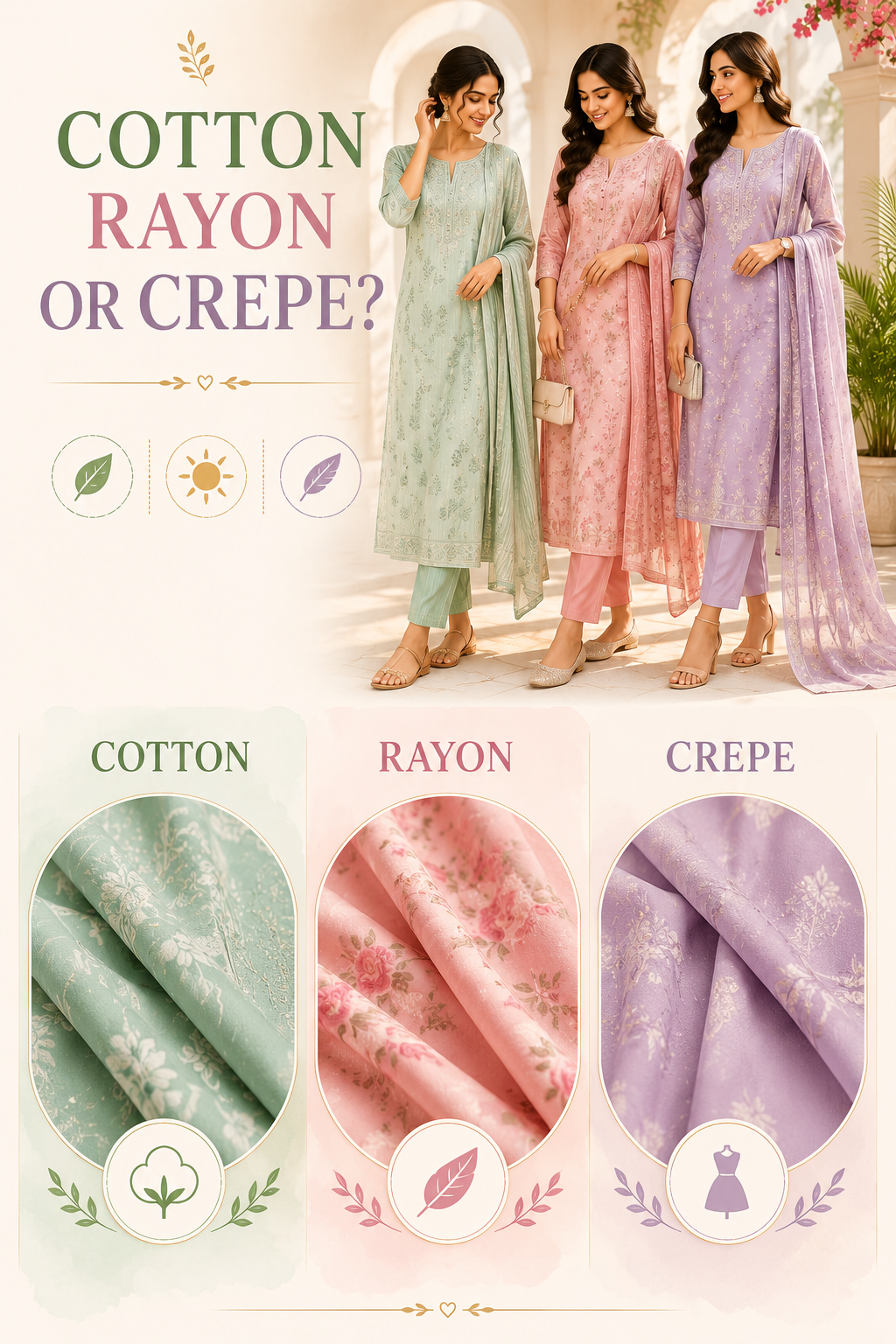
Anyone who has lived through a full year in Maharashtra knows that the state does not have one climate — it has several, often within the same week. Pune's evenings cool down sharply even when its afternoons are punishing. Mumbai's humidity makes even mild heat feel oppressive. Kolhapur and the interior districts swing from dry summer heat to a heavy, soaking monsoon within a matter of weeks. Nagpur's summer is famously one of the hottest in the country.
Through all of this, the salwar suit remains one of the most practical and widely worn outfits across the state — for daily wear, office wear, festivals, and family functions. But the fabric you choose for that suit determines whether you spend your day comfortable or constantly adjusting, sweating, or feeling weighed down.
This guide breaks down cotton, rayon, and crepe in detail — how each behaves in Maharashtra's specific climate conditions, which one suits which season and occasion, and how to choose correctly so your suit works with the weather instead of against it.
Understanding Maharashtra's Weather Before You Choose a Fabric
Fabric choice only makes sense in the context of what the fabric actually has to deal with. Maharashtra's year breaks down into three broad seasons, each placing very different demands on clothing.
Long, dry, and intense heat — particularly severe in Nagpur, Vidarbha, and inland Maharashtra, where temperatures regularly cross 40°C. Coastal areas like Mumbai add humidity on top of the heat. The priority in this season is breathability and moisture absorption above everything else.
Heavy, sustained rainfall across most of the state, with high humidity that lingers even between showers. Fabrics need to dry quickly, resist clinging when damp, and not retain moisture or odour. This is the season where fabric choice most affects daily comfort and practicality.
Mild by national standards but genuinely cool in the mornings and evenings, especially in Pune, Nashik, and inland districts. Daytime can still be warm. This is the one season where slightly heavier fabrics like crepe become more comfortable rather than less.
Cotton vs Rayon vs Crepe: At a Glance
| Feature | Cotton | Rayon | Crepe |
|---|---|---|---|
| Fibre type | Natural — plant-based | Semi-synthetic — wood pulp based | Usually synthetic or silk blend |
| Breathability | Excellent | Good | Moderate |
| Moisture absorption | Excellent | Good | Low to moderate |
| Drape | Crisp to soft, depending on weave | Fluid, silk-like | Structured with slight texture |
| Wrinkle resistance | Low — wrinkles easily | Moderate | Good |
| Best season in Maharashtra | Summer, all-year daily wear | Most of the year, especially monsoon transition | Winter, office wear, monsoon (less clingy) |
| Maintenance | Easy — machine washable | Easy to moderate — gentle wash | Moderate — often needs gentler care |
| Price range | ₹400 – ₹3,000 | ₹500 – ₹3,500 | ₹600 – ₹4,500 |
Cotton: The Maharashtra Summer Essential
- Daily wear through Maharashtra's long summer season
- Home wear and household activity
- College and casual outdoor settings
- Hot inland districts — Nagpur, Vidarbha, interior Maharashtra
- Budget-friendly daily wardrobe building
- Monsoon — cotton stays damp longer in humid conditions and clings when wet
- Office settings requiring a crisp, wrinkle-free look through the day
- Very formal occasions — reads as casual compared to crepe or silk-finish fabrics
Rayon: The Versatile All-Rounder
- Daily wear that needs a slightly more elegant drape than cotton
- Transitional weather — late summer into early monsoon, and post-monsoon into winter
- Printed and patterned salwar suits — rayon holds prints and colours very well
- Travel wear — resists wrinkling better than cotton and packs easily
- Semi-formal daily occasions and casual office settings
- Peak summer heat in inland Maharashtra — less breathable than pure cotton
- Heavy monsoon rain exposure — rayon can lose shape and stretch slightly when very wet
- Women who prioritise maximum natural fibre comfort
Crepe: The Structured Office and Winter Choice
- Office wear in air-conditioned environments — crisp and professional all day
- Winter mornings and evenings in Pune, Nashik, and inland Maharashtra
- Monsoon days — resists clinging and water-spotting better than cotton or rayon
- Semi-formal and formal occasions requiring a polished, structured look
- Travel — holds its shape exceptionally well, minimal wrinkling
- Peak summer heat — significantly less breathable than cotton or rayon
- Outdoor daytime wear in Nagpur or Vidarbha summer conditions
- Women who need maximum moisture absorption for active, sweaty days
Which Fabric for Which Maharashtra Season
| Season | Cotton | Rayon | Crepe |
|---|---|---|---|
| Peak Summer (April–June) | Best choice — maximum breathability | Good for indoor or evening wear | Too warm for outdoor daytime wear |
| Monsoon (July–September) | Good but slow to dry once wet | Good — dries reasonably fast | Best — resists clinging and water spots |
| Post-Monsoon (October–November) | Good for daytime warmth | Best — ideal transitional fabric | Good for cooler evenings |
| Winter (December–February) | Good for warm afternoons | Good for daily wear | Best — added warmth and structure |
| Office / AC environment (all year) | Good, can feel cool in strong AC | Good balance | Best — most polished and professional |
| Outdoor daytime, inland heat (Nagpur, Vidarbha) | Best — essential for extreme heat | Acceptable but warmer than cotton | Avoid — too warm for this climate |
How to Decide: 5 Questions to Ask Before You Buy
Caring for Each Fabric in Maharashtra's Climate
| Care Step | Cotton | Rayon | Crepe |
|---|---|---|---|
| Washing method | Machine wash (gentle) or hand wash | Gentle hand wash preferred | Gentle hand wash or dry clean |
| Water temperature | Cold to lukewarm | Cold water only | Cold water only |
| Drying | Sun or shade — dries fast | Shade — avoid direct sun | Shade — avoid wringing |
| Ironing | Medium-high heat, often needed | Low-medium heat, rarely needed | Low heat or steam, minimal need |
| Monsoon storage | Ensure fully dry before storing — prone to mustiness | Dry fully — resists mustiness moderately well | Dries fastest, least prone to monsoon dampness issues |
Frequently Asked Questions
Which fabric is best for Mumbai's humid weather specifically?
For Mumbai's combination of heat and high humidity, lightweight cotton is generally the best choice for daily and outdoor wear because it absorbs sweat effectively and allows air circulation. Rayon is a strong second choice, particularly for office or semi-formal wear, since it manages humidity reasonably well while offering a more polished drape. Crepe is best reserved for air-conditioned office settings in Mumbai rather than outdoor or commuting wear, where its lower breathability becomes a disadvantage in the city's humidity.
Is crepe too warm for Maharashtra's summer?
Yes, generally. Crepe is less breathable than both cotton and rayon, making it a poor choice for outdoor wear during Maharashtra's intense summer months, particularly in inland areas like Nagpur and Vidarbha where temperatures regularly exceed 40°C. Crepe works much better in winter, in air-conditioned office environments, and during monsoon days when its resistance to clinging and water spotting becomes more valuable than its lower breathability is a drawback.
Can rayon be worn during the monsoon in Maharashtra?
Rayon can be worn during the monsoon, but with some caution. It dries reasonably quickly compared to cotton, which is an advantage in humid, rainy conditions. However, rayon can lose some of its shape and stretch slightly when it becomes very wet, so it is best paired with an umbrella or worn on days with lighter rainfall rather than heavy, sustained downpours. For days with heavy rain expected, crepe is generally the more practical monsoon fabric choice.
Which fabric needs the least ironing for a busy work schedule?
Crepe requires the least ironing of the three fabrics — its structured, slightly textured surface resists wrinkling naturally and holds its shape well even after a full day of wear. Rayon is a reasonable second option, wrinkling less than cotton but more than crepe. Cotton wrinkles the most easily of the three and will typically need ironing before each wear, which is worth factoring in if your mornings are tight on time.
Should I buy all three fabrics, or just focus on one?
For most women living in Maharashtra, a mixed wardrobe across all three fabrics gives the best year-round comfort and practicality. A good starting ratio is roughly half cotton for daily and summer wear, supplemented with rayon for everyday semi-formal occasions, and crepe for office wear and the cooler winter months. Relying on only one fabric means being underdressed for the weather during at least part of the year — Maharashtra's seasonal range is wide enough that no single fabric performs best across all twelve months.
Final Thoughts
It is the one that still feels right
after a full day of Maharashtra's heat, humidity, or chill —
whichever the season happens to bring.
Cotton, rayon, and crepe each have a genuine, well-earned place in a Maharashtra wardrobe. Cotton carries you through the long summer. Rayon bridges the transitional months with grace and drape. Crepe holds its structure through winter mornings, office days, and monsoon downpours alike. Choosing the right one for the right day — rather than reaching for whatever looks nicest in the moment — is what makes the difference between a suit that fights the weather and one that simply works with it.
At Mahavir Cloth Center, our salwar suit collection spans cotton, rayon, and crepe across every season, occasion, and budget — because every woman in Maharashtra deserves a wardrobe that actually works with the weather, not against it.
Visit Us & Explore the Collection →Explore our full range of Sarees, Kurta Suit Sets, Sharara Sets, and Kids Ethnic Wear at mahavirclothcenter.com.