
Blog
Plazzo vs. Sharara Suits: key differences and which one to choose

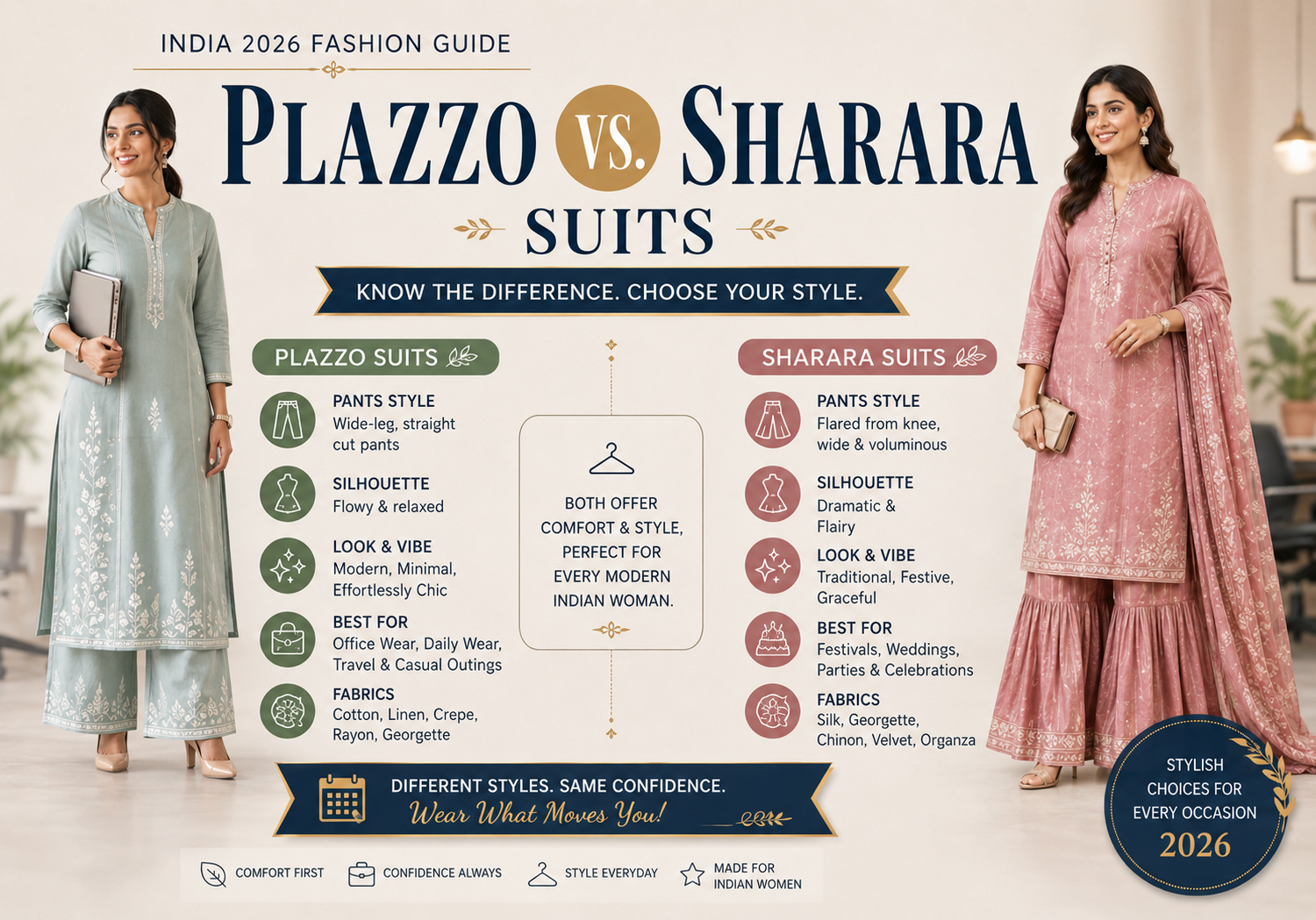
A palazzo suit features wide, flowy straight-cut pants that fall from the waist in a continuous sweep — relaxed, modern, and effortlessly comfortable. A sharara suit features flared pants that are fitted at the thigh and dramatically flare below the knee — traditional, festive, and rooted in Mughal-era elegance. Palazzo suits are best for casual wear, office ethnic days, and everyday comfort. Sharara suits are best for weddings, festivals, and formal occasions where you want a traditional, grand look. The right choice depends on your occasion, your body type, and the statement you want to make.
You are standing in a store — or scrolling through an ethnic wear collection online — and you spot two stunning outfits that look almost similar at first glance. Both have flowy bottoms. Both are paired with a kurta or top. Both look graceful and feminine. But one is a palazzo suit and the other is a sharara suit, and they are actually quite different in silhouette, origin, occasion suitability, and styling.
The confusion between the two is extremely common, even among women who wear ethnic wear regularly. This guide breaks down every key difference between a palazzo suit and a sharara suit — and helps you decide exactly which one belongs in your wardrobe and when to wear it.
Palazzo Suit vs Sharara Suit: At a Glance
| Feature | Palazzo Suit | Sharara Suit |
|---|---|---|
| Origin | Western-influenced Indo-western fusion | Mughal-era, North Indian traditional |
| Silhouette | Wide, straight flare from the waist | Fitted at thigh, dramatic flare below knee |
| Length | Full length — ankle to floor | Full length with pronounced bell shape |
| Paired With | Short kurti, crop top, long tunic | Long kurta, angrakha, or heavily embroidered top |
| Fabric | Georgette, crepe, rayon, cotton | Silk, velvet, brocade, net, georgette |
| Occasions | Casual, office, daytime festivals, travel | Weddings, engagement, festive, formal events |
| Dupatta | Optional | Almost always essential |
| Comfort | Very comfortable, easy to move in | Festive and dressy, takes practice to walk in |
| Body type | Flattering for most, especially tall and curvy | Most flattering for petite and slim frames |
| Price range | ₹600 – ₹8,000 | ₹1,500 – ₹30,000+ |
The Palazzo Suit: Everything You Need to Know
What is a Palazzo Suit?
A palazzo suit consists of wide-legged, straight-cut palazzo pants paired with a kurta, short top, or tunic. The pants flare evenly from the waist all the way down to the ankle, creating a long, sweeping silhouette. Unlike sharara pants, palazzo pants do not have a defined fitted section — they are wide throughout. The overall look is relaxed, modern, and versatile.
✔ Strengths of a Palazzo Suit
- Extremely comfortable for all-day wear
- Easy to drape and style — no practice needed
- Works for casual, semi-formal, and office ethnic wear
- Available across a huge price range
- Can be dressed up or down easily
- Flattering for tall, curvy, and plus-size women
✘ Limitations of a Palazzo Suit
- Too casual for bridal or grand wedding occasions
- Can look shapeless if the fabric is very thin
- Petite women need to style carefully to avoid being overwhelmed
- Less traditional — not suited for highly formal religious ceremonies
Best Palazzo Suit Fabrics: Georgette palazzo suits for a flowy, festive look. Crepe palazzo suits for a structured, office-ready appearance. Rayon palazzo suits for everyday casual comfort. Cotton palazzo suits for summer and daily wear. Silk palazzo suits for semi-formal occasions.
Styling Tip — Palazzo + Short Kurti: Pair a printed palazzo with a solid-coloured short kurti in a matching or complementary shade. Add block-heeled sandals to elongate the legs — palazzo pants look their best when the hem just grazes the floor.
Styling Tip — Palazzo + Long Tunic: A long A-line tunic or angrakha-style top paired with a solid palazzo creates an elegant, semi-formal look suitable for festivals, family gatherings, or office ethnic days. Keep accessories minimal and let the silhouette do the work.
| Palazzo Suit Style | Best Fabric | Best Occasion |
|---|---|---|
| Printed Palazzo + Short Kurti | Rayon, Cotton | Casual outings, college, travel |
| Solid Palazzo + Embroidered Kurti | Georgette, Crepe | Festivals, family functions |
| Silk Palazzo + Long Tunic | Silk, Chanderi | Semi-formal, small weddings |
| Embellished Palazzo Set | Net, Georgette | Evening events, receptions |
| Cotton Palazzo + Simple Kurti | Cotton, Linen | Office ethnic day, daily wear |
The Sharara Suit: Everything You Need to Know
What is a Sharara Suit?
A sharara suit is rooted in Mughal-era fashion and consists of wide-flared pants that are fitted or straight from the waist to the knee, then flare dramatically and widely below the knee in a bell shape. This distinctive silhouette — tight above, voluminous below — is the defining feature that separates a sharara from every other bottom. It is almost always paired with a long, heavily embroidered kurta and a dupatta, creating a look that is undeniably traditional, festive, and grand.
✔ Strengths of a Sharara Suit
- Deeply traditional — perfect for weddings and religious events
- Visually stunning and grand — makes a strong style statement
- The flared silhouette is universally admired and photographed beautifully
- Ideal for petite women — the flare adds height and elegance
- Pairs beautifully with heavy embroidery and zari work
✘ Limitations of a Sharara Suit
- Not suited for casual or everyday wear
- Requires careful walking — the wide flare needs practice
- Can feel heavy and warm in fabric-rich versions
- Not ideal for plus-size women without careful styling
- Higher price range for quality embroidered pieces
Best Sharara Suit Fabrics: Silk sharara suits for bridal and grand wedding occasions. Velvet sharara suits for winter weddings and receptions. Georgette sharara suits for a lighter, more comfortable festive look. Net sharara suits for evening events and mehndi ceremonies. Brocade sharara suits for a rich, traditional appearance at formal functions.
Styling Tip — Traditional Sharara: Pair a heavily embroidered sharara with a long angrakha-style kurta in a complementary colour. Let the dupatta fall over one shoulder and pin it at the kurta. Finish with jhumkas and a maang tikka for a complete traditional look.
Styling Tip — Contemporary Sharara: A solid-coloured sharara in georgette or net, paired with a short embroidered blouse-style top, gives the sharara silhouette a modern, fashion-forward update. This works beautifully for mehendi functions, sangeets, and reception parties.
| Sharara Suit Style | Best Fabric | Best Occasion |
|---|---|---|
| Embroidered Sharara + Long Kurta | Silk, Brocade | Weddings, engagement ceremony |
| Velvet Sharara + Embellished Top | Velvet | Winter wedding, reception |
| Georgette Sharara + Short Kurti | Georgette | Mehndi, sangeet, festive events |
| Net Sharara + Embroidered Blouse | Net, Chiffon | Evening events, receptions |
| Printed Sharara Set | Crepe, Georgette | Semi-formal, family functions |
Key Differences Between Palazzo and Sharara
| Difference | Palazzo Suit | Sharara Suit |
|---|---|---|
| Silhouette shape | Wide and straight from waist to ankle — uniform flare throughout | Fitted at thigh, dramatic bell-shaped flare below the knee |
| Cultural roots | Indo-western fusion, modern origin | Mughal-era, deep North Indian tradition |
| Formality level | Casual to semi-formal | Semi-formal to bridal formal |
| Ease of wearing | Very easy — no technique required | Requires practice walking in the wide flare |
| Paired kurta length | Short kurti, crop top, or mid-length tunic | Long kurta or angrakha — always floor-grazing |
| Dupatta | Optional — look is complete without it | Almost always worn — considered essential to the look |
| Best body type | Tall, curvy, plus-size women | Petite and slim women |
| Footwear | Flats, block heels, kolhapuris | Heeled juttis, wedges, or heeled sandals |
| Embellishment level | Minimal to moderate | Moderate to heavily embellished |
| Photograph quality | Clean and modern in photos | Exceptionally grand and dramatic in photos |
Occasion Guide: Which Suit to Wear When
| Occasion | Palazzo Suit | Sharara Suit |
|---|---|---|
| Casual daily wear | Perfect choice | Too formal |
| Office ethnic day | Ideal | Too elaborate |
| College or outing | Best choice | Not appropriate |
| Daytime festival | Ideal | Good if lightweight |
| Mehndi / Sangeet | Good | Perfect choice |
| Small family wedding | Good | Ideal |
| Grand wedding as guest | May feel too casual | Perfect choice |
| Engagement ceremony | Good if embellished | Ideal |
| Reception party | Good in silk | Perfect choice |
| Bridal outfit | Too casual | Excellent choice |
| Travel or outdoor event | Best choice | Not practical |
Which Suit Works Best for Your Body Type?
| Body Type | Palazzo Suit | Sharara Suit |
|---|---|---|
| Petite (below 5’3″) | Choose lightweight fabric and vertical prints. Pair with heels and a short kurti to elongate. | Very flattering — the fitted thigh section and wide flare below the knee creates an illusion of height and elegance. |
| Tall and Slim | Excellent — can carry wide palazzo pants with bold prints and heavy fabrics beautifully. | Works well — the silhouette adds volume and visual interest to a lean frame. |
| Curvy (Hourglass) | Highly flattering — the flowy fabric skims over curves and creates a long, graceful line. | Works best in georgette or net with a fitted top that defines the waist before the flare begins. |
| Athletic / Rectangular | Great choice — the wide palazzo adds visual volume to the lower body and creates the illusion of curves. | The bell flare below the knee adds hip and lower body volume. Style with an embellished top for a balanced look. |
| Plus Size | Excellent choice — go for vertical prints, solid colours, and a well-fitted short kurti. Avoid very voluminous fabrics. | Can work if styled carefully — choose georgette over heavy fabrics, keep the top long and fitted, and avoid very wide flares that add bulk. |
So Which One Should You Choose?
| Your Situation | Our Recommendation |
|---|---|
| You want everyday ethnic comfort | Palazzo Suit — easy, breezy, and versatile |
| You are attending a wedding as a guest | Sharara Suit — grand, traditional, and memorable |
| You are a first-time ethnic wear buyer | Palazzo Suit — easier to style and wear |
| You are a bride or bridesmaid | Sharara Suit — the definitive festive choice |
| You need office-appropriate ethnic wear | Palazzo Suit in crepe or cotton |
| You are attending a mehndi or sangeet | Sharara Suit in georgette or net |
| You are petite and want to look taller | Sharara Suit with heeled juttis |
| You want something comfortable for a full day | Palazzo Suit — light enough for all-day events |
| You want a festive look without too much fuss | Palazzo Suit in silk or embroidered georgette |
| You want a dramatic, photogenic outfit | Sharara Suit — always grand in photographs |
| Budget-conscious but want quality | Palazzo Suit mid-range (₹1,500 – ₹3,500) |
| Investment-worthy festive outfit | Sharara Suit in silk or velvet (₹5,000 – ₹15,000) |
Universal Styling Rules for Both Suits
Whether you choose a palazzo suit or a sharara suit, these five principles will always make the outfit look better on you.
1
The kurti or top length is everything.
The length of your top determines the entire balance of the outfit. A palazzo suit looks best with a short to mid-length kurti that stops between the hip and the thigh. A sharara suit demands a long kurta that falls to or near the knee — anything shorter disrupts the traditional proportion of the look.
2
Fabric quality defines the drape.
A good quality georgette palazzo will move and fall beautifully. A cheap polyester version will cling, bunch, and look stiff. The same rule applies to shararas — a quality silk or georgette sharara drapes with elegance, while a poor-quality version looks flat. Always prioritise fabric quality over quantity.
3
Footwear changes the entire look.
For palazzo suits, block heels, wedges, or kolhapuri flats all work beautifully. For sharara suits, always choose heeled footwear — a heeled jutti, wedge sandal, or kitten heel — because the wide flare of the sharara needs height underneath to fall properly and avoid dragging on the floor.
4
Balance embellishment between top and bottom.
If your palazzo pants or sharara is heavily printed or embroidered, keep the kurti relatively simple, and vice versa. Competing embellishments on both the top and bottom create a busy, cluttered look. Let one piece be the star and let the other support it.
5
The dupatta is your most powerful styling tool.
For palazzo suits, the dupatta is optional and can be carried casually over one shoulder. For sharara suits, the dupatta is non-negotiable — it completes the traditional silhouette. Drape it over one shoulder and pin it at the kurta, or let it fall over both shoulders for a more formal look. The right dupatta drape elevates the entire outfit instantly.
Frequently Asked Questions
What is the main difference between a palazzo and a sharara?
The key difference lies in the cut. A palazzo pant is wide and straight from the waist all the way down to the ankle — the flare is uniform throughout. A sharara pant is fitted or straight from the waist to the knee, and then flares dramatically and widely below the knee in a distinctive bell shape. That fitted-then-flared construction is what makes a sharara instantly recognisable.
Can a palazzo suit be worn to a wedding?
Yes — with the right styling. Choose a palazzo set in silk, embroidered georgette, or chanderi with zari work. Pair it with a well-fitted embroidered kurti, add a dupatta, and style with heeled sandals. This creates a look that is elegant and festive enough for a wedding as a guest or family member, though it may not match the grandeur of a sharara or lehenga for the most formal occasions.
Which is more comfortable — palazzo or sharara?
Palazzo suits are significantly more comfortable for extended wear. The wide, straight cut allows free movement and is easy to walk, sit, and move in throughout the day. Sharara suits require a bit of practice — the wide bell flare below the knee takes some adjustment to walk gracefully in, particularly on stairs or uneven ground. For a full-day event, palazzo wins on comfort every time.
Which suit is better for petite women?
A sharara suit is often more flattering for petite women because the fitted section at the thigh creates a defined silhouette before the dramatic flare begins, which visually adds height and elegance. If choosing a palazzo suit, petite women should opt for vertical prints, lightweight fabric, and heeled footwear, and avoid very wide, heavy fabrics that can overwhelm a smaller frame.
Can I wear a sharara suit without a dupatta?
Technically yes, but it is not advisable for traditional occasions. The dupatta is an integral part of the sharara suit’s silhouette and cultural identity. Skipping it at a wedding or religious ceremony can make the look feel incomplete. For a more contemporary or fusion styling at a casual event, you can skip the dupatta — but always carry one if the occasion is formal or traditional.
Final Thoughts
A palazzo suit whispers modern grace.
A sharara suit announces traditional grandeur.
Both are extraordinary — and both deserve a place in your wardrobe.
The palazzo suit and the sharara suit are not competitors — they are companions, each suited to a different chapter of your life. The palazzo is your everyday elegance, your festive comfort, your effortless style. The sharara is your celebration outfit, your grand occasion statement, your heirloom-worthy look.
Understand the occasion, know your body type, choose the right fabric, and wear whichever you choose with complete confidence. That is the only rule that truly matters.
At Mahavir Cloth Center, we stock a curated collection of palazzo suits and sharara suits across every fabric, occasion, and budget — because every woman deserves to find the perfect outfit without compromise.
Visit Us & Explore the Collection →
Explore our full range of Sarees, Kurta Suit Sets, Sharara Sets, and Kids Ethnic Wear at mahavirclothcenter.com.