Blog
How to Choose the Perfect Saree for Your Body Type

Here is a truth that every saree lover deserves to hear: there is no body type that cannot wear a saree beautifully. None. The saree is arguably the most democratic garment in the world — a single piece of unstitched fabric that has been draped across every possible body shape for thousands of years, on queens and farmers, on teenagers and grandmothers, on brides and working women.
The problem is not the saree. The problem is the mismatch — choosing the wrong fabric, the wrong drape style, or the wrong print for your particular silhouette. A heavily embroidered Kanjivaram on a petite frame can look overwhelming. A flimsy chiffon draped loosely on an athletic figure can look shapeless. But get the combination right, and every woman — regardless of height, weight, or proportions — looks extraordinary.
First: Know Your Body Type
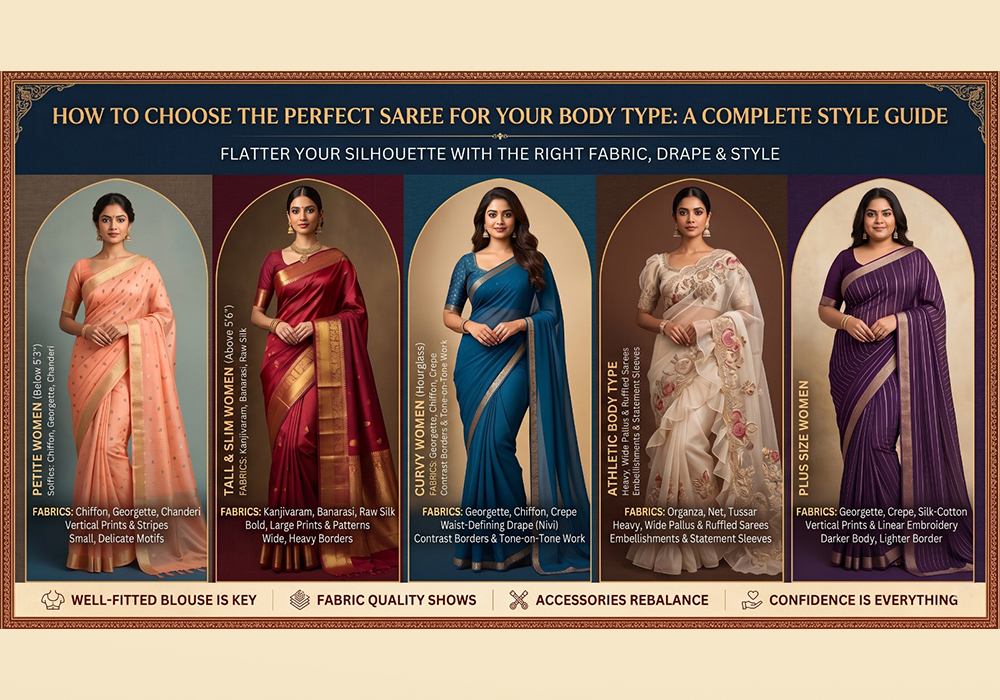
Before choosing a saree, understand your basic silhouette. Most women fall into one of five broad categories.
| Body Type | Key Characteristics | Common Concern |
|---|---|---|
| Petite | Height below 5'3", smaller frame overall | Saree fabric can overwhelm the frame |
| Tall and Slim | Height above 5'6", lean build | Saree can look flat or shapeless |
| Curvy (Hourglass) | Defined waist, fuller bust and hips | Want to highlight curves, not hide them |
| Athletic / Rectangular | Broad shoulders, narrow hips, minimal waist definition | Want to create the illusion of curves |
| Plus Size | Fuller figure, broader torso | Want to look elongated and proportionate |
Most women are a combination of two types — read both sections and pick the tips that apply most to your specific proportions.
Body Type 1: Petite Women (Below 5'3")
| ✔ What to Choose | ✘ What to Avoid |
|---|---|
| Lightweight fabrics — Chiffon, Georgette, Mulmul, Chanderi | Heavy silks — Kanjivaram, thick Banarasi |
| Vertical prints and stripes | Large horizontal prints or checks |
| Small, delicate motifs and bootis | Oversized floral or geometric patterns |
| Narrow to medium borders | Very wide, heavy borders |
| Sarees in a single dominant colour | Too many contrasting colour blocks |
| High-waist blouse that elongates the torso | Heavily structured or stiff blouses |
Body Type 2: Tall and Slim Women (Above 5'6")
| ✔ What to Choose | ✘ What to Avoid |
|---|---|
| Heavy, structured fabrics — Kanjivaram, Banarasi, raw silk | Very flimsy fabrics like plain chiffon |
| Bold, large prints and patterns | Very small, barely visible motifs |
| Wide, heavily worked borders | Borderless or very narrow borders |
| Rich jewel tones — deep red, royal blue, emerald | Very pale or washed-out colours |
| Horizontal design elements | Strict vertical stripes that over-elongate |
| Heavy zari work and embroidery | Minimal or plain sarees without embellishment |
Body Type 3: Curvy Women (Hourglass Silhouette)
| ✔ What to Choose | ✘ What to Avoid |
|---|---|
| Fluid fabrics: Georgette, Chiffon, Crepe, Satin silk | Very stiff fabrics that hide body shape |
| Sarees with waist-defining drape styles | Heavily voluminous drapes that add bulk |
| Solid colours or tone-on-tone work | Very busy all-over prints |
| Contrast borders that highlight the silhouette | No border (looks unfinished) |
| Fitted, structured blouse that defines the waist | Loose or oversized blouse |
| Dark or medium tones for the body | All-over very light colours if self-conscious |
Body Type 4: Athletic or Rectangular Body Type
| ✔ What to Choose | ✘ What to Avoid |
|---|---|
| Fabrics with volume — Organza, Net, Silk, Tussar | Flat, clingy fabrics — crepe, jersey |
| Sarees with heavy, wide pallus | Minimal pallu or simple drapes |
| Ruffled or layered sarees | Very plain, unembellished sarees |
| Embroidery and embellishments on the hip area | Plain body with all detail at the border only |
| Lighter colour on the lower half | Same dark tone top to bottom |
| Interesting necklines and sleeve designs on blouse | Very simple, plain blouses |
Body Type 5: Plus Size Women
| ✔ What to Choose | ✘ What to Avoid |
|---|---|
| Medium-weight fabrics — Georgette, Crepe, Silk cotton | Very stiff fabrics that add bulk visually |
| Vertical prints, stripes, and linear embroidery | Bold horizontal prints or wide checks |
| Sarees with darker body and lighter border | All-over very light or bright colours |
| Small to medium-scale prints | Oversized prints that overwhelm the frame |
| Structured, well-fitted blouse | Very tight or very loose blouse |
| Single-colour sarees with contrast border | Multiple competing colour blocks |
The Master Style Guide: All Body Types at a Glance
| Style Element | Petite | Tall & Slim | Curvy | Athletic | Plus Size |
|---|---|---|---|---|---|
| Best fabric | Chiffon, Chanderi, Georgette | Kanjivaram, Banarasi, Raw Silk | Georgette, Crepe, Satin | Organza, Net, Tussar | Georgette, Crepe, Silk-Cotton |
| Avoid fabric | Heavy silk | Plain chiffon | Stiff silk | Clingy crepe | Very stiff fabric |
| Best print | Small motifs, vertical | Bold, large patterns | Solid or tone-on-tone | Embellished, textured | Vertical, linear |
| Avoid print | Large horizontal | Very small motifs | Busy all-over print | Flat, plain fabric | Bold horizontal |
| Border width | Narrow to medium | Wide and heavy | Contrast border | Wide and heavy | Medium with contrast |
| Best drape | Nivi, neat pleats | Gujarati style | Nivi, pinned pallu | Bengali, heavy pallu | Neat Nivi, high tuck |
| Blouse neckline | V-neck, Sweetheart | Boat neck, Square | Princess cut, Cropped | Statement sleeves | V-neck, U-neck |
| Best colours | Pastels, single tone | Jewel tones, rich | Deep tones, contrast | Light lower half | Dark body, light border |
| Avoid colours | Multiple contrasts | Washed-out pastels | All-over pale | All-over dark | Multiple competing colours |
Universal Rules That Work for Every Body Type
Regardless of your silhouette, these five principles apply universally and will always improve how a saree looks on you.
Frequently Asked Questions
Which saree fabric is most flattering for beginners?
Georgette and Chanderi are the most forgiving fabrics for first-time wearers. Both are lightweight, easy to drape, and flattering across most body types. They hold pleats well and are comfortable for extended wear.
Can a plus-size woman wear a heavily embroidered saree?
Absolutely. The key is placement — embroidery concentrated on the border and pallu rather than all over the body creates a structured, elegant look. Avoid all-over heavy embroidery that adds visual bulk across the entire silhouette.
What is the most universally flattering saree colour?
Deep jewel tones — royal blue, emerald green, deep burgundy, and rich plum — are universally flattering across skin tones and body types. They photograph beautifully, work for most occasions, and create a polished, sophisticated look.
How do I stop my saree pleats from falling out during the day?
Use a good quality safety pin at the waistband to secure the pleats to the petticoat. Make sure the petticoat fits snugly at the waist. Georgette and crepe fabrics hold pleats more reliably than very slippery fabrics like satin.
Final Thoughts
Understand your silhouette. Choose the right fabric. Drape it with intention.
Pair it with a well-fitted blouse. Wear it with confidence.
That combination works for every woman, every time.
At Mahavir Cloth Center, our saree collection covers every fabric, every occasion, and every budget — because we believe every woman deserves to find her perfect saree without compromise.
Visit Us & Explore the Collection →Explore our full range of Sarees, Kurta Suit Sets, Sharara Sets, and Kids Ethnic Wear at mahavirclothcenter.com.