Blog
How to Shop for Ethnic Wear Online in India Without Getting Cheated

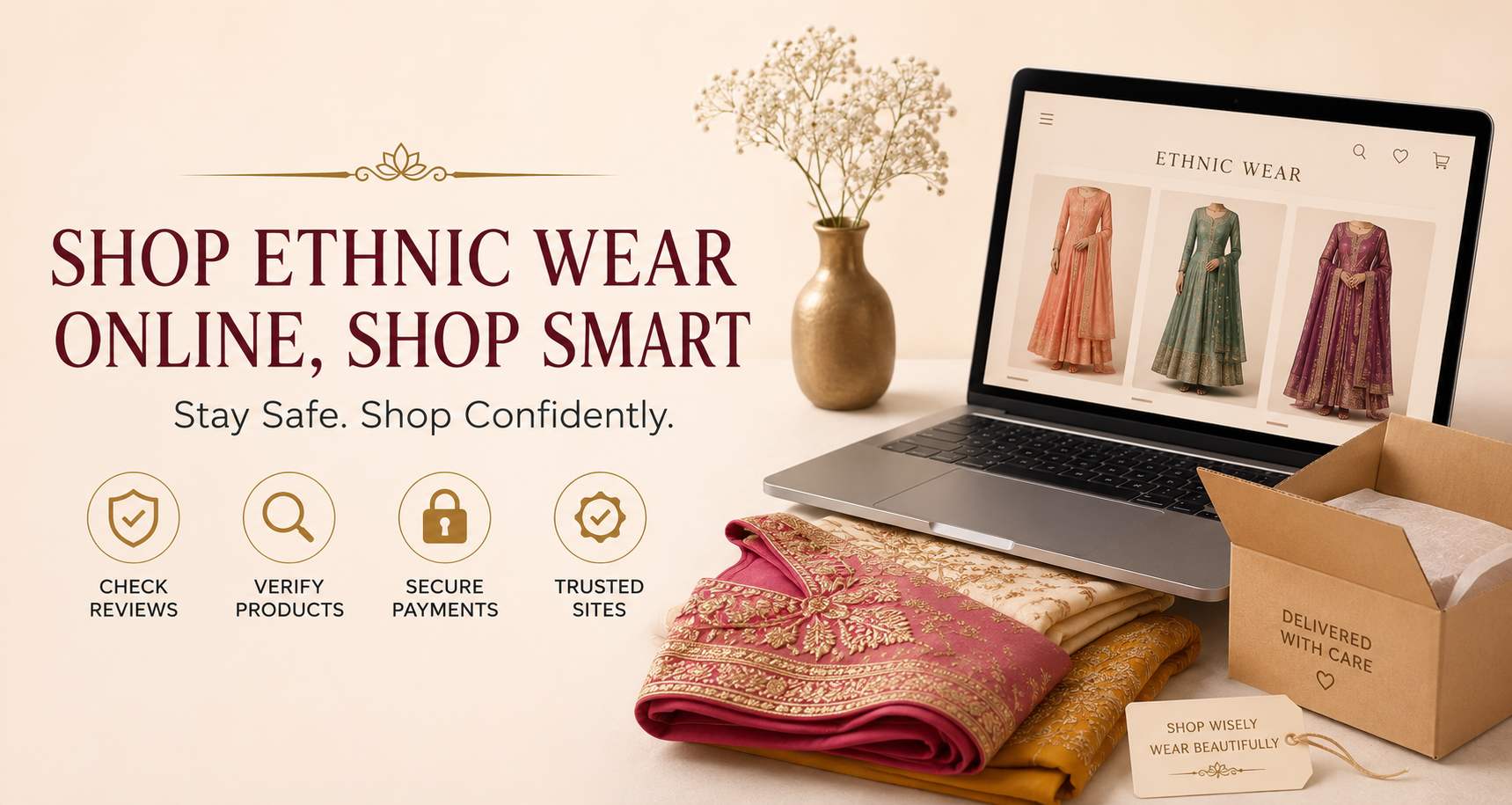
Shopping for ethnic wear online in India has transformed dramatically in the last five years. What was once a niche activity reserved for buyers who could not access major city markets has become the primary way millions of women across India now find and purchase sarees, suits, lehengas, and kurta sets. The convenience is real. The variety is extraordinary. And the risks — if you do not know what to look for — are equally real.
The most common complaint among online ethnic wear buyers in India is not the price. It is the gap between what they saw and what they received. A saree that looked a rich burgundy in the product photograph arrived a dull maroon. A fabric described as pure silk felt distinctly synthetic. A handloom saree with a premium price point showed every sign of being a mill-made imitation. A size that matched the age label did not match the child at all.
Every one of these disappointments is preventable. This guide tells you exactly how.
6 Red Flags That Should Stop You From Buying
Before getting into what to check, start with the non-negotiables — these six signals, when present, mean you should close the page and look elsewhere regardless of how beautiful the product photographs appear.
Any legitimate ethnic wear seller will specify the exact fabric — "100% pure silk," "georgette," "cotton-polyester blend." If a listing says "premium fabric," "high-quality material," or similar vague terms without naming the specific fibre, the seller either does not know what they are selling or is deliberately hiding it. Do not buy.
A "pure Kanjivaram silk" saree for ₹800. A "genuine Banarasi" for ₹500. A "handloom Jamdani" for ₹600. None of these are possible. When a price is dramatically below what the fabric and craft genuinely require, the product is not what it claims to be — every single time. Know your price baselines and treat any listing below them with complete scepticism.
A product listing with only styled model photographs — no close-up of the fabric texture, no image of the reverse side, no pallu or border detail shot — is hiding something. Legitimate handloom and quality fabric sellers are proud to show their product up close. Close-ups reveal quality; sellers who avoid them know their product does not hold up under scrutiny.
A seller with no return policy on ethnic wear has no confidence that the product matches the description. Every reputable platform and seller offers at least an exchange option on clothing. Before purchasing anything above ₹1,000, confirm the return policy explicitly. "No returns" on clothing is a significant red flag.
A product with no reviews, or only reviews that say "good product, fast delivery" without specific fabric or quality comments, is unverified. Look for reviews that mention specific details — the weight of the fabric, the accuracy of the colour, the quality of the embroidery. Generic reviews are frequently purchased. Specific, detailed reviews from verified buyers are the most reliable quality signal available.
A seller who cannot be contacted directly — no phone number, no verifiable address, no response to pre-purchase questions — has no accountability. If a problem arises after purchase, you have no recourse. Always check that the seller has reachable contact information before making any significant purchase.
How to Verify Fabric Claims Before You Buy Online
Fabric misrepresentation is the most common form of ethnic wear fraud online in India. Here is how to verify what a seller claims before the product arrives — while it is still possible to walk away.
Verifying Silk Claims Online
- Ask the seller directly: "Is this 100% pure mulberry silk or a silk blend?" — their response tells you a great deal
- Look for the Silk Mark certification mentioned in the listing for premium sarees
- Check the price against market reality — pure silk sarees start from ₹3,000 at the absolute minimum
- Read reviews specifically for comments on fabric texture and feel
- Request a fabric swatch from the seller before committing to an expensive purchase
- The listing uses "premium silk," "luxury silk," or "silk-feel" rather than specifying the silk type
- The price is under ₹2,000 for any silk claim
- The fabric appears uniformly shiny and plastic-looking in photographs
- No GI tag or Silk Mark mentioned for premium regional silk claims
Verifying Handloom Claims Online
- Slight irregularities in the weave — handloom is beautiful but not machine-perfect
- Motifs visible on BOTH sides of the fabric — a hallmark of genuine handloom
- GI (Geographical Indication) tag mentioned for regionally protected weaves
- Handloom Mark certification from the government of India
- Price consistent with handloom market reality — genuine handloom is never cheap
- Perfectly uniform pattern with no variations across the entire fabric body
- Motifs visible only on one side — the reverse is plain or shows floating threads differently than handloom
- Price dramatically below the known handloom market minimum
- No GI tag, Handloom Mark, or certification mentioned
- Very fast delivery — genuine handloom requires time to source
How to Manage Colour Accuracy When Shopping Online
Colour difference between what is shown online and what arrives is the single most reported complaint in online ethnic wear shopping. It is also largely unavoidable — but it can be managed and minimised significantly with the right approach.
| Issue | Why It Happens | How to Protect Yourself |
|---|---|---|
| Colour appears brighter online than in person | Product photographs are taken under bright studio lighting that saturates and intensifies colour | Look for customer photographs in reviews — they show real-world colour under natural light |
| Colour appears different on different screens | Screen calibration varies significantly between devices — what looks teal on your phone may look green on another | View the product on multiple devices and in different lighting; trust text descriptions over photographs |
| Fabric shows different colour than expected | Different fabric textures absorb light differently — the same colour looks different in cotton vs silk vs georgette | Look for photographs that show the fabric in a draped, worn context rather than flat lay only |
| Photograph uses colour filters or editing | Many seller photographs use editing to make colours more vibrant and appealing | Request unedited swatches or natural light photographs from the seller before purchase |
Avoiding Sizing Problems in Online Ethnic Wear
Sizing in Indian ethnic wear online is highly inconsistent across sellers and platforms. Age-based sizing for kids, generic "free size" claims for women's suits, and inconsistent measurement charts cause the largest number of returns and disappointments in online ethnic wear shopping.
How to Choose a Reliable Online Ethnic Wear Seller
Every fabric listed by name and composition. Care instructions included. Blouse piece dimensions specified. A reliable seller does not leave you guessing about what you are buying.
Not just studio images — actual buyer photographs showing the product in real-world conditions. These show true colour, real drape, and genuine fabric texture in a way that edited studio images do not.
A seller who answers questions about fabric composition, GI certification, or measurement details quickly and specifically — rather than vaguely or not at all — is a seller who knows and stands behind their product.
At minimum, an exchange policy for size issues. A return policy for products that genuinely do not match the description. A seller who offers this has confidence in their product and accountability for what they sell.
Reviews that mention fabric weight, colour accuracy, embroidery quality, and delivery condition — across multiple recent buyers — indicate a seller with a genuine track record. Look for patterns across reviews rather than individual outliers.
A phone number that is answered. An address that can be verified. A business name that appears consistently across their platform, packaging, and communications. Accountability requires contactability.
The Complete Pre-Purchase Checklist
Before placing any online ethnic wear order above ₹1,000, run through this checklist. Each item takes less than two minutes. Together, they eliminate the vast majority of online shopping disappointments.
| Check | What to Look For | Red Flag If |
|---|---|---|
| Fabric composition | Specific fibre named — "100% cotton," "pure georgette," "silk-cotton blend" | Vague terms like "premium fabric" or "high-quality material" |
| Price vs market reality | Price consistent with the claimed fabric's known market range | Price dramatically below market minimum for the claimed fabric |
| Product photographs | Close-up of fabric texture, reverse side, border, and pallu visible | Only model photographs, no fabric detail images |
| Customer reviews | Detailed, specific reviews mentioning fabric, colour accuracy, quality | No reviews, or generic reviews without specific product details |
| Size information | Specific measurements in centimetres or inches alongside size labels | "Free size" or "one size fits all" with no measurements provided |
| Return / exchange policy | Clearly stated policy with conditions and timeline | No return policy, or "all sales final" without justification |
| GI / certification (for handloom) | GI tag, Silk Mark, or Handloom Mark mentioned for premium claims | Premium handloom claim with no certification mentioned |
| Seller contact | Phone number, address, or verifiable business information available | No contact information or only a generic email address |
| Blouse piece details | Blouse piece included and dimensions specified | No mention of whether blouse piece is included |
| Delivery timeline | Realistic delivery timeline stated — not "delivered in 1-2 days" for custom or handloom | Unrealistically fast delivery promised for handloom or embroidered products |
What to Do If You Receive the Wrong Product
Frequently Asked Questions
How can I tell if an online ethnic wear seller is trustworthy before buying?
Check for four things: specific and honest product descriptions that name the exact fabric and composition, genuine detailed customer reviews rather than generic or absent ones, a clearly stated return or exchange policy, and reachable contact information. A seller who is honest about what they sell, shows their product in close-up detail photographs, and stands behind it with a return option is almost always a trustworthy one. If any of these four elements are absent or vague, approach with significant caution.
What is the biggest scam in online ethnic wear shopping in India?
The most common and costly scam is fabric misrepresentation — selling synthetic, machine-made, or art-silk products at pure silk or genuine handloom prices. It is widespread, difficult to detect from photographs alone, and often discovered only when the product arrives. The best protection is knowing the price floors for genuine fabrics — no genuine Kanjivaram for ₹800, no genuine Jamdani for ₹500 — and being immediately suspicious of any listing that offers a premium fabric claim at a price well below market reality.
Is it safe to buy expensive sarees — above ₹5,000 — online?
Yes, but only from sellers who meet a higher standard of verification for expensive purchases. For any saree above ₹5,000, confirm the specific fabric composition, ask for the GI or Silk Mark certification if it is a regional weave, check for genuine customer reviews specifically mentioning the quality at that price point, and confirm the return policy before purchasing. At this price level, requesting a fabric swatch from the seller before committing is entirely reasonable and most reputable sellers will comply.
What should I do if the colour I received is very different from what was shown online?
Photograph the product in natural daylight alongside the product listing on your screen, clearly showing the colour difference. Contact the seller or platform immediately within the return window with these photographs as evidence. A slight shade variation is generally not grounds for a return on most platforms. A significant, obvious colour difference — for example, navy described as black, or orange listed as coral — is legitimate grounds for a return or exchange claim on any reputable platform. Document everything and file the claim promptly rather than waiting.
Is buying ethnic wear from a local trusted store better than buying online?
For premium, high-value purchases — genuine handloom sarees, bridal lehengas, heavily embroidered occasion wear — buying from a trusted local store remains significantly better than buying online. You can feel the fabric, verify the quality directly, check the construction and finishing, and have immediate recourse if something is wrong. For everyday ethnic wear, co-ord sets, salwar kameez, and casual outfits in the ₹500–₹3,000 range, trusted online sellers with strong review records offer excellent value and convenience. The general rule is: the higher the price and the more important the occasion, the more valuable in-person shopping becomes.
Final Thoughts
It is only risky when you do not know what to check
and what the checks should tell you.
Know your fabrics. Know your price floors. Read the reviews carefully.
And never let a beautiful photograph make a decision
that only a fabric description can justify.
The information in this guide costs nothing to apply. A few minutes of checking before every order — fabric composition, price reality, review quality, return policy — eliminates the majority of online ethnic wear disappointments before they happen. The buyers who shop online with consistent satisfaction are not luckier than those who do not. They simply know what to look for, and they look for it every single time.
At Mahavir Cloth Center, we believe in honest, transparent pricing and genuine product descriptions — because every customer deserves to receive exactly what they were shown. Browse our collection online or visit us in store for the assurance of in-person quality verification.
Visit Us & Explore the Collection →Explore our full range of Sarees, Kurta Suit Sets, Sharara Sets, and Kids Ethnic Wear at mahavirclothcenter.com.