Blog
Pre-Stitched Saree vs Traditional Draping

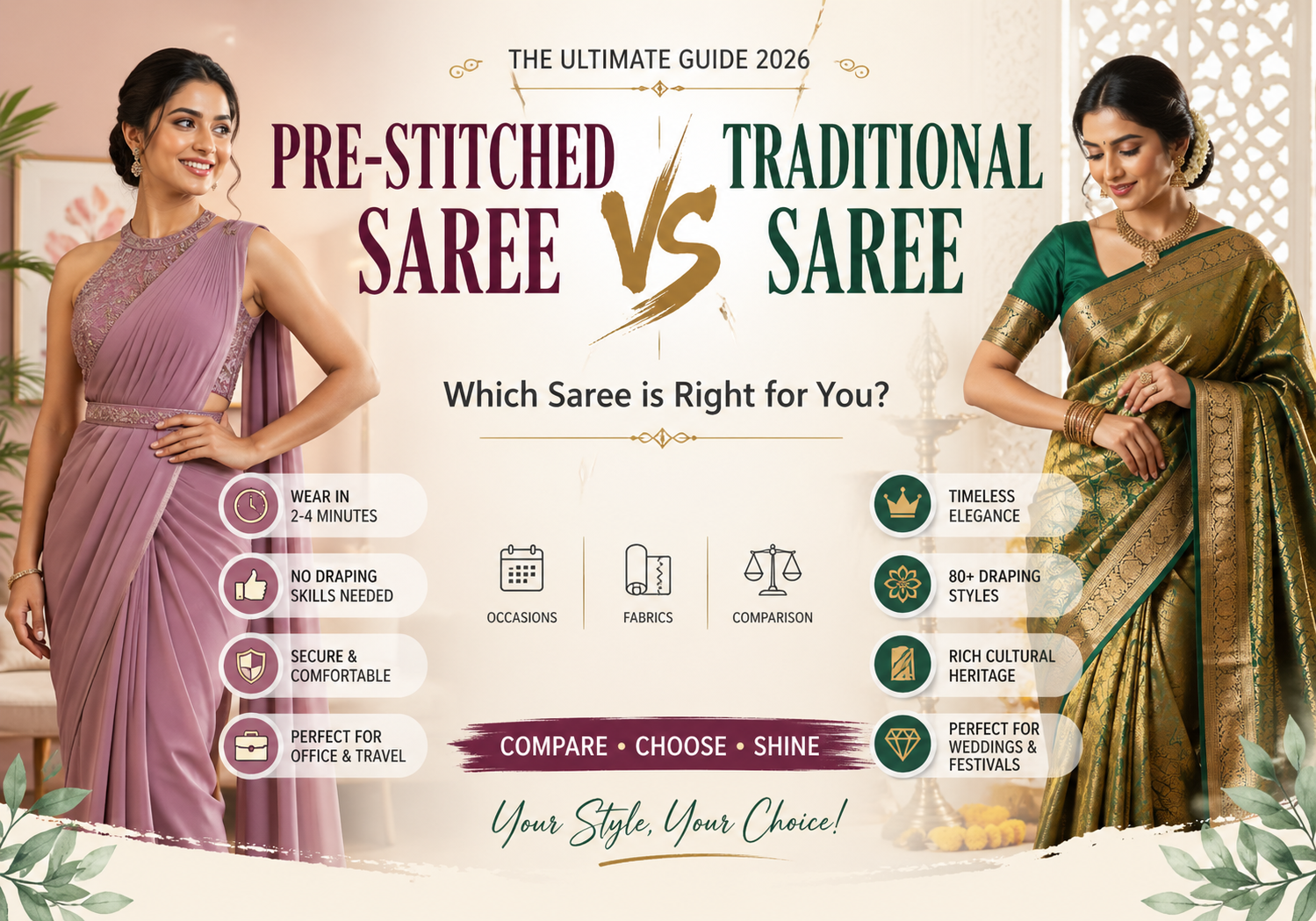
Pre-Stitched Saree vs Traditional Draping: Which Is Better for Modern Women?
The saree has survived thousands of years of fashion evolution without losing a single ounce of its grace. But in 2026, modern women face a dilemma that didn't exist a generation ago: should you choose a pre-stitched saree that you can wear in minutes — or a traditionally draped saree that takes skill, time, and practice to perfect?
Both options have their passionate advocates. Both have genuine advantages. And the truth is, neither is universally "better" — what matters is which one is better for you, on a specific occasion, with your specific lifestyle and comfort level.
This comprehensive guide breaks it all down — the history, the pros and cons, the occasions, the fabrics, and a direct side-by-side comparison — so you can make an informed, confident decision every time you reach for a saree.
What Exactly Is a Pre-Stitched Saree?
A pre-stitched saree — also called a readymade saree or pre-draped saree — is a saree that has been machine-stitched or hand-stitched into a fixed drape by the manufacturer. All the pleats are pre-set, the pallu is attached to the shoulder, and the garment typically has an inner skirt or lehenga-style base built in.
You simply step into the skirt, hook or zip it up, and pin the pallu at the shoulder. The entire process takes under three minutes — and the result looks almost identical to a traditionally draped saree from a distance.
Pre-stitched sarees have become widely popular among:
- Working professionals who need to look polished in limited time
- Young women who love sarees but haven't yet mastered draping
- Women who want to wear sarees for travel or all-day events without adjusting pleats
- Brides and guests attending multiple events across several days
What Is Traditional Saree Draping?
Traditional saree draping is the art of wrapping 5 to 9 metres of unstitched fabric around the body in a specific style that varies by region, community, and occasion. The most common draping style across India is the Nivi drape — where the saree is tucked into the petticoat, pleated at the front, and the pallu is draped over the left shoulder.
But India has over 80 documented regional draping styles, each with its own technique, aesthetic, and cultural significance:
| Draping Style | Region | Distinctive Feature |
|---|---|---|
| Nivi | Andhra Pradesh (most popular pan-India) | Pallu over left shoulder, front pleats |
| Bengali | West Bengal | Pallu over both shoulders, no petticoat pleats |
| Gujarati / Seedha Pallu | Gujarat, Rajasthan | Pallu brought from back, draped over right shoulder to front |
| Maharashtrian Nauvari | Maharashtra | 9-yard saree draped like a dhoti — no separate petticoat |
| Coorg / Kodagu | Karnataka | Pallu at the back, pleats pinned on the right |
| Kerala Kasavu | Kerala | Mundum Neriyathum — two-piece drape in white and gold |
| Tamil Madisar | Tamil Nadu (Brahmin community) | 9-yard saree, dhoti-style with legs visible |
Traditional draping requires practice — typically 10 to 20 minutes for beginners, and 5 to 8 minutes for experienced wearers. The skill of draping a saree beautifully is traditionally passed down from mothers and grandmothers, and many women consider it a cherished ritual in itself.
Head-to-Head Comparison: Pre-Stitched vs Traditional Draping
Here is the most comprehensive side-by-side comparison you will find anywhere — covering every factor that matters for a modern woman's decision.
| Factor | Pre-Stitched Saree | Traditionally Draped Saree |
|---|---|---|
| Time to Wear | ✔ 2–4 minutes | 10–25 minutes (beginner) / 5–8 min (experienced) |
| Skill Required | ✔ None — wear-and-go | Moderate to high — requires practice |
| Draping Security | ✔ Fixed stitching — no slippage | Can slip, shift, or loosen over hours |
| Comfort for All-Day Wear | ✔ Excellent — no constant readjusting | Depends on skill — may need adjustments |
| Elegance & Visual Impact | Good — professional and polished | ✔ Superior — natural drape, fluid movement |
| Regional Style Options | ✗ Limited — mainly Nivi-style fixed | ✔ 80+ styles possible |
| Fabric Variety | Good range — mainly lighter fabrics | ✔ All fabrics — including heavy silks |
| Cultural Authenticity | Moderate | ✔ High — traditional and region-specific |
| Suitability for Weddings | Good for guests — adequate | ✔ Ideal — especially for brides and close family |
| Suitability for Office / Daily Wear | ✔ Excellent | Possible but requires practice |
| Travel-Friendly | ✔ Very — minimal adjustments needed | Less suitable — may need re-draping |
| Reusability / Versatility | Moderate — fixed style | ✔ High — same saree, multiple draping styles |
| Price Range | ₹500 – ₹8,000 typically | ₹300 – ₹1,00,000+ (wide range) |
| Ideal For | Beginners, busy women, daily wear | Experienced wearers, weddings, formal events |
Pros and Cons of Pre-Stitched Sarees
Advantages
- Ready in under 3 minutes — ideal for busy mornings
- No draping skill required whatsoever
- Pleats stay in place all day without re-tucking
- Pallu stays fixed — no fear of it slipping during movement
- Perfect for offices, commuting, and long working hours
- Great for beginners and women who don't wear sarees often
- Comfortable for women who aren't used to petticoats
- Consistent look every single time you wear it
- Many styles include an attached blouse or belt for ease
Limitations
- Fixed draping style — cannot be changed to a different regional style
- The stitching restricts the natural, fluid movement of the fabric
- May not look as graceful as a well-draped traditional saree up close
- Heavy fabrics like Kanjivaram or Banarasi are not commonly available in pre-stitched form
- Not considered as traditionally appropriate for certain rituals
- Alteration is difficult once stitched — no flexibility in drape depth or pallu length
- Some styles look noticeably "pre-made" at close range
Pros and Cons of Traditional Saree Draping
Advantages
- Unmatched elegance — fabric drapes and flows beautifully with natural movement
- Enormous variety — 80+ regional draping styles to choose from
- Available in every fabric, weight, and price range imaginable
- One saree can be draped in multiple styles for different occasions
- Culturally authentic — appropriate for all religious and traditional ceremonies
- Can be tailored to your exact body type by adjusting drape depth and pallu length
- The ritual of draping is itself a meaningful, meditative experience
Limitations
- Requires learning and practice — intimidating for beginners
- Takes 10–25 minutes to drape properly for inexperienced wearers
- Risk of saree coming undone during a busy or active day
- Needs periodic readjustment — especially pallu and front pleats
- Not practical for daily office wear unless you are experienced
- Requires a well-fitted petticoat and correct pinning technique
Which Is Better for Different Occasions?
The real answer to "pre-stitched or traditional?" almost always comes down to the specific occasion. Here is a practical occasion-by-occasion guide.
- Going to the office or a corporate event
- Attending a casual lunch, brunch, or daytime function
- Traveling by flight or long-distance train
- You're a beginner who wants to start wearing sarees
- Attending college or a cultural programme
- Wearing a saree for the very first time
- You have only 5 minutes to get ready
- Running errands or attending a semi-formal event
- Attending a wedding as bride, close family, or guest of honour
- Participating in a religious ceremony, puja, or festival
- Wearing an heirloom, heavy silk, or designer saree
- Attending a formal gala, award ceremony, or state function
- Seeking a region-specific cultural look (Bengali, Gujarati, etc.)
- Wearing the saree for photography or a photoshoot
- You have time to prepare and want to look truly exceptional
The Fabric Factor: Which Sarees Work Best in Each Style?
Not all fabrics perform equally well in pre-stitched and traditional formats. Understanding this can help you make much smarter choices when shopping.
| Fabric | Pre-Stitched Suitability | Traditional Draping Suitability | Best For |
|---|---|---|---|
| Georgette | ✔✔ Excellent | ✔✔ Excellent | Office, parties, daily wear |
| Chiffon | ✔✔ Excellent | ✔ Good | Casual occasions, summer wear |
| Crepe | ✔✔ Excellent | ✔✔ Excellent | Office, semi-formal events |
| Net / Organza | ✔ Good | ✔✔ Excellent | Parties, evening events |
| Raw Silk / Tussar | Limited availability | ✔✔ Excellent | Festive, semi-formal |
| Kanjivaram Silk | ✗ Rarely available | ✔✔ Ideal | Weddings, religious ceremonies |
| Banarasi Silk | ✗ Rarely available | ✔✔ Ideal | Weddings, formal occasions |
| Cotton / Khadi | ✔ Good | ✔✔ Excellent | Daily wear, summer |
| Chanderi | ✔ Good | ✔✔ Excellent | Festive, light occasions |
Expert Verdict
For heavy, luxury fabrics like Kanjivaram, Banarasi, and pure silk — traditional draping is almost always the right choice. The stiffness and weight of these fabrics actually help hold the drape beautifully on their own. For lighter fabrics like georgette and chiffon, pre-stitched sarees work extremely well and can look stunning at any occasion up to semi-formal.
The Modern Woman's Dilemma: Practicality vs Tradition
There is a deeper question underneath the pre-stitched vs traditional debate — and it is worth addressing openly: Is choosing a pre-stitched saree somehow less authentic? Does it indicate less respect for tradition?
The answer is an unequivocal no.
The saree has always evolved. The blouse — now considered an inseparable part of the saree — was not a traditional component until the 19th century. Safety pins, which modern saree wearers consider essential, were introduced only in the late 1800s. The fall-and-pico stitching at the bottom of the saree is a relatively modern tailoring innovation. Every generation has found ways to make the saree more practical for its own lifestyle.
Pre-stitched sarees are simply the latest chapter in that long history of evolution. What matters — what has always mattered — is the dignity, elegance, and intention with which the garment is worn.
5 Expert Tips: Getting the Best of Both Worlds
-
Own both — use them for different occasions The smartest saree wardrobe includes both pre-stitched and traditional sarees. Use pre-stitched for weekday office wear and casual events; save your traditional draping skills for weddings, festivals, and special occasions where elegance truly matters.
-
Learn at least one traditional draping style Even if you rely on pre-stitched sarees daily, invest time in learning the basic Nivi drape. Once it becomes muscle memory, it takes under 8 minutes — and the visual difference on a formal occasion is significant.
-
Use pre-stitched sarees to build confidence Many women avoid wearing sarees altogether because they are intimidated by draping. Pre-stitched sarees are the perfect gateway — wear them regularly, build comfort with the garment, and gradually graduate to traditional draping as your confidence grows.
-
Never compromise on blouse fitting — either way Whether you choose pre-stitched or traditional, the single biggest factor in how well your saree looks is the blouse. A perfectly tailored blouse elevates any saree instantly. Get yours stitched to your exact measurements every time.
-
Match fabric to format As the fabric table above shows, not all fabrics suit both formats equally well. Georgette and chiffon work brilliantly in pre-stitched form. For your Banarasi or Kanjivaram — always go traditional. Respecting the fabric's natural drape is what separates a good saree look from a great one.
Quick Decision Guide: Which Should You Choose Right Now?
| Situation | Recommended Choice | Reason |
|---|---|---|
| Office / corporate meeting | Pre-Stitched | Clean, professional, no readjusting needed |
| Wedding (as bride) | Traditional | Authenticity and elegance are non-negotiable |
| Wedding (as guest) | Either | Both look equally good for guests |
| Religious puja or ceremony | Traditional | Cultural and ritualistic appropriateness |
| Festival (Navratri / Dussehra / Diwali) | Either | Festive mood allows both styles |
| College cultural programme | Pre-Stitched | Active movement, no fear of it coming undone |
| First time wearing a saree | Pre-Stitched | No stress, consistent result, confidence booster |
| Formal photoshoot | Traditional | Natural drape photographs significantly better |
| Travel / long journey | Pre-Stitched | No readjustment needed over hours |
| Daily wear (experienced wearer) | Traditional | More comfortable and versatile over time |
Frequently Asked Questions
Is a pre-stitched saree appropriate for a wedding?
Can a pre-stitched saree be converted back to a regular saree?
How long does it take to learn traditional saree draping?
Which fabric is best for a pre-stitched saree?
Are pre-stitched sarees considered less traditional or less authentic?
What is the price difference between pre-stitched and regular sarees?
Which option is better for working women?
Final Verdict: There Is No Wrong Answer
If there is one conclusion to draw from this entire guide, it is this: the debate between pre-stitched and traditionally draped sarees is not a competition. It is a spectrum.
The best-dressed women in India — whether in Mumbai's corporate corridors or Jaipur's grand wedding halls — have always known that the right choice depends on the right occasion. Pre-stitched sarees are a genuine innovation that makes the saree more accessible, more practical, and more relevant to the modern Indian woman's life. Traditional draping is an art form that produces a level of elegance no pre-stitched garment can fully replicate for formal occasions.
Own both. Learn both. Celebrate both. The saree in all its forms — stitched, draped, modern, traditional — is magnificent.
Explore Our Saree Collection
At Mahavir Cloth Center, we carry a wide range of georgette, chiffon, Kanjivaram, Banarasi, and cotton sarees for every occasion and budget — both ready-to-wear and traditional styles.
Visit us in Kolhapur or explore our full collection online.
Explore our full range of Sarees, Kurta Suit Sets, Sharara Sets, and Kids Ethnic Wear at mahavirclothcenter.com.

Leave a Reply
Your email address will not be published. Required fields are marked *