Blog
Kids Ethnic Wear Guide

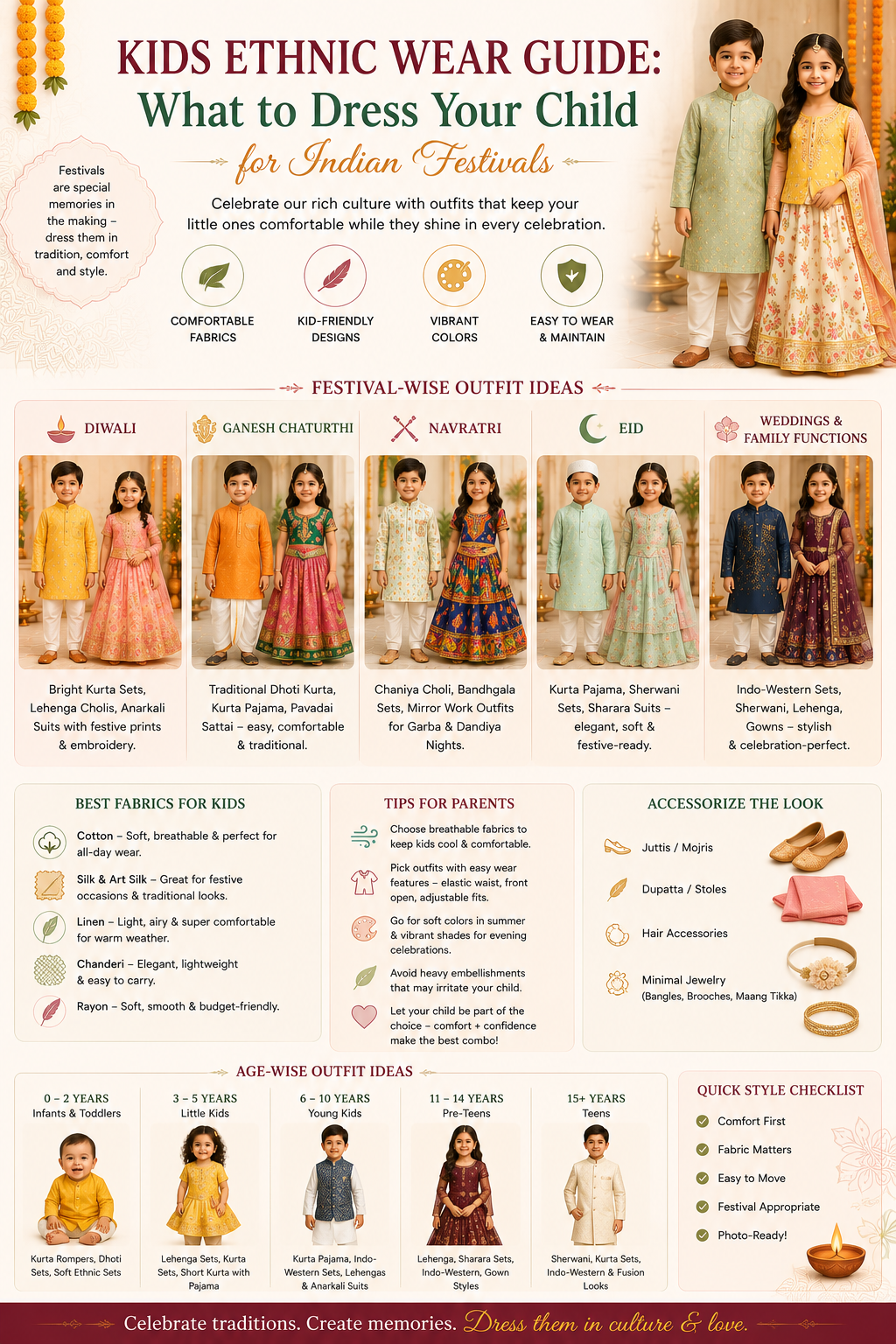
Every parent knows the challenge. The festival is three days away. You want your child to look wonderful — dressed in something that honours the occasion, photographs beautifully, and makes them feel proud of what they are wearing. But you also know that within twenty minutes of arriving at any celebration, your child will have run through a crowd, eaten something messy, sat on the floor, and possibly cried about something entirely unrelated to the outfit.
The best kids' festival ethnic wear accounts for all of this. It looks beautiful and it survives the child wearing it. It is comfortable enough that the child forgets they are dressed up. It is washable enough that the post-celebration cleanup is not a crisis. And it is age-appropriate enough that the child actually feels good in it rather than like a prop in someone else's photograph.
This guide covers exactly how to achieve that — for every festival, every age group, and every child.
The Golden Rules of Kids' Festival Ethnic Wear
Before getting into specific festivals and outfits, these five principles apply to every single purchase of kids' ethnic wear for any Indian festival. Follow them and most buying decisions become significantly easier.
Boys' Festival Ethnic Wear: Complete Guide
Kurta Pyjama — The Most Versatile Boys' Festival Outfit
- Every Indian festival — the most occasion-flexible boys' outfit
- All age groups from toddler to teen
- Both indoor and outdoor festival occasions
- Boys who need maximum comfort and movement freedom
- First ethnic outfit — easiest to wear and manage
- Very long kurtas that drag on the ground for young boys
- Tight pyjama waistbands — always choose elasticated
- Heavy silk or velvet for outdoor summer festivals
Sherwani — For Grand Occasions and Weddings
- Weddings — as ring bearer, baraat participant, or close family member
- Engagement and naming ceremonies
- Grand Diwali or Eid parties where the occasion demands formality
- Professional photographs and portrait sessions
- Boys aged 5 and above — younger children find it restricting
- Active outdoor festivals — too structured for running and playing
- Very young boys under 4 — too complex to manage
- Summer outdoor events — heavy fabric in heat is very uncomfortable
- Casual family gatherings — too formal for everyday celebration
Dhoti Kurta — For Traditional and Regional Festivals
Girls' Festival Ethnic Wear: Complete Guide
Salwar Kameez — The Timeless Festival Staple for Girls
- Every Indian festival — no occasion where it is wrong
- All age groups from toddler to teen
- Active girls who need full movement freedom
- Parents who need a machine-washable festival outfit
- Girls attending full-day outdoor festivals
- Very grand weddings — an embroidered sharara or Anarkali reads more formally
- High-photography occasions — a more dramatic silhouette photographs better
Sharara Suit — The Festival Showstopper for Girls
- Weddings and engagement ceremonies
- Eid and Diwali grand celebrations
- Mehndi and sangeet functions
- Portrait photography and professional shoots
- Girls aged 5 and above
- Very active outdoor festivals — wide flare restricts running
- Girls under 3 — too complex to manage
- Full-day outdoor events in summer heat
Lehenga Choli — For the Most Special Occasions
Festival-by-Festival Dressing Guide for Kids
| Festival | Best for Boys | Best for Girls | Best Colour | Key Tip |
|---|---|---|---|---|
| Diwali | Kurta pyjama in silk or georgette | Sharara set or embroidered salwar kameez | Gold, red, pink, emerald, royal blue | Avoid very flammable synthetic fabrics near diyas — choose cotton blend |
| Navratri | Kurta pyjama in bright festive colour | Lehenga choli or palazzo suit | Colour of the day | Prioritise comfort and movement — children dance for hours |
| Eid | Kurta pyjama or sherwani | Sharara set or embroidered salwar kameez | White, pastel green, ivory, blush | Light, elegant embroidery — Eid favours grace over grandeur |
| Holi | Old cotton kurta pyjama | Old cotton salwar kameez or palazzo | White — shows colours beautifully | Never dress children in good ethnic wear for Holi colour play |
| Ganesh Chaturthi | Dhoti kurta or kurta pyjama | Salwar kameez or cotton sharara | Saffron, yellow, orange, red | Traditional colours — festival has strong cultural significance |
| Durga Puja | Dhoti kurta or kurta pyjama | Cotton salwar kameez | Red, white, yellow, orange | Traditional Bengali colours — avoid black |
| Raksha Bandhan | Simple kurta pyjama | Salwar kameez or palazzo set | Any festive colour | Comfortable outfit — children will be active and celebratory all day |
| Onam | Dhoti kurta in white | Cotton salwar kameez — white with gold | White with gold (Kasavu) | Onam has a specific aesthetic — white and gold is the traditional choice |
| Wedding function | Sherwani or embroidered kurta pyjama | Sharara set or lehenga choli | Rich jewel tones | Most photogenic outfits — prioritise fit and comfort for long events |
| Lohri / Baisakhi | Kurta pyjama in bright colour | Salwar kameez or palazzo suit | Mustard, orange, red | Comfortable for folk dance and outdoor fire celebration |
Age Group Guide: What Works at Every Stage
Soft cotton kurta pyjama for boys and cotton salwar kameez for girls — both with elasticated waists and zero hard embellishments. Machine washable only. Pastel colours and gentle prints. Comfort is the only criterion that matters at this age.
Cotton or cotton-blend kurta pyjama for boys. Simple cotton salwar kameez or palazzo set for girls. Can introduce mild embroidery. Elasticated waists essential. Bright cheerful colours work beautifully at this age. Keep outfits machine washable.
Boys can wear a simple sherwani for grand occasions. Girls can wear a sharara set for festive events. Both can handle slightly more embellishment and structured fabric. Machine-washable fabrics still strongly preferred for this active age group.
Full range of styles appropriate for both boys and girls. Boys can wear richer sherwani or embroidered kurta pyjama. Girls can wear embroidered three-piece sharara sets with a light dupatta. Can introduce richer fabrics — georgette, chanderi.
Teen fashion identity matters enormously. Boys want contemporary kurta styles — asymmetric hems, Indo-western cuts, or well-fitted sherwanis for grand occasions. Girls want festival outfits that feel current and aspirational — involve them fully in the selection process.
Best Fabrics for Kids' Festival Ethnic Wear
| Fabric | Best Age Group | Best Season | Wash Care | Best Occasion |
|---|---|---|---|---|
| Soft Cotton | All ages — essential for under 5 | All year, especially summer | Machine wash | Daily ethnic, casual festivals |
| Cotton Blend | 3 years and above | All year | Machine wash | School events, casual festivals |
| Georgette (lined) | 6 years and above | Winter and indoor events | Gentle hand wash | Diwali, Eid, weddings |
| Silk Cotton | 8 years and above | Autumn and winter | Gentle hand wash | Weddings, grand occasions |
| Net (with lining) | 10 years and above | Indoor events only | Gentle hand wash | Weddings, receptions |
| Silk / Brocade | 12 years and above | Winter, indoor occasions | Dry clean | Grand weddings, formal events |
| Velvet | 10 years and above | Winter only | Dry clean | Winter weddings, grand occasions |
Frequently Asked Questions
What is the best ethnic outfit for a toddler at an Indian festival?
For toddlers under 3, a soft cotton kurta pyjama for boys or a cotton salwar kameez for girls is the best choice — without exception. The fabric must be 100% soft cotton, the waistband must be elasticated, embellishments must be minimal or absent, and the outfit must be machine washable. At this age, comfort and safety completely outweigh appearance. A beautifully coloured plain cotton outfit on a comfortable, happy toddler looks far better at any festival than an elaborate embroidered set on a crying, uncomfortable one.
What should a boy wear to a wedding as a family member?
For boys aged 5 and above attending a wedding as a close family member, a sherwani is the most appropriate and grand choice — the boys' equivalent of the occasion. For boys under 5, a richly embroidered kurta pyjama in a jewel tone — deep teal, burgundy, or royal blue — is equally beautiful and significantly more comfortable. Pair with simple juttis and the look is completely wedding-ready. Ensure the waistband and fit allow the boy to sit comfortably for extended periods.
How do I keep my child's festival outfit clean during the celebration?
For food events, carry a small stain-removal pen or wet wipes. Dress younger children in darker colours or busy prints that hide stains better than light solid colours. For outdoor festivals, choose darker or printed outfits over white and pastel. Most importantly — choose machine-washable fabrics so that post-festival cleanup is a quick laundry load rather than an anxious dry-clean trip. Accept that children's festival outfits will get stained — plan for it rather than spending the entire celebration preventing it.
What colours should children wear for Diwali?
For Diwali, choose rich, warm festive colours — deep red, gold, emerald green, royal blue, magenta, or bright pink for girls. For boys, deep jewel tones — navy, bottle green, maroon, or teal — in an embroidered kurta pyjama look entirely appropriate and festive. Avoid black for young children at Diwali — it is not traditionally auspicious for the festival. One important practical note: avoid highly synthetic, flammable fabrics near lit diyas — always choose natural or natural-blend fabrics for Diwali outfits.
At what age can a girl wear a sharara suit to a festival?
Girls can wear a sharara suit from approximately age 4 or 5 — when they are steady enough on their feet to manage the wide flare of the sharara without tripping. For girls under 5, a salwar kameez or simple palazzo set is more practical and equally beautiful. From age 5 upward, a lightweight georgette or cotton-blend sharara set in a festive colour, without a dupatta for younger girls, is a completely age-appropriate and stunning festival outfit choice.
Final Thoughts
It is the outfit your child wears comfortably all day,
runs in, laughs in, and photographs beautifully in —
and that you can wash without anxiety afterward.
Every Indian festival is a memory in the making. The clothes your child wears to those festivals become part of those memories — in photographs, in stories, and in the way your child learns to love and identify with their cultural heritage. Choose their festival outfits thoughtfully, practically, and beautifully. Prioritise their comfort first, the occasion second, and the photograph third — and the result will be all three, at once, every time.
At Mahavir Cloth Center, our Kids Ethnic Wear collection covers every festival outfit for boys and girls across every age group, fabric, and budget — because every child deserves to feel wonderful at every celebration.
Visit Us & Explore the Collection →Explore our full range of Sarees, Kurta Suit Sets, Sharara Sets, and Kids Ethnic Wear at mahavirclothcenter.com.